2 Nov 2012

Saying No to Nursing for the First Time

Yesterday we had to take our dog to the vet. We had a 10am appointment, but Jacob decided to have a party from 5am to 8:30am, after waking every half hour to nurse throughout the first part of the night. I think somebody was processing his Halloween experience (no, he didn't have much candy at all). I called the vet to get a later appointment and we all slept in.

Minutes before our new and improved appointment time, I was still scrambling to get everyone ready. Diaper (we don't tend to bother with them in our own house), two layers of pants, socks, shoes, sweater, coat, and the hat and mitts that my boy won't wear but I feel I should have with me so that I don't look like quite such a neglectful parent. What can they say if the mitts on a string are dangling from his sleeves? I'm trying, right?? I whip his hat out of my pocket and stick it on him when someone walks by, and then he promptly rips it off. Somehow we WILL get this figured out by the time it gets dangerously cold here.

I got my own shoes on, found the dog's leash under a mountain of toys, and was finally putting on my coat when Jacob pointed at the zipper I was doing up. He started to pull it down. "You want to nurse?" He nodded. Now? "We can't right now. We're late. We really have to go. We're going to the vet's office - maybe you can pet the cat. Would you like that?" He nodded again. For pretty much the first time ever, I said we couldn't nurse right then. I offered to trade nursing for a cat, and it worked!

We rushed down the road and coaxed the dog into the vet's office (at least this time I didn't have to carry all forty pounds of her AND the toddler up the stairs). I thought we might have a moment to nurse while we waited, but since we were late, we were ushered straight into an exam room. The vet came right in, and Jacob was well enough distracted by all the goings-on. As we were wrapping up our conversation, Jacob zipped open my sweater and started pulling at my shirt. The vet smiled and said, "He just wants to be really close right now doesn't he?" I SO didn't feel like explaining that I'm trans, had this baby myself, and yes, still breastfeed him at 18 months. I zipped my sweater back up and cuddled him instead, which more or less worked.

Nursing Jacob to sleep in the rocking chair.
Nursing is the fastest way to get Jacob to sleep
By the time we got back home and sat down for a nice, unhurried nursing, over an hour had passed since he had first asked. It is incredible to think of how this has changed since the newborn days when waiting a few extra seconds to get the supplement from the fridge seemed like a disaster. This is the beginning of a gradual, gentle weaning process that I expect will take years. If Jacob had fallen and bonked his head and NEEDED to nurse at the vet's office, I would have done it no matter what. Had he badly wanted to nurse for any reason, we would have nursed. But this time he didn't. While typing this post, I've been holding him asleep on my chest, and we've nursed a few times when he fussed over the last hour. I'm sure we've got hundreds, if not thousands, of hours of nursing time yet to come, but things are starting to shift.


31 Oct 2012

Using an At-Chest Supplementer

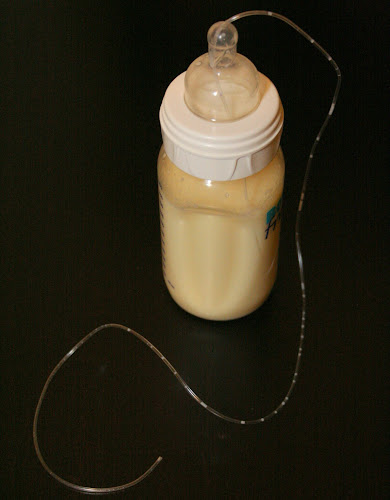
Homemade at-chest supplementer consisting of a bottle, nipple and tube.
Making an at-chest supplementer is easy and cheap.
Note that this post is not medical advice. I am sharing here what I have learned through personal experience. If you are concerned about your baby's health, seek help from a doctor.

Using an at-chest (at-breast) supplementer is a great way to feed your baby if you are unable to produce all of the milk he or she requires. This method is completely supportive of the nursing relationship, and does not involve your baby latching on to any artificial nipples, such as bottle nipples. As wonderful as it is, this kind of supplementer can be brutally hard to use at first. I've been using one for over eighteen months, so I'll share some tips!


First, let me explain what it is. All the different versions consist of a container to hold the supplement and a long, narrow tube. One end of the tube goes into the supplement, and the other end is placed right by your nipple. Your baby latches onto both the tube and your nipple simultaneously, drawing supplement from the container and getting all the milk that you are producing, too.


What's great about it? Using an at-chest supplementer allows you to do all feedings at your own chest. This is amazing for your nursing relationship and all the bonding that comes with it. It's also important for promoting normal jaw development in the infant - the physical action of chestfeeding develops a baby's muscles differently than bottlefeeding does. Using the supplementer helps you produce more milk, too, because even at times when your baby is only receiving supplement and you are not producing any milk, your chest tissue is being stimulated to make more. For those who produce little to zero milk, using the supplementer makes it possible to still have a nursing relationship.

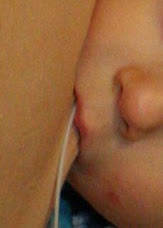
Jacob latches with the supplementer near the corner of his mouth.
How do I get one? You can buy a commercial supplementer, or you can easily and cheaply make your own. I prefer the homemade kind, so that's what I'll describe first. You can use any baby bottle to hold your supplement. Get gavage tubes from a pharmacy, or in bulk from a medical supply store. The kind to look for is 5 French (that's the diameter), 36 inches in length. You might want a tube with a bigger diameter if your baby has a weak suck, a complication of some conditions such as cleft palate or prematurity. Using a shorter tube is super irritating because it forces you to hold the supplement container so close to your baby's mouth (who has enough hands to do all that?!). Cut off the extra plastic bits, if there are any, on one end of the tube. The other end will be closed and rounded and will have two or three holes just before the tip - I cut off this part too because otherwise the supplement doesn't seem to come out easily. Some don't do this because they believe that cutting this end makes the tube sharp (we never experienced a problem with this). Thread one end of the tube through the bottle nipple (expand the opening of the nipple with a knife if required) so that it is sitting in the supplement. To clean the tube after use, just suck some hot water through it. Do not boil this kind of tube - it is not made from materials designed to withstand such a hot temperature.

The main difference between the homemade and commercial systems is cost. The Lact-Aid is $48.75 or $62.50, depending on whether you get the deluxe or standard model. The Supplemental Nursing System (SNS), made by Medela, was $42.99 on Amazon when I checked at the time of writing. It should be noted that Medela is a company that violates the World Health Organization's code on the marketing of bottles and artificial nipples. Unfortunately, its product name, SNS, is often incorrectly used as a generic name for a supplementer. You can make your own supplementer for the cost of any baby bottle and nipple and a $5.00 gavage tube. If you use this system in the long-term, you will end up spending a fair bit on tubes. They can be bought in bulk for about $1.00 a piece, and most people replace them once per week (or when they get too stiff to use) - so, you could spend $52 on tubes if you use the homemade supplementer for one year. I've been told by several people who used an SNS or Lact-Aid for over a year that both systems hold up very well to wear and tear and rarely need replacement parts.


With both the SNS and the Lact-Aid, the supplement container hangs around your neck. I like my homemade version because I can put the container down beside me on a table or hold it between my knees - I hated the idea of something relatively heavy dangling from my neck. I also like being able to have a decent amount of supplement on hand. The containers of the SNS (re-usable) and Lact-Aid (disposable bags) are smaller than most baby bottles. My number one reason for using my homemade version is that it is simpler - it has only three parts (bottle, nipple, and tube).
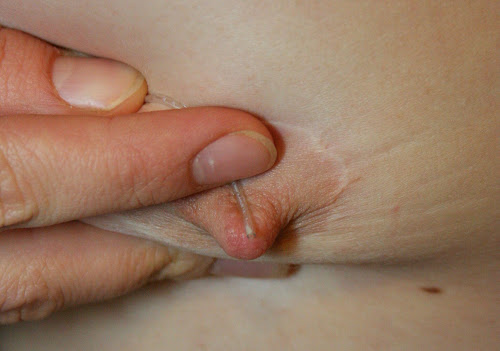

I mould my chest tissue using my middle finger and thumb, and position the tube with my forefinger. End of tube is in line with the end of my nipple.
Moulding the chest tissue and positioning the tube
How do you actually use this thing?? Some people latch the baby on first, and then sneak the tube in through the corner of the baby's mouth by moving a bit of breast tissue gently out of the way. This never worked for me. I have so little chest tissue that if I moved any part of it, my baby would lose his grip immediately. A downside of this method that a friend of mine learned the hard way is that it may become impossible to sneak the tube into your baby's mouth once he or she has teeth getting in the way.

There's a lot to have to juggle between latching your newborn and placing a tube. This is how I do it: I get my baby in position and latch him first without the tube (otherwise he gets too antsy waiting for me to have everything ready). Then I take the end of the tube and get it near the end of my nipple. I briefly un-latch my baby. I use my thumb and middle finger to mould my chest tissue into a shape that my baby can latch to, and use my index finger to position the tube so that the end of it is in line with the tip of my nipple. The tube comes from above my nipple so that it points to the roof of my baby's mouth when he latches. I slip my index finger out of the way just as he is latching on and then I hold the tube in place for an extra second or two until the supplement is flowing up the tube. Some people tape the tube to their chest, but this didn't work for me. The tube would always flip in the wrong direction when I tried to mould my chest tissue for my baby to latch.
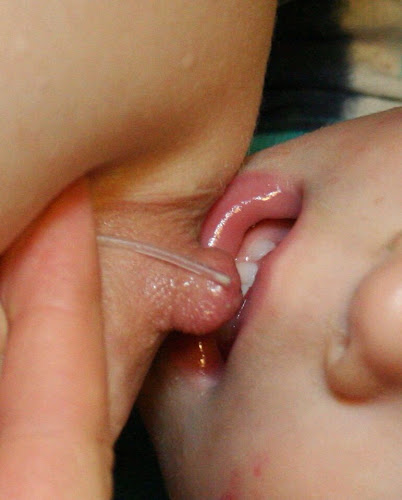
Immediately before latching, Jacob's mouth is open and the tube is already well-placed.
About to latch
Using a supplementer is initially very challenging. I couldn't position it on my own for the first two weeks! My partner had to help me with every single feeding until I developed this method of doing it on my own. It helped when my baby's latch became stronger. Nowadays, at eighteen months, I don't even think about it. My baby latches himself on, and I know exactly where the tube needs to go so that the supplement will come up easily.

Have you used a supplementer? Do you have any additional tips to share that we should know about?

15 Oct 2012

The End of Donor Milk

Yesterday, Jacob turned 18 months old, and tonight I thawed our last remaining bag of donated human milk. About two weeks ago, we saw that the end was near and started mixing donor milk about half and half with cow's milk. So far, Jacob has tolerated this reasonably well. We'll continue to give him donor milk when we can find it and families with younger babies don't want it, but at the moment, our freezers are storing nothing but the summer's vegetables.

I can hardly believe that we did this for 18 months. Jacob took about 25 ounces of supplement a day for much of that time, adding up to nearly 14 000 ounces of donor milk in total. We never needed formula. Some donors gave us a few two-ounce bags, while others filled our deep freezer. We are deeply grateful for every drop of it.

When Jacob was four days old, and we began supplementing, we wanted to make it to just one week on only human milk. We knew that even this would make a difference to his rapidly developing gastrointestinal tract. When we got to one week using human milk, we wondered if perhaps we could find donations for him for one month. Then two months. Then three. Six (plus solid foods). One year?! 16 months?!!! Yes. The World Health Organization recommends breastfeeding to two years of age and beyond, remember?

Finally, in the last few weeks, Jacob's first set of molars finished coming in and he has been starting to chew food with considerably more ease. I guess it's time. He's ready to start munching solid foods as a large part of his diet!

I suddenly had the thought as I thawed this last bag, "Tomorrow will be Jacob's first day having only cow's milk and no human milk." Then I realized what an incredible disservice that notion is to myself. I have been breastfeeding, and producing breast milk for my boy, for the past 18 months. The donor milk is what I see all the time. I collect it, store it, thaw it, pour it into bottles, and Jacob sucks it up the at-breast supplementer. It's easy to feel as if I make nothing for him.

I don't know how much I actually produce considering how much supplement Jacob takes, but I can still spray milk when I hand express. Perhaps this amounts to a few ounces per day. Eventually this evening it dawned on me: Jacob will keep getting human milk as long as I keep breastfeeding him. I'm really doing it.


8 Oct 2012

I LOVE Toddler Nursing

Nursing my kiddo has never been more fun than it is now.

Boy covers my nipple with his hands. Looks at me. Grins. I show my surprise and confusion: "Where, oh, where did my nipple go? I just can't seem to find it anywhere!" Boy takes his hands away, with a triumphant ta-da type gesture. I demonstrate my delight: "Oh, there's my nipple!" Repeat in classic peekaboo-with-toddler fashion.

Boy looks at my nipple. Yep, he's got that I'm-about-to-latch look on his face. He obviously wants to nurse. He leans in, kisses my nipple, and then pops back up and laughs uproariously. He tricked me! Repeat and repeat.

Some of the best moments of all happen after my boy has had a usual toddler tumble. He reaches up for my arms. Once I'm holding him, his right thumb goes in his mouth and his left hand searches through my shirt buttons. "Do you want to nurse?" I ask him. He nods his head quickly between full body sobs. There is no more guessing - he knows what he wants and how to tell me. He can affirm that, yes, absolutely yes, the only thing that will do right now is nursing.

We started out assuming we would formula-feed with bottles, and now I'm nursing an 18-month-old. I can't wait to see where the rest of this amazing parenting journey will take us.

30 Sep 2012

Milk-Sharing: Safe Infant Feeding and Being a Human

The last post for this year's World Milksharing Week Blog Carnival comes to us from Jake Marcus at Sustainable Mothering. She shares with us her personal story of a huge oversupply, and hosts a highly informative piece by James Akre that was originally published by babygooroo on June 28th, 2012. For those of you who may be just joining us now in the blog carnival, Deena Blumenfeld brings us an introduction to milksharing that you can read on her blog, Shining Light.

Milk-Sharing: Safe Infant Feeding and Being a Human
from Sustainable Mothering

Back in the 1990s, I had more breast milk than I could handle. I knew then and know now that many by Text-Enhance">women, due largely to the circumstances of their lives and not their biology, are not able to produce all the milk their children need. And there are breastfeeding people (some cis-female and some not) who have biological reasons why they can't produce enough breast by Text-Enhance">milk for their children.
Well, that is where people like me can come in.

By the second trimester of my first pregnancy, my perfectly happy "Barely B" cups had become G cups. I didn't know there were G cups and never had desired to own them. When my first son was born, I pumped in the fruitless hope that he would drink breast milk from a bottle while I was in court. He had other ideas. Then I pumped for comfort because I was constantly engorged. I could pump eight ounces in five minutes, switch bottles, and pump another eight ounces. But my son would have none of it. He wanted breasts or nothing.

Pretty soon I had a freezer stocked full of pumped breast milk my son wouldn't drink. So, after some research, I contacted HMBANA in the hope of finding a good home for my by Text-Enhance">gallons of milk. But I was also on an SSRI at the time - one then and now considered entirely safe for breastfeeding children. The HMBANA policy, I was told then, was that no milk donations would be accepted if the donor was on any medications whatsoever. So HMBANA would not accept my milk.

When son number two was born, not only did I have over supply but overactive let-down. That meant my first let-down would hit the back of my son's throat with such force it triggered his gag reflex and he chomped down in an attempt to slow the flow. There are only so many times a baby, affectionately nicknamed "Moose" for his ten pound birth by Text-Enhance">weight and trap-like mandibles, can chomp on your nipples before something must be done. That something was pumping before each feed so that my let-down was not so fast. And that meant more gallons of breast milk in my freezer.

There were no informal milk-sharing networks on the Internet in the nineties. Or if there were, I didn't know about them. So I was forced to pour gallon after gallon of breast milk down the drain.
Menschheit is a difficult word to translate. Literally it is the German noun meaning "humanity" or "mankind," but I grew up hearing it used in Yiddish to by Text-Enhance">describe a quality - the quality of acting like a real human being. This, in Yiddish, is considered a good thing. Giving my abundant excess breast milk to a baby who needed it seemed to me to be the most basic menschheit. It is what a person does if she is really human.

It made me incredibly sad that I couldn't find a home for my breast milk. And it makes me very happy that today people with excess milk can find other people who need milk and make the exchange. This is menschheit; it was what humans do for one another.
Following is a post written by economist and breastfeeding expert James Akre about the safety and necessity of milk-sharing. It was originally published by baby gooroo on June 28th and is reprinted here with the kind permission of Akre and baby gooroo:

    Since pre-history, mothers in need of human milk have relied on other mothers in their family and community with milk to spare and share. According to the World Health Organization (WHO) and UNICEF, the second-best feeding option, after breastfeeding, is breast milk expressed by a child’s own mother, followed by milk from a healthy wet-nurse or from a human-milk bank.
    The Human Milk Banking Association of North America (HMBANA) acknowledges that its not-for-profit member banks—two in Canada and 11 in the U.S. serving a total population approaching 350 million — cannot satisfy even a quarter of the current demand for banked milk. Under the circumstances HMBANA rightly gives priority to sick and premature babies. But at $3-$6 an ounce, a week’s supply could cost as much as $750—something few parents can afford to pay even if banked milk were available.

    “A growing awareness of the importance of breast milk for babies has accelerated the demand for human milk at a time when processed donor milk is scarce and costly,” says Amy Spangler, president of baby gooroo. “Intent on giving their babies what every baby needs most, mothers are bypassing milk banks and going directly to the supplier—other breastfeeding mothers with milk to spare.”

    The Milk-Sharing Debate
    With the help of social media, mothers are increasingly aware that milk-sharing is a viable option for mothers who can’t breastfeed or obtain banked milk. Mothers of healthy babies who need milk are linking with other mothers willing to donate milk via chapters of two popular Facebook-based communities—Eats on Feets and Human Milk 4 Human Babies—operating in more than 50 countries.

    These online communities allow donor mothers to share their milk, safely and ethically, in the belief that they and recipient mothers are capable of weighing the inherent benefits and risks and making informed decisions. This altruistic commerce-free exchange is grounded in the principle that all who are involved in milk sharing take full responsibility for their actions and subsequent outcomes.

    However, the position staked out by some public health authorities, notably in Canada, France, Israel, and the U.S., including the Canadian Paediatric Society and the American Academy of Pediatrics is clear: Don’t do it!

    Some in the health and medical establishment regard internet-based sharing as a threat both to their authority and to public health. They reject a system that operates outside their influence, that can’t be regulated, and where mothers alone exercise control. Some especially anxious observers go so far as to allege that mother-to-mother milk sharing undermines the ability of the few under-provisioned human-milk banks to meet the urgent needs of sick and preterm babies, by further reducing potential milk donations.

    It should be noted that donor mothers have been breastfeeding their own children. With few exceptions, these mothers and their children are being followed closely by health care professionals with all that this implies for health status monitoring; and they are ready to discuss their lifestyle and disclose their medical records before sharing their milk. And yet health authorities are contending that mother-to-mother milk sharing is fundamentally riskier than feeding infant formula, and that it’s impossible for mothers, acting on their own, to minimize health risks.

    Those in favor of milk sharing disagree.

    Weighing and Managing Relative Risk

    Milk banks function according to a strict medical model where regulations, rules, and protocol determine what is done, when, and for whom. Babies receiving banked donor milk are virtually always sick and hospitalized; healthy children seldom qualify for access to the limited amount of banked milk. Health professionals prescribe milk for the sickest, neediest, and most fragile babies, who are frequently immuno-compromised and risk death.

    In addition, the screening criteria that milk banks typically apply disqualify many otherwise healthy women who might be willing to donate their milk. Exclusion criteria include previous residence in the UK (due to possible infection with mad cow disease), regular consumption of caffeinated beverages, a baby older than 6 months of age, and a small amount of available milk.
    In contrast, milk sharing takes place in the community where interpersonal contact plays a significant role. Typically, the personalities and values of those involved are largely responsible for influencing decisions; the children concerned are healthy; and mothers are motivated by a heightened awareness of the importance of human milk for human babies and a desire to contribute to the common good.

    There are risks associated with milk sharing just as there are with feeding babies formula.
    It is thus a question of weighing and managing relative risk, minimizing potential harm, and maximizing benefit. Rather than resisting and dismissing milk sharing, the constructive approach would be for health authorities and health care professionals to engage with mothers in ways that help make the practice as safe as possible, such as providing reliable information on donor screening, milk collection, storage, pasteurization, and feeding practices, and expediting voluntary sharing of medical records.

    There are encouraging signs of a more nuanced attitude among health professionals. For example, based on their survey of more than 400 health professionals, two researchers from the University of Wisconsin School of Medicine and Public Health in 2010 concluded that those knowledgeable about breastfeeding overwhelmingly support wet-nursing and sharing of unpasteurized human milk. The majority of those surveyed recommended that donors should be screened like blood donors, and should be instructed on safe milk handling and storage techniques. Although health professionals view all infants as possible candidates for unpasteurized donor human milk, concerns remain about safety and social problems with wet-nursing and milk sharing. Lastly, survey participants agreed that professional recommendations should be developed to optimize safety and acceptance of wet-nursing and human-milk sharing.

    What the Milk-sharing Community Advises
    The four pillars to support the safe sharing of breast milk from Eats on Feets stress:
      Informed Choice — Mothers are responsible for understanding the options, including the risks and benefits, of all infant and child feeding methods.
      Donor Screening — Mothers can communicate with donors by asking questions about their health and lifestyle, and by requesting blood screening test results.
      Safe Handling — Mothers and donors should handle milk with clean hands and equipment and use proper storage methods.
      Home pasteurization — If in doubt, mothers can pasteurize milk at home: on the stovetop in order to inactivate HIV; or using a single bottle pasteurizer that performs the Holder method of pasteurization.
       
    Meanwhile, Human Milk 4 Human Babies stresses that, “It is in the spirit of informed choice that milk sharing on these [Internet] pages will occur, and all people posting here will take complete responsibility for the outcome of milk sharing.” It also reminds mothers that:

    Full Disclosure Reduces Risk
    Suggested points of discussion can include medications, alcohol and drug use. In many countries, testing for infectious diseases is done during routine prenatal/antenatal care. You may be able to consult a health care provider to obtain further testing if desired. You can ask for copies of those test results. If you cannot get a complete picture of the health of your donor, one option is to look into at-home pasteurization.

    Mother-to-mother human-milk sharing is here to stay. Though technology has transformed the practice, it remains fundamentally identical to what mothers of good will have been doing since pre-history on behalf of other mothers and their babies.

    Not-for-profit human-milk banks and commerce-free mother-to-mother milk sharing can and should operate on parallel non-competitive tracks. They are complementary, not antagonistic. Indeed, there is significant untapped potential for both systems to play mutually supportive roles in pursuit of a single common objective—helping to ensure that no babies are denied their nutritional birthright.

29 Sep 2012

The Lorax and Other Milksharing Stories

World Milksharing Week's Blog Carnival is pleased to present two blogs in Spanish. Vilma Badillo Rodriguez shares posts from her blog, Borinquen Lacta con Amor. One story reveals how a milk donation allowed a family to get their first night of real sleep in three months, while another involves the good fortune of one mother suffering from low supply meeting a parent with a great abundance.
Jesusa Ricoy-Olariaga, drawing from Dr. Seuss, explains in the following post how as a society we have completely mistaken milksharing for what it actually is. She's brilliant - I can't say anymore, you just gotta read it! In English, below, and here in Spanish.
I was kindly invited by a breastfeeding dad - yes you read that right - to write a post on milk sharing.
I am currently on holiday in my home town of Alicante in Spain where my brain has gone into relax mode but have still found myself trying to stumble across a story for the purposes of this article.
I wanted to look back and find the commonality of women feeding their children, their sisters' children and their friends' children.
I spoke with my mother who recalled talk of milksharing in her own family but, it was in connection with an older brother who died before she was born. Then I met a Muslim friend in the street and we talked about how in her culture babies who are not part of the same family but have been breastfed by the same woman are considered siblings and therefore can't marry. I called some associations in Alicante and a lovely girl told me that although she didn't know where I could find historical information, she did mention that her late grandmother breastfed other children.
"Mister" he said with a sawdusty sneeze, "I am the Lorax. I speak for the trees. I speak for the trees, for the trees have no tongues. And I'm asking you sir, at the top of my lungs" – he was very upset as he shouted and puffed "What's that THING you've made out of my truffula tuft?"What I was looking for I couldn't seem to find so I just tried to relax with my family. So we rented the movie The Lorax based on the tale by Dr. Seuss. It's an ecological story of how greed destroyed nature until everyone forgot how nature looked like and what impact it had for ourselves and all the things around us. There is a point in the story where the main character is explaining what real trees are like and the evil guy trying to control everything reacts by shouting how disgusting the earth is and how it breeds dirt and bugs and pollutes the air. He has become rich and all powerful by selling bottled air to people in this polluted world and I couldn't help thinking of the similarities with the way milksharing is depicted today on the few ocassions that it is even mentioned: as something that is weird and disgusting, risky, dirty even, as something that it is alien to us when actually it's what makes us us.
Earlier this year a couple of friends had minor issues with their babies. The biggest problem was trying to gain support from professionals for formula not to be administered as a simple remedy. One midwife threatened my friend with calling the social services if she accepted donated milk from any of us which we had expressed, something that for me came naturally after feeling my milk building up as the mum was telling me she needed help. I never felt anything beyond the fact that a human baby needed milk, a friend's baby. I had milk so why wouldn't I help?  It was as natural as if someone was crying and I happened to have a handkerchief with absolutely no relation to the social perception of women fighting each other in their motherhood capabilities according to production, quality or endurance of their 'job'.
We do not do that. We mammals mother our babies. We nurture and care for them. We impose milksharing on cows. We steal their babies milk for our babies while we censor our own mothers' power and abilities because somebody once put a label to an imitation of something that cannot be imitated.
In The Lorax a tree was cut down. Then another and then some more until there were no trees left of even a memory of them. The perpetrator didn't have bad intentions. He simply saw that there was a need for his product.
Not that long ago there was a culture of normality of mothers feeding their babies, and indeed the babies of others. I am glad that even if I was personally unable to find out much from our past culture of milksharing, perhaps because milksharing was seen as an ordinary act of love within the greater matriarchal story that remains unwritten, I was thrilled to see so many references in my life to the new seed that will not allow our 'tree' - the milk of human kindness - to be forgotten. 
Our milk is ours. Our babies are ours.
Our milk is free. Our babies are too.
UNLESS someone like you 
cares a whole awful lot,
nothing is going to get better.
It's not." Dr. Seuss  

Ps: This post is dedicated to Trevor Macdonald a breastfeeding dad and everyone who cares a whole awful lot.


Winning the Milk Lottery

In celebration of World Milksharing Week 2012, Diana West, BA, IBCLC, contributes this post about her personal story involving her son’s extreme allergies. Diana experienced internet milk donation before the existence of Facebook-based networks. Her highly informative books, Defining Your Own Success: Breastfeeding After Reduction Surgery and The Breastfeeding Mother’s Guide to Making More Milk have helped many thousands of parents struggling with low milk supply and have great relevance to the milksharing community. She is also the co-author of the bestselling book, The Womanly Art of Breastfeeding, 8th ed. Watch for her upcoming book about sleep and the breastfed baby, co-authored with Diane Wiessinger and Linda Smith, to be published by Ballantine Books in July, 2013.
Through the years, I’ve shared my story about breastfeeding after breast reduction surgery with many people. I didn’t have enough milk for my first son, Alex, but I was proud to be able to provide about 2/3 of his daily needs with my own milk, which I was pumping exclusively because he had a nursing strike at three months that I hadn’t known how to get past. Unfortunately, we had discovered from several scary reactions that he was severely allergic to cow’s milk protein, so we had to use the uber-expensive hydrolysate formulas to take up the slack. The part of the story that most folks don’t know is that he was once the lucky recipient of 700 ounces of human milk that was given to us by a very special mother in New Jersey.

The way this came about was that I saw a posting on a breastfeeding usenet newsgroup - in 1995, usenet newsgroups were the way people connected online using very basic, non-website message boards (pretty primitive, I know! - but it was great at the time). One day when Alex was about six months old, I saw a posting from a mom who had a seven-month-old baby. She wrote that she had accumulated more frozen milk for going back to work than her baby could ever use and she wanted to give it to a mom who didn’t have enough milk and a baby who had a special need for it. She had also undergone extensive infertility treatments in order to conceive her baby, so she had negative test results for just about every communicable disease under the sun to prove that her milk was safe. She clearly expressed that she didn’t want any payment for the milk other than the good feeling that it was going to a mom and baby who really needed it. With my low supply and Alex’s severe cow’s milk allergy, we fit the bill perfectly. The only catch was that the recipient needed to be within driving distance of her home to be able to transport the large quantity of milk inexpensively without thawing. Fortunately, we lived only three hours away.

Hoping against hope and feeling like it was almost too good to be true, I responded to her post as soon as I saw it, telling her our story and how much we would value her milk. I was amazed and elated when she responded just a few minutes later, agreeing that we were the perfect match and choosing us to receive her milk. I felt like we won the lottery. Not only would this help Alex with his allergies tremendously - hydrolysate formula has pre-digested milk proteins that cause fewer allergic reactions, but Alex’s severe eczema was proof that he still reacted to it - it would also save us a lot of money because hydrolysate formula cost about four times the price of regular formula. I was a stay-at-home mom and my husband was just starting out in his IT career, so times were tough and the cost of the special formula was a real stretch for us.

Once it was confirmed that we had “won” the milk, the milk-rich mom and I emailed back and forth to figure out how to get the milk from her location in New Jersey to ours in Maryland. The biggest challenges were figuring out how to keep the hundreds of two and four ounce bags of milk frozen on the three-hour journey home. My husband Brad and I also had to think of a way to store them safely when our only freezer was the small one on top of our fridge that was already jam packed with food. And all the maneuvers had to include our six-month old baby and Brad’s work schedule since we didn’t have family nearby to help out.

The storage problem was solved by deciding to buy the deep freezer we’d always wanted anyway. It was a big expense for us in those days, but we knew it would give us a way to buy food in bulk so it would actually pay for itself in the long run. We solved the journey problem by working out that we could drive there on a Saturday afternoon with baby Alex and lots of toys to entertain him (this was before DVD players and iPads!), pick up the milk bags, put them in several large insulated coolers that we borrowed from friends, stay long enough to visit with the family and thank them properly, and then drive back home fast enough without breaking any speed limits to put the milk in the new deep freezer before it thawed.

As it turned out, on the morning of the trip it took us forever to get the car packed with Alex, his toys, the many coolers, and everything else we needed for a day away from home with a little baby and an exclusively pumping mom. By the time we hit the road, we were running several hours behind, which kept the New Jersey family waiting anxiously for our arrival. The whole family had dressed up and readied their home for our visit, and while they waited and waited for us to get there, the older kids rode their bikes up and down their road looking for our car. We felt like such newbie, inefficient parents to keep them waiting like that, but they were so sweet and welcoming when we finally arrived.
Milk siblings forever.
As a special (but very token) way to thank them, I had made up a purple t-shirt for Alex that said “Milk Brother” and one for her baby that said “Milk Sister,” based on the Islamic teachings that children who share a mother’s milk are considered siblings and not allowed to marry. (Neither of us is Muslim, but we liked the tradition.) The mom loved the shirts. We put them on the babies and let them crawl around each other in her back yard while we snapped pictures. Then both families went out to a nice dinner and basked in the good feelings of their altruism and our deep gratefulness. Afterward, we loaded all the milk into the insulated coolers and started the urgent (but not speeding!) drive home. We made it back in good time and got all the milk safely into its new home in the deep freezer.

I don’t remember how long the milk lasted, but because he was so severely allergic to cow’s milk and many other foods, Alex needed milk and formula until he was nearly two. So we stretched those 700 ounces out as long as we could and always felt so happy each time we could use human milk instead of the expensive and horrible smelling hydrolysate formula. Eventually, the deep freezer bought just for the milk became more and more empty and we began filling it up with frozen vegetables and other foods. Alex is now almost 17 years old, and shaving and driving if you can believe it (and very embarrassed that I’m blogging about this). The milk and his need for it are long gone, but we still have the deep freezer and we’ll always have the warm and wonderful memory of a mother in New Jersey who shared her milk bounty to help our baby.