6 Jun 2016

Proud to be a New La Leche League Leader!


In 2014, La Leche League International changed its policy about the eligibility of Leader (volunteer) Applicants to be inclusive of all gender identities. As a result of the rule change, I was able to apply, and I went through La Leche League Canada’s (LLLC) thorough and fantastic training, becoming accredited as a Leader two weeks ago. I am grateful to the Leader who supported me and spent many hours answering my questions, and to the Leader at the Accreditation Department who guided me with patience and kindness and kept me on track.

LLL’s updated policy came in advance of federal legislation proposed by the Government of Canada to protect transgender Canadians from discrimination. This quote from a message sent by LLLC to its Leaders shows the confident position La Leche League has taken on this issue (reprinted here with permission):

 We recognize that any breastfeeding parent, regardless of whether they self-identify as a mother or father, should be - and is now - welcome to investigate LLL Leadership. There are other prerequisites that a potential Leader needs to satisfy, but being a woman isn't one of them.”

La Leche League is the world’s best breastfeeding peer support organization - this was the reason I wanted to become a Leader when I first asked about applying, and it is why I am so proud to join other Leaders in serving breastfeeding families. Leaders assist more than 20,000 families across Canada each year, using carefully compiled resources.

I feel I truly found my community when I found La Leche League. LLL is one place where I know I will be accepted with my breastfeeding toddler and where my nursing relationship with my child will always be valued. In fact, I believe I have felt more criticism around nursing an “older”* child in public than for nursing as a man. And that really speaks to why we still desperately need LLL, and why it was founded sixty years ago. We need to continue sharing information and resources around breastfeeding and the breastfeeding relationship with those who come in search of support in the context of a culture that continues to marginalize breastfeeding.

* “older” is in quotes, because we are talking here about anyone over the age of one. But let’s face it: two- and three-year-olds are simply not “older”!


17 May 2016

Chestfeeding Research Published!


In this University of Ottawa study, funded by the Canadian Institutes of Health Research, I interviewed 22 transmasculine individuals.


Here’s a quick overview of what’s new and exciting about this paper:


1)     Discussion of pregnancy and chestfeeding after top surgery. Out of 22 participants, 9 had chest surgery before they became pregnant. They experienced different amounts of mammary growth during pregnancy. Some chose to chestfeed and others didn’t. This is the first paper to discuss experiences of chestfeeding after chest surgery!


2)     The paper includes the first academic reference to a transmasculine individual binding during the lactation period, and taking testosterone during the lactation period. As the paper states, the participant reported that his child had normal testosterone levels, i.e., it appears that the child was not exposed to any effects of testosterone through the milk. Also, the participant reported that there seemed to be no decrease in his milk supply. Binding and taking testosterone allowed the participant to chestfeed for longer because these actions helped mitigate his gender dysphoria.


3)     Zero of the participants’ surgeons discussed the potential for future chestfeeding before performing top surgery. Equally important, participants reported that they didn’t feel comfortable bringing the topic up, either. They cited their surgeons’ strong and obvious belief in the gender binary and the feeling that they needed to tell the right story in order to access chest surgery.


4)     Changes in secondary sex characteristics during pregnancy. References in the academic and medical literature state that a low-pitched voice and facial hair are permanent results of taking testosterone. However, in this paper, we report the experience of one participant who found that when he stopped taking testosterone and became pregnant, his facial hair literally fell out and his voice became higher in pitch. 


5)     Experiences of gender dysphoria. As you might expect, some study participants reported experiencing gender dysphoria when chestfeeding. Some of them stopped chestfeeding due to gender dysphoria. However, others did not gender the process of feeding their babies from their chests at all. Nine of 16 participants who initiated chestfeeding reported experiencing no gender dysphoria while chestfeeding. Three of them didn’t experience gender dysphoria during chestfeeding but they DID experience it after they weaned their babies. The usefulness of chestfeeding in terms of nutrition and bonding was cited frequently as a reason for doing it. 


6)     Unexpected and unwanted lactation. Several participants who had had chest surgery and chose not to chestfeed their babies experienced problems with milk coming in. One had early symptoms of mastitis. Both the participants and their health care providers were unprepared. 


7)     How gender dysphoria can be triggered by health professionals. We tend to think of gender dysphoria as something that a trans person experiences because of their body. In this study, we found dysphoria could be triggered, in a person who otherwise was not experiencing it, by the way they are treated by others. From the paper: “care providers and others are capable of causing gender dysphoria in a patient by misgendering them. Conversely, care providers can affirm a patient’s gender identity through appropriate language, respectful touch, and other intentional actions, and thus alleviate distress associated with gender dysphoria.” In other words, the act of chestfeeding itself might not cause gender dysphoria for a transgender guy, but a health care provider talking about putting baby to “mom’s breast” might do so. 


8)     Using donor milk. Seven of the 22 participants said they used or intended to use donor milk, and one donated milk to others. 


9)     The language. This study was trans led, and the language used throughout the paper is appropriate for our community. We didn’t say in this paper, “some trans men use this word chestfeeding” and then ourselves use breastfeeding or nursing after that when we wrote in our own words. We used chestfeeding throughout the paper, as THE word. Why? Some trans guys are okay with “breastfeeding,” but some are very triggered by it. We didn’t think any trans guys would be triggered by “chestfeeding,” so we decided to use that term throughout.


What a way to celebrate the International Day Against Homophobia, Transphobia and Biphobia!


With so much thanks to the study participants who made this possible, and my research team members Joy Noel-Weiss, Diana West, Michelle Walks, MaryLynne Biener, Alanna Kibbe, and Elizabeth Myler. Big thank you as well to Karleen Gribble for her detailed comments in the open peer review process!

13 May 2016

Book Launch events!

"Where's the Mother? Stories from a Transgender Dad" is now available for preorder wherever books are sold. I'll be appearing at two launch events: one in Toronto and one in Winnipeg. I hope you and your friends can attend!

"Launch Event" Saturday June 4th at 11am:  Toronto Public Library
Yorkville 22 Yorkville Ave, Toronto, Ontario M4W 1L4

Trevor MacDonald reads from his book Where's the Mother: Stories from a Transgender Dad. Trevor founded the first online support group for transgender people interested in pregnancy, birth, and breast or chestfeeding. He shares his own parenting experiences on his blog,www.milkjunkies.net. Join us for a reading, Q&A, and signing session. This is a child friendly event so bring the whole family!


"An Afternoon With Trevor MacDonald" Sunday June 12 at 2pm: McNally Robinson Booksellers 1120 Grant Avenue, Winnipeg, Manitoba R3M 2A6

A book launch tour event with Trevor MacDonald, who will read from "Where's the Mother? Stories from a Transgender Dad". Trevor will be on hand for discussion and book signing afterwards.


24 Apr 2016

Teaching my child about the transphobia our family faces


Things were easier when my boy was a baby. If someone questioned my gender or asked where my baby’s mother was, my infant was unaware. Now, he just turned five years old, and he understands everything. He is perceptive. And he is due to go to kindergarten in September.

When it was simple: feed and hold the baby.
My partner and I have always been completely open with our kids about how they came into this world. They know that I carried them and gave birth to them, and they know I’m transgender and what that means. When I became pregnant with our second, we used CorySilverberg’s fantastic “What Makes a Baby” to explain conception, pregnancy, and birth. Silverberg’s book uses correct terminology like egg, sperm, uterus, and vagina but does not attach those terms to gender identities. Our son learned that to make a baby, you need an egg and sperm, and you need a place called a uterus for the baby to grow. Some people have eggs in their bodies, and some have sperm.

I transitioned before my kids were born. They are growing up knowing me as Trevor, their Dada. Since we live our lives this way every moment of every day, this is our normal.

So how do I explain to my kid that other people see our family as incredibly unusual (if not immoral)? How do I explain that it really isn’t a funny game to open the bathroom stall door at a crowded public market before I’ve got my pants up again after having a pee? How do I explain why people ask us over and over again where his mother is or where we got him from?

In “Like Me and You,” the renowned children’s entertainer Raffi sings that everyone is “the child of a mother and a father.” My partner and I frequently sang loudly over the lyrics, “the child of a Dada and a Papa!” One day, about a year ago, I pressed pause after that line, and said, “He’s forgetting some families, isn’t he?” My son nodded. We talked about our own family, and some of his friends who are raised by single mothers, or two moms. It was the beginning of an ongoing conversation.

We’re not religious, but we live in a conservative, rural area where most people attend church regularly. Last week, a lesbian mom made our local news because she asked her school board to lift its prohibition on classroom discussions of same-sex relationships and diverse family structures. She received some good public support and also a lot ofbacklash including a threat that she reported to police. 

Also last week, my son asked me what God is. Oh, the questions of a five-year-old! I tried to explain how different people have varying beliefs about God and evolution. And then I told him about the Bible. I told him that it says a “man shall not lie with a man.” I said that some religious people take that rule very seriously and others don’t. I also told him it says things like you shouldn’t wear clothing made from mixed materials, and that no one seems to pay attention to that particular rule.

I told my son that the law says it’s okay for two men to love each other and live together and have a family, even though some people don’t like that. I reminded him that we have family friends who believe in God, and that those friends also believe that the Bible tells them to love others and treat them kindly regardless of their gender identity. I reminded him that we have always been welcomed by that family. I did not tell him that the mom expressed to me how worried she is that attending school here could adversely affect her daughter’s current open acceptance of gender-diverse people like us.

My son heard me gasp aloud the other day when I saw a headline about the latest “bathroom bill” in the US. “What?” he asked. I said that some politicians passed a law that would require transgender men like me to use the women’s bathroom, and transgender women to use the men’s. His eyes widened and he said quickly, “But that’s in other countries, right?” Yes, I assured him.

It feels like a lot for age five. But don’t you dare tell me that I shouldn’t have had kids because I am transgender, because “look how hard it will be for them.” Instead, you can teach your kids that some families have two moms or two dads, and that some people transition. I don’t want to have to teach mine why certain families keep their distance from us, why we are treated by some like a curiosity, or why kids of LGBT parents are getting bullied at school.

If school kids aren’t proactively taught to respect diverse family structures equally, then I am left needing to teach my kids about the transphobia and homophobia that is directed at us. Calls to keep education about LGBTQ families limited to discussions within the home are in fact calls for LGBTQ families to teach their kids how to grapple with bullying and discrimination in schools without support from teachers or administrators. On the other hand, including classroom discussions about diverse family structures would remove some of that burden.

It sure feels much easier as a parent to explain love rather than hate in response to the endless ‘why’s that come from a young child.


17 Apr 2016

Questions Not to Ask a Pregnant Transgender Person*


* Or any pregnant person whose gender identity you are not absolutely 100% certain about, so really, ANY pregnant person.

I came out as a transgender guy and transitioned by changing my legal name, taking testosterone, and having top surgery. Friends and colleagues were generally awesome with that, and highly supportive. Virtually everyone I knew used male pronouns for me as I asked them to, and many made special efforts to help me feel accepted.

A few years later, I stopped taking testosterone and became pregnant, and my allies’ world was turned upside down. These are real questions that real people asked me. Let me explain why they are damaging, and what would be better. 

1.    Have you had surgery “down there”?

This one is a sign that somebody hasn’t thought things through, and I think it comes from the assumption that all transgender people want to transition “all the way.” Transition for a female-to-male individual must involve hysterectomy, right? Wrong! We transition in a variety of ways, to whatever degree makes us comfortable (or that we can afford). For some trans people, transition is not linear, either. You really don’t need to know whether your pregnant trans friend has had or desires any other kind of bottom surgery, such as clitoral release, urethral lengthening, or phalloplasty. Read about those procedures by Googling to your heart’s content.

2.    Are you going to keep the baby?

The person asking wants to know if the pregnancy was planned. Just like the rest of the population, some transgender people who become pregnant didn’t intend to have babies, but that’s not the case for all of us. The unpleasant implication behind the question is that a transgender person shouldn’t want to have (or shouldn’t have) a baby. A much better question would be “How are you feeling?” Your pregnant trans friend will disclose as much as they are comfortable with and might indicate how you can help.

3.    How do you know this is safe?

A lot of people assumed that because I had a beard and a low voice, I was still taking testosterone despite being pregnant. People asked me this as though I had never considered the issue before. To me, the question suggested that I was ignorant or didn’t care about my baby, or both. Even health care providers asked repeatedly if I was taking testosterone, seemingly not believing my answer.

Before trying to get pregnant, I talked to my endocrinologist (hormone doctor) and family doctor about any risks they could foresee. My endocrinologist advised me to stop taking testosterone and wait until my menstrual cycles became regular. He said that, in the form I was taking it, testosterone leaves the tissues quite quickly, typically within about ten days. He told me that my eggs should not be affected by my previous testosterone use. My family doctor just shrugged and reminded me to take folic acid!

If you have a transgender friend or acquaintance who is pregnant, you don’t need to ask this. If you’re a health care provider, knowing whether or not your patient is still taking testosterone is important. You also need to realize that for some of us at least, a beard doesn’t disappear when testosterone use is halted.

4.    Did you enjoy the process of making your baby?

This is just another way of asking a transgender person how they have sex. It’s weird and awkward. And for folks who don’t have simple access to sperm in their relationship, conceiving a baby might be separate from making love anyway.


5.    But what about breastfeeding?

I think breastfeeding is awesome, and I have been breastfeeding my kids for five years straight - but having a baby doesn’t hinge on it. I was asked about breastfeeding when I was pregnant, as if not being able to breastfeed should make me reconsider my pregnancy. The question itself put an immense amount of pressure on me. It turned out that I am able to make a small amount of milk despite having had chest surgery, and I deeply value my breastfeeding relationship with my child. However, lots of people, transgender or not, choose not to breastfeed, and that is their choice.

For friends and health care providers alike, a more open-ended question would be better, such as “how do you plan to feed your baby?” If you are lactating and interested in helping, you could ask if your transgender friend might wish to accept donated milk. 

6.    Do you know the baby’s gender?

During my pregnancies, people asked me this obsessively. I always thought to myself, do you know who you’re asking? Identifying a baby as male or female based on its genitalia has to do with its sex, not its gender. Furthermore, I never cared during my pregnancies about what my babies’ genitals might look like. I wondered if they would be healthy, happy, sleepy, curious, affectionate, serious, light-hearted, optimistic or any number of other characteristics before I thought about whether they had a penis or vulva. A better question to ask would be whether your friend has felt their baby move yet or heard the heartbeat - both are indescribably beautiful and intimate ways to connect with the being growing inside the belly.

Finally, I want to mention that a few friends have come out to me as transgender or genderqueer during or after their pregnancies. Friends, family, and health care providers interacting with a pregnant person might be unaware of that person’s gender identity. Be careful about the assumptions contained in your questions no matter who you’re talking to.

25 Sep 2015

Canadian Midwives Statement - Feminist and Inclusive


The Canadian Association of Midwives’ (CAM) Board of Directors published a statement today about the inclusion of trans, genderqueer, and intersex people in midwifery care. The message is loud and clear. CAM sees no contradiction in providing woman-centred care and respecting diverse identities. The Board acknowledges the organization's feminist roots in its first sentence and goes on to declare,

“We are aware of recent events in the United States and the claims of some that the important steps being taken to ensure that trans, gender queer and intersex people in our care and in our communities are not marginalized, denied or made invisible, are somehow undermining our ability to provide woman-centered care. CAM refutes this statement completely. We believe that it is critical for midwives to honour and respect all people’s right to self-determination and their right to receive health care that is free from discrimination, transphobia and prejudice. Women and women’s health care will not benefit by refusing to recognize or include the rights of others.”

In the statement, the Board mentions that CAM is taking action in order to serve marginalized populations better. CAM is currently reviewing its own language to insure inclusion of people of all genders. The organization is “committed to providing resources and education for our members” about the needs of trans, genderqueer, and intersex people.

I am thrilled to be helping contribute to education on this front by speaking at CAM’s annual conference this November. My session is titled “Some men haveuteruses: a qualitative study about transgender men who experienced pregnancy& birth.”  My presentation is paired with one I’m excited to attend by lesbian midwifery clients Jenna Jacobs, a trans woman, and Eby Heller, a cis woman.

CAM’s Board finishes with a powerful conclusion to its statement: “We believe that ensuring that our work and our language reflects the existence and inclusion of trans, gender queer and intersex people does not erase the existence of women, it simply extends basic human rights to all midwives and the people they serve.”

It will be interesting to see what language they decide on.


17 Sep 2015

What is Really Behind the “Woman-Centred Midwifery” Letter


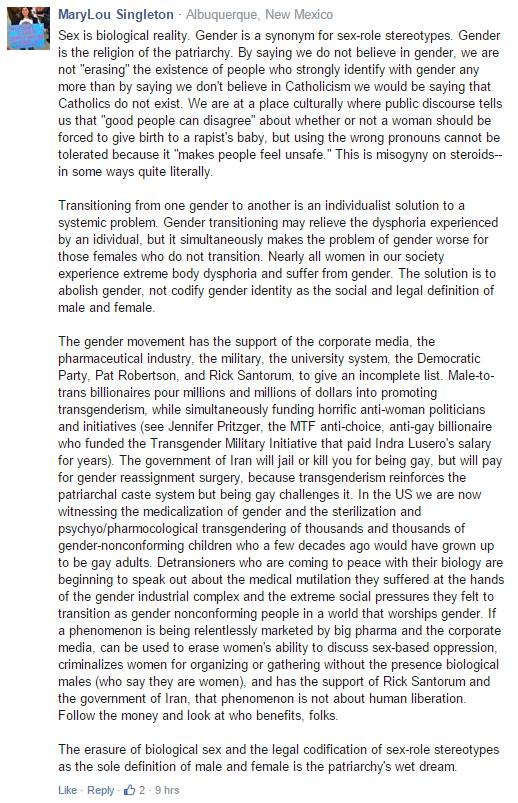
A few days ago, I wrote a blog post attempting to claim a middle ground between gender inclusivity and feminism in the midwifery community. I am a gay, transgender man, and I am a feminist. A vicious response by a lead midwife from the group Woman-Centred Midwifery was posted and then deleted later in the day. Have no fear, I obtained a screen capture of it so we can all read it and discuss.

Here’s a quick synopsis of the issue: The Midwives Alliance of North America (MANA) formerly referred to clients as "women" and "mothers," but in 2014 changed some (but not all) language in its core competencies document to refer to "pregnant people" and "birthing individuals." On August 20th, a dissenting group of midwives calling themselves "Woman-Centred Midwifery" wrote a letter to MANA protesting the “erasure” of the word “woman” from the documents.

I proposed that organizations like MANA can and should continue to use the words “woman” and “mother” in addition to gender neutral terms like “all birthing people” or “people of all genders.” There can be respect for women’s struggles against patriarchy and inclusivity of transgender, genderqueer and intersex individuals at the same time.

In response, Mary Lou Singleton, the first signatory on the Open Letter to MANA, wrote a comment on my blog post that is the most bizarre and hostile piece of misinformation I’ve ever seen. Her opinion about transgender people is made abundantly clear by her use of terms such as "medical mutilation" and "gender industrial complex."

But there's still more. Ms. Singleton asserts, "Male-to-trans billionaires pour millions and millions of dollars into promoting transgenderism, while simultaneously funding horrific anti-woman politicians and initiatives." Yes, it is true that there is one trans billionaire in the world. She doesn’t represent all trans people, who in general face high rates of poverty and are frequently victims of violence. I love a good conspiracy theory as much as the next person, but painting one of our society’s most oppressed groups as the oppressors is not only far-fetched, it contributes further to the transphobia and discrimination we already encounter.

Ms. Singleton continues: “transgenderism reinforces the patriarchal caste system but being gay challenges it... The erasure of biological sex and the legal codification of sex-role stereotypes as the sole definition of male and female is the patriarchy's wet dream. ” What about individuals like myself who are both transgender AND gay? What about transgender women who are lesbians? And, let’s remember the topic at hand - midwifery care during pregnancy, birth and post partum. I can say from personal experience that being a guy with a beard, a low voice and a pregnant belly does not constitute conforming to sex-role stereotypes in our society. Nursing a baby while sporting facial hair does not constitute conforming to sex-role stereotypes in our society.

As the first signatory on the Open Letter to MANA, I assume that Ms. Singleton must have a good deal to do with the motivation behind it. I fear that we have now seen the true colours of this particular “woman-centred midwifery” group - hateful yet utterly confused.  I hope that others who signed will carefully consider the implications and will withdraw their support of such a brutal ideology.

Many thanks to Sion Jesse for providing this screen capture: