I'm excited to report that Publishers Weekly reviewed my book, Where's the Mother: Stories from a Transgender Dad.
And, the reviewer appreciated the ways that I draw attention to varying degrees of privilege, including my own. It's a rad, queer review!
From Publishers Weekly: "MacDonald’s debut memoir tells a tale noticeably absent from the
plethora of parenting and breastfeeding books available: that of a
transgender man in a gay marriage to a cisgender man who was himself
adopted, both desperately trying to feed their biological child nothing
but human milk... MacDonald owns his identity, using his elevated platform to call
attention to issues faced by transwomen and transmen, people of color,
and those living in poverty. Most importantly, his story of
transitioning is frank, clever, and easy to process, providing plenty of
parallels to his later struggles with nursing for curious cis readers... a refreshing and insightful narrative."

Breastfeeding and parenting from a transgender perspective.
Showing posts with label parenting. Show all posts
Showing posts with label parenting. Show all posts

16 Jun 2016
Parenting Through a Vigil for Orlando
As queer parents, my partner and I carefully
discussed whether to attend our local vigil in Winnipeg, Canada for the LGBT
people of colour who were victims in Orlando. I’m a gay, transgender man,
married to a gay man, and we are privileged to be raising a five-year-old boy,
Jacob, and a twenty-month-old girl, Emily. We needed to consider how to talk to
our children about what happened, if the event would be safe for them, and if
we could convince our kids to behave appropriately given the circumstances that
were the reason for the vigil.
Our twenty-month-old toddler is going
through painful teething and prefers my arms at all times, so leaving her with
someone else during the vigil was not an option. The event started at 8:30pm,
when our kids would usually be winding down for bed. But we wanted desperately
to be there, to find our community and exchange hugs, and to show our support
for the victims who were mostly young, LGBT, Latinx people.
My partner and I decided that we must get
there. We talked to our five-year-old about what happened using simple but
honest language. We emphasized that the violence occurred in another country,
and that as white people living in Canada, we are lucky to have more privilege
than those who were killed or injured in Orlando. It is important for us to
stand up in support of our queer siblings of colour.
But as we said these things, we were
also aware that other
LGBT events could be targeted. A trans friend of mine who lives in Philadelphia told me
that he and his partner decided not to risk taking their own young child to any
pride events due to safety concerns. One parent or the other might go, but not
both, and never their child. The calculations we make about personal safety and
risks feel dramatically different now that we are parents.
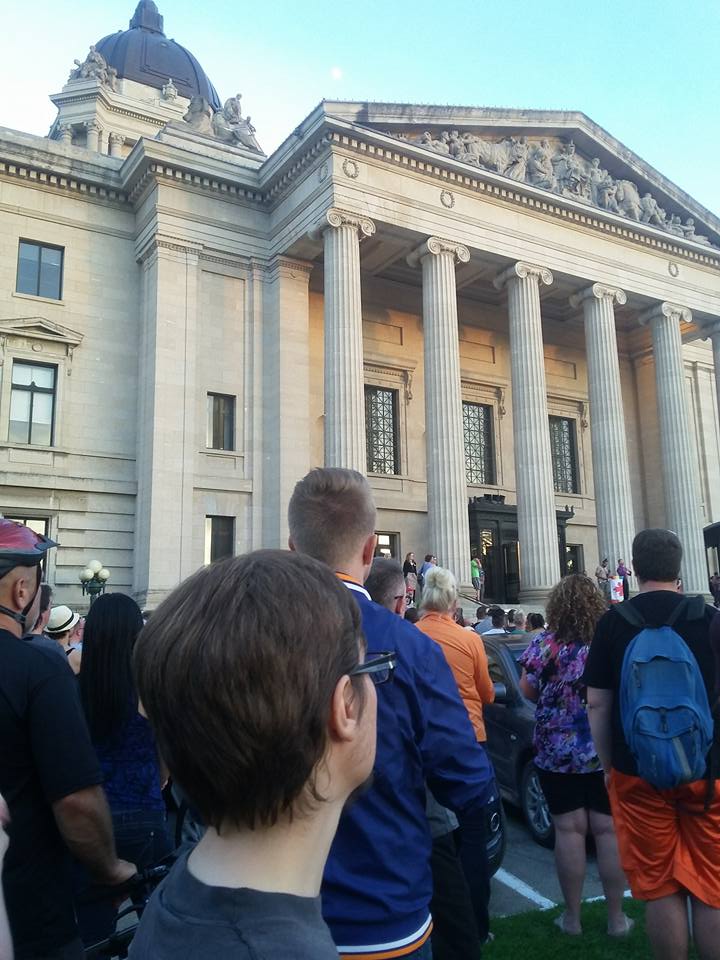
At the vigil in Winnipeg, hundreds of queer people and allies gathered, surrounded by
a heavy police presence as well as ambulances and fire trucks that lined the
block. I felt deeply moved by the words of an officer who spoke on behalf of
police to let us know that they and other first responders are here for our
community, doing their best to keep us safe.
Simultaneously, I thought of trans
friends I know who have experienced discrimination and violence at the hands of
police. I’m not talking about decades ago at the Stonewall riots, but personal
friends in Canada and in the US who continue to endure police brutality.
As politicians and community leaders spoke
and lit candles, we struggled to find the right balance as parents at the
event. A family sitting next to ours on the grass had brought ninja turtles for
their children to play with. After a few minutes of trying to listen to the
speeches whilst our children gazed with rapt attention at the other children’s sickeningly
inappropriate gunplay, we moved elsewhere. My toddler needed to pee about half
a dozen times, so I kept whisking her over to some nearby bushes and then
returning to the crowd. She and her brother ran up and down a small hill, but
didn’t make too much noise, and hopefully didn’t disturb others. At one point,
a man with a walker came through and I hastily grabbed both children to prevent
them from tripping him, while listening to a community organizer speaking out
against Islamophobia.
After the main speeches were over and
some balloons released to the sky, our kids were absolutely finished. It was 10
pm. A lawyer we hadn’t seen for years approached to greet us but we had to
hurry away. During the car ride home, when all I wanted to do was reflect
quietly, I sang cheerfully to our toddler who was constantly on the verge of
screaming from exhaustion but could not seem to fall asleep.
After becoming parents we got busy and
our priorities changed. We haven’t been to a gay bar in years. We connect to
our queer community much more easily online than we do in person. Other queer
parents we know posted to Facebook to say they were at the vigil in spirit but
needed to stay home for bedtime. For any parent, often already tired from
sleepless nights and working during the day, it takes a huge amount of energy
to get kids out to an event like this one and address their many questions and
various behaviors while paying one’s own respects. Add to this the daily stresses
of being a trans or non-binary person and it can become overwhelming.
Yet, my partner and I are fearful of what our
kids will face when they enter the public school system http://www.milkjunkies.net/2016/04/teaching-my-child-about-transphobia-our.html and broader society. Now more than ever, we feel motivated to
do our best to be involved in our community and to promote tolerance and
diversity. First, we must take care of ourselves and survive. And then when we
can, for the sake of our own children and LGBT youth everywhere, we must attend
the vigils, we must speak out, we must stand up for vulnerable people, we must
lead by example, and change the world for the better.
28 Nov 2012
Birth and Death: Helping a Toddler Say Goodbye
I've learned a lot in the last few days. Our family knew already for a few weeks that a tough time was looming ahead of us. Our dog was diagnosed with stomach cancer and wasn't responding well to medications. After a difficult, painful weekend, I arranged for a veterinarian to come to our home to euthanize her.
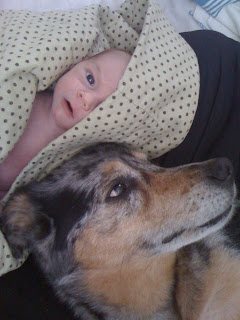 I had asked my vet what she thought we should do with Jacob, now 19 months, during this process. She recommended that her assistant take him into a different room, and told me that when I talked to him about our beloved Quinoa, I should try not to cry because it could make him fear death. Well, I knew right away that this wouldn't be possible for me to accomplish.
Quinoa was a sweet, gentle soul who taught me about good parenting, including cuddling, co-sleeping, and patience. Oh, the patience that this dog had! She taught Jacob the importance of being kind (she would get up and calmly walk away if he wasn't), sharing food with others (she was always polite but she did have a way of letting him know when she deserved a piece of his bread or a morsel of his egg) and catching snowballs (he hated snow this season until he saw Quinoa playing in it about two weeks ago). There was no way I wasn't going to cry over parting with her.
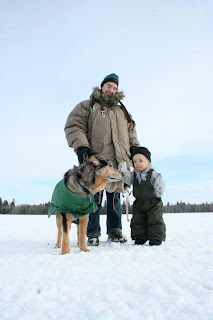 As Quinoa's final days approached, Ian and I both realized that Jacob would be most upset if he saw me having such intense emotions but was separated from me. He had to be there with us. When the time came, Ian cradled Quinoa's head in his lap, and I put my lips to her ear and told her all about the car rides she would enjoy and the cheese she'd love to eat again. Jacob stood quietly between us and watched, one small hand on my back and the other holding my shirt sleeve.
We stayed with Quinoa for many hours after she died. I washed off the urine that she had released at the moment of her passing, and we took turns grooming her still soft and shiny coat. Jacob found an old bottle of her ear drops and tried to administer them. We went over every single part of her body - we felt every lump and bump, noted which of her toes were white and which black, remarked on the beautiful, warm orange colouring on the underside of her tail and the details in her clear, blue eye. We felt her body become cooler, and then stiff. Spending this time with her body helped each of us to celebrate her life and accept her transition. Jacob looked at her and asked me, "Owee?" I told him, no, not anymore. He responded, "Oh."
I remembered that we deeply need to do many of these tasks with our newborns, too, in order to meet them, celebrate their birth, and establish bonding and breastfeeding. When new parents are free from medical interference, they examine every tiny bit of their babies, touching them everywhere, even smelling and licking them. This is what we require as mammals and humans. We and our loved ones, both those we are welcoming and those we are wishing farewell, deserve this time and space together to try to come to terms with the mystery of consciousness. Too frequently, babies are whisked away and bathed by nurses, and bodies of loved ones are "touched up" and cleaned by professionals instead of those who knew them best.
Everywhere I go, I think of Quinoa. I look around for her, but she's not lying under the painting of Everest on the wall, or by the window, or at the front or back door, or on our bed. I regret that Jacob is not at an age where he will remember her, but we'll tell him stories and show him photos of his dear friend. He may have a sense that death is something that happens, and through which we hold each other, in the midst of our tears.
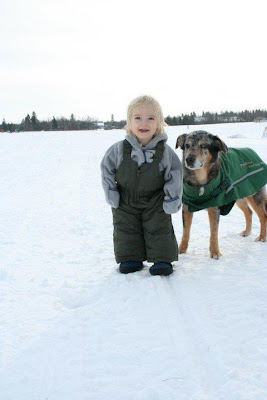
Quinoa was a sweet, gentle soul who taught me about good parenting, including cuddling, co-sleeping, and patience. Oh, the patience that this dog had! She taught Jacob the importance of being kind (she would get up and calmly walk away if he wasn't), sharing food with others (she was always polite but she did have a way of letting him know when she deserved a piece of his bread or a morsel of his egg) and catching snowballs (he hated snow this season until he saw Quinoa playing in it about two weeks ago). There was no way I wasn't going to cry over parting with her.
We stayed with Quinoa for many hours after she died. I washed off the urine that she had released at the moment of her passing, and we took turns grooming her still soft and shiny coat. Jacob found an old bottle of her ear drops and tried to administer them. We went over every single part of her body - we felt every lump and bump, noted which of her toes were white and which black, remarked on the beautiful, warm orange colouring on the underside of her tail and the details in her clear, blue eye. We felt her body become cooler, and then stiff. Spending this time with her body helped each of us to celebrate her life and accept her transition. Jacob looked at her and asked me, "Owee?" I told him, no, not anymore. He responded, "Oh."
I remembered that we deeply need to do many of these tasks with our newborns, too, in order to meet them, celebrate their birth, and establish bonding and breastfeeding. When new parents are free from medical interference, they examine every tiny bit of their babies, touching them everywhere, even smelling and licking them. This is what we require as mammals and humans. We and our loved ones, both those we are welcoming and those we are wishing farewell, deserve this time and space together to try to come to terms with the mystery of consciousness. Too frequently, babies are whisked away and bathed by nurses, and bodies of loved ones are "touched up" and cleaned by professionals instead of those who knew them best.
Everywhere I go, I think of Quinoa. I look around for her, but she's not lying under the painting of Everest on the wall, or by the window, or at the front or back door, or on our bed. I regret that Jacob is not at an age where he will remember her, but we'll tell him stories and show him photos of his dear friend. He may have a sense that death is something that happens, and through which we hold each other, in the midst of our tears.
Subscribe to:
Posts (Atom)