Showing posts with label attachment parenting. Show all posts

5 Apr 2017

Parenting Survival: When My Toddler Can't Sleep

The Toddler was up at 2am so we went out to listen for frogs. Unfortunately, the frogs in the ditch seemed to be fast asleep. We settled for waking up all the animals in the barn. We got the rooster crowing nicely and the goats got up to pee and poop. Then we turned off the barn light and went out again, leaving them all wide awake. None of it woke the frogs.

Inside the house, we cooked plantain because the Toddler was famished. 
 
Toddler: Friends X and Y were here, but not right now.

Me: No, not right now. You know why?

Toddler: X and Y are sleeping!

Me: YES!!!

Smiles and cuddles. Yawn.
 
ALL this started because Toddler woke up wanting to nurse and in my groggy state I didn't notice that the damn supplementer tube was pulled out of the water and not working, which led to much screaming. Not your average breastfeeding problems, yet somehow I am certain every parent has been there done that in some similar fashion.

Now she has nursed back to sleep and is using my belly for her pillow.

Supplementer? Toddler? Yes. After relying on it heavily when she was an infant, we just have not been able to shed the tube. It is part of our nursing relationship, even though the "supplement" is water. She is about the best hydrated kid I know, and I suspect the water is alright for her teeth, too.

28 Nov 2012

Birth and Death: Helping a Toddler Say Goodbye

I've learned a lot in the last few days. Our family knew already for a few weeks that a tough time was looming ahead of us. Our dog was diagnosed with stomach cancer and wasn't responding well to medications. After a difficult, painful weekend, I arranged for a veterinarian to come to our home to euthanize her.
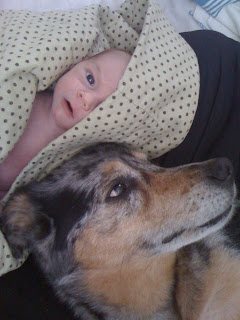
Our newborn Jacob with Quinoa
I had asked my vet what she thought we should do with Jacob, now 19 months, during this process. She recommended that her assistant take him into a different room, and told me that when I talked to him about our beloved Quinoa, I should try not to cry because it could make him fear death. Well, I knew right away that this wouldn't be possible for me to accomplish.

Quinoa was a sweet, gentle soul who taught me about good parenting, including cuddling, co-sleeping, and patience. Oh, the patience that this dog had! She taught Jacob the importance of being kind (she would get up and calmly walk away if he wasn't), sharing food with others (she was always polite but she did have a way of letting him know when she deserved a piece of his bread or a morsel of his egg) and catching snowballs (he hated snow this season until he saw Quinoa playing in it about two weeks ago). There was no way I wasn't going to cry over parting with her.
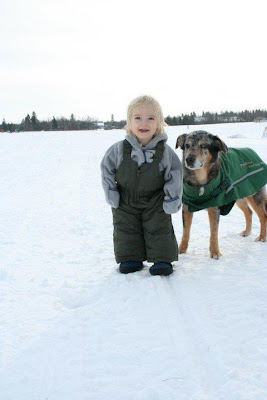
My toddler throwing a snowball for Quinoa, in her last week.
As Quinoa's final days approached, Ian and I both realized that Jacob would be most upset if he saw me having such intense emotions but was separated from me. He had to be there with us. When the time came, Ian cradled Quinoa's head in his lap, and I put my lips to her ear and told her all about the car rides she would enjoy and the cheese she'd love to eat again. Jacob stood quietly between us and watched, one small hand on my back and the other holding my shirt sleeve.

We stayed with Quinoa for many hours after she died. I washed off the urine that she had released at the moment of her passing, and we took turns grooming her still soft and shiny coat. Jacob found an old bottle of her ear drops and tried to administer them. We went over every single part of her body - we felt every lump and bump, noted which of her toes were white and which black, remarked on the beautiful, warm orange colouring on the underside of her tail and the details in her clear, blue eye. We felt her body become cooler, and then stiff. Spending this time with her body helped each of us to celebrate her life and accept her transition. Jacob looked at her and asked me, "Owee?" I told him, no, not anymore. He responded, "Oh."

I remembered that we deeply need to do many of these tasks with our newborns, too, in order to meet them, celebrate their birth, and establish bonding and breastfeeding. When new parents are free from medical interference, they examine every tiny bit of their babies, touching them everywhere, even smelling and licking them. This is what we require as mammals and humans. We and our loved ones, both those we are welcoming and those we are wishing farewell, deserve this time and space together to try to come to terms with the mystery of consciousness. Too frequently, babies are whisked away and bathed by nurses, and bodies of loved ones are "touched up" and cleaned by professionals instead of those who knew them best.

Everywhere I go, I think of Quinoa. I look around for her, but she's not lying under the painting of Everest on the wall, or by the window, or at the front or back door, or on our bed. I regret that Jacob is not at an age where he will remember her, but we'll tell him stories and show him photos of his dear friend. He may have a sense that death is something that happens, and through which we hold each other, in the midst of our tears.

Quinoa playing in the snow with our toddler

17 May 2012

More American Dogs Get to Co-sleep Than Babies

One of the basic principles of attachment parenting is "safe sleep," meaning that a loving parent attends to his or her child's emotional and physical needs at night as well as during the day. Many attachment-minded families find that sleeping together with their baby is the best way to accomplish this. However, the vast majority of American parents choose to put their children in cribs in separate rooms at night. A surprising number of dog owners, on the other hand, allow their dogs to sleep with them and report that they, and their dogs, enjoy it. It's a dog's life - just not for babies.

I believe the very first time I considered co-sleeping of any kind, I was thinking of dogs. I was eight years old, and our family dog was obviously ill, whining in pain. My parents chained him up outside so that he couldn't run away. Before bed, I went out to visit him and was frightened to see and hear him suffering, but I wanted to be with him. My parents made me go to bed, and the dog was dead by morning. I still hate knowing that he was in pain and all alone during that awful night.

When I was ten, we brought home a new puppy. Mom locked her downstairs in the mudroom and put down newspaper in case she peed. We went to our beds (separate ones) that night to the sound of ceaseless crying and yelping. Mom explained that the puppy was used to sleeping with her litter mates and that she was lonely. This was the first of many times that I begged to be allowed to have our dog sleep with me in my room. I was told the puppy would get used to her new surroundings eventually, and that we had to leave her on her own. This was a normal part of growing up for every dog.

As an adult, I learned that dog trainers seem to agree that sleeping together (at least in the same room) is important for bonding with one's animal, and the practice is far from rare. As Cesar Milan, the "Dog Whisperer," notes, "It is perfectly natural for a dog to sleep with other pack members, and it is also a powerful way to bond with your dog." A 2007 survey by the American Pet Products Association of over 2500 American pet owners found that a whopping 43% of dogs sleep in bed with their owners. When I adopted my current dog, she wanted to sleep with me and I obliged. This was the first time in my life that I slept with another living creature. I loved it.

After I read about safe infant-parent bed-sharing, it seemed natural to me to sleep with our baby, too. What else would we do? Let our dog cuddle with us in bed while our infant cried in the other room? If sleeping together is so beneficial for bonding with a pet, why wouldn't it be great for bonding with baby, too? However, a 2006 study in Kentucky found that only 15% of infants and toddlers aged two weeks to two years sleep with their parents. Is it possible that Americans are better in tune emotionally with their pets than their babies?

I wanted to do anything and everything that could be helpful to the breastfeeding relationship, including bed-sharing. What we discovered, however, is that co-sleeping is just as important for Ian's relationship with Jacob as it is for mine. I am fortunate to spend hours and hours nursing and wearing our baby during the day since I am the one who gets to stay home from work. Someone once asked Ian if he is jealous of our breastfeeding relationship, and he responded with an emphatic "No! I get to co-sleep!" Every night, all three of us cuddle together. Especially when he was younger and easier to move aroud in his sleep, I'd nurse Jacob down and then slide him over to Ian who would tuck his arm around him without even waking up. This way Ian got his fair share of skin-to-skin time and felt well-connected to our baby.

Nowadays our dog frequently snoozes by herself on the couch (maybe because the baby wakes up so much at night!) and then joins us for snuggling in the morning. But if there's a thunder storm, she always ends up in our bed, and from time to time, she chooses to be with us from the start of the night. I have no doubt that Jacob's nighttime preferences will change, too, as he grows and develops. One thing is for certain though: our bed will always be open to whoever needs it.

5 May 2012

Night Weaning, and Why We're Not Ready for it

A friend asked me the other day if I have night-weaned Jacob yet. Barely even thinking, I responded with an emphatic, "No! That's definitely not a good thing for him right now."


This Mom went on to describe her reasons for night-weaning her youngest child and how difficult it had been. She had to go back to work and was simply exhausted from being woken up frequently to nurse at night. Sounds familiar to many of us, I'm sure. "The first night he cried for five hours. My husband had me wear head phones so that I could get through it. The next night he only cried for about three hours. Pretty soon we got down to ten minutes."

Since embarking on this mysterious and beautiful parenting journey, I have come to understand why sleep deprivation can be used as a torture technique. It genuinely feels horrid. I have been known to say when I'm getting to an extreme of exhaustion, "I want to die I'm so tired!!"

But I also cannot picture night-weaning anytime soon, so I guess it's all the more fortunate that I do not yet have to go back to work. Jacob just turned one, and he is going through an extraordinary developmental stage that is demanding for everyone involved. Frankly, he thinks he is too busy to nurse much during the day, and I believe him! He is learning to walk, to climb stairs (though not to go back down them), to eat solid foods, to share toys, and to cope with strong emotions. And he will soon surpass his dads in his confident use of electronics. During the daytime he is rushing to grow up, which leaves only the nights for being a baby with an intense need for both human milk and touch.

I understand why people night-wean their kids, and I don't blame them for wanting to do it. But I think about my poor little guy trying so very hard to explore and establish his independence in his waking hours, and I know that now is definitely not the time for us. If it is painful for me as an adult to lose sleep, I am sure it would be even more so for him to go without the comfort of nursing while he attempts to process the huge adventures of his days. It is hard work to be a baby.

As my many attachment-minded friends love to remind me, we will get through it, and this too shall pass.


4 Apr 2012

Responsive Parenting

The first word that comes to mind when I think of attachment parenting is "responsive". I want to respond quickly and compassionately to my child. Since I'm just at the beginning of my adventures in parenting, this has mostly meant breastfeeding so far. What do you do when an infant wakes up crying? Breastfeed! What do you do when your baby is hurt? Breastfeed! Scared? Breastfeed! Tired? Breastfeed! But for me, responding to my baby appropriately also means ignoring everyone else - the glares, the stares, and the giggles. I'm transgender and I breastfeed because it is what my baby expects and deserves.

Bottle of injectible testosterone
My infant doesn't know I'm transgender.

At this point in his short life, my child has no idea that I'm any different from any other breastfeeding parent. He doesn't know that I was born female but took testosterone to transition. He doesn't know that I had chest surgery and that's why we have to nurse using a supplemental nursing system. He doesn't know that while he has two dads, most other kids have a mom and a dad.

What does my baby know? He feels that he wants to be held a lot, although this is beginning to change as he explores the world more and more. He knows that when he nurses, much of his body touches a warm, caring adult body and he is safe. He feels that he wants to suck, A LOT.

So I have to respond selectively to the people around me, which is not always easy. I'm ultra-sensitive to my boy. I try to breastfeed him when he gives early signs that he may want to nurse. I am insensitive to the man in the restaurant who is staring as I latch on my little guy. If I'm feeling brave, I look up and smile at him, but mostly I pay attention to positioning my baby and the SNS. I don't respond to the woman who stares at me or the teenagers who point and giggle. I'm busy. If these other folks are hungry, I'm pretty sure they can go off and find their own food without my help, but my baby is depending on me. He trusts me.

I will always remember the funny looks I've received, while my baby may or may not remember breastfeeding depending on his age when we stop. But he will get through his toddlerhood and early childhood with a strong sense of attachment. He knows that I will always respond.

This post is part of the Attachment Parenting is for Everyone blog carnival, hosted by Attachment Parenting International. Learn more by visiting API Speaks, the blog of Attachment Parenting International.

18 Feb 2012

Hanging on to My Kid

Ice path in Winnipeg
If you are depressed in the winter time in Winnipeg, my best suggestion has always been to bundle up your kids and head outside onto the city's two frozen rivers at the Forks. Many days lately have been sparkling, sunny, and even somewhat warm.

It often seems like a great effort to get going and make it out with little ones in the winter. I feed Jacob and change him right before leaving and then hope that he'll be happy enough during our adventures to hang on until we get back home. I strap him into my cloth carrier, put my gigantic winter coat over both of us, leash up the dog, and off we go for our walk. Down on the river path we amuse ourselves by watching kids skate past - some of them are toddlers who are sliding along for the first time, doing little more than a funny-looking shuffly walk while others are macho teens rocketing up and down the river despite gaping cracks and holes in the ice. Jacob smiles at the border collie dogs who zip by pulling their owners on cross-country skis. Everyone out there seems to be laughing and we almost always stop to talk to someone we know. Winnipeg is a small town.

Sometimes we see something truly bizarre. A few weeks ago, Jacob and I crossed paths with a man and a woman, skating cautiously, holding their infant in a car seat between them. Now, I don't even like to walk that way, but skating, carrying a bucket seat? Really?

I had to say something. "Well, that's an interesting way to do it. Looks like you're having fun."

"Yeah, we don't have a stroller yet but we really wanted to get out."

I replied, "I tried to skate with this little guy on the path in a stroller but he would have none of it. He wanted to be held."

The man explained to me, "Oh, we've been very careful since the beginning to not let ours get used to being held. I mean, that would be like being in prison - he'd want it all the time."

I think I stared blankly for a moment and then wished them a lovely afternoon. When we North Americans don't want to be "tied" to our babies, we tie them down instead to an unending variety of inanimate devices. We strap them into car seats (whether or not we are driving anywhere), strollers, bouncy seats, jolly jumpers, and excersaucers and shut them up in cribs, bassinets and playpens. All this to avoid an adult human holding a human baby, because that would be nothing less than incarceration.

And yet I feel the opposite of a loss of freedom when I'm holding Jacob. With him snuggled up against my chest I know that I can comfort and protect him against anything, and this makes me feel safe. All I can say is that at least everyone in that family I met was outside enjoying the sun's rays and their promise of spring to come.