Showing posts with label formula. Show all posts

26 Sept 2012

Getting Through Thrush With a Milk Donor's Help

I love this story by blogger Michelle Bowman. Her up-front and entertaining piece highlights a common nursing problem and shows us how the gift of donor milk enabled her to overcome it and breastfeed successfully. Like many recipients, Michelle didn't need all that much milk in order to get her own supply back on track. However, the relatively small donations made an enormous difference to her nursing relationship with her baby.

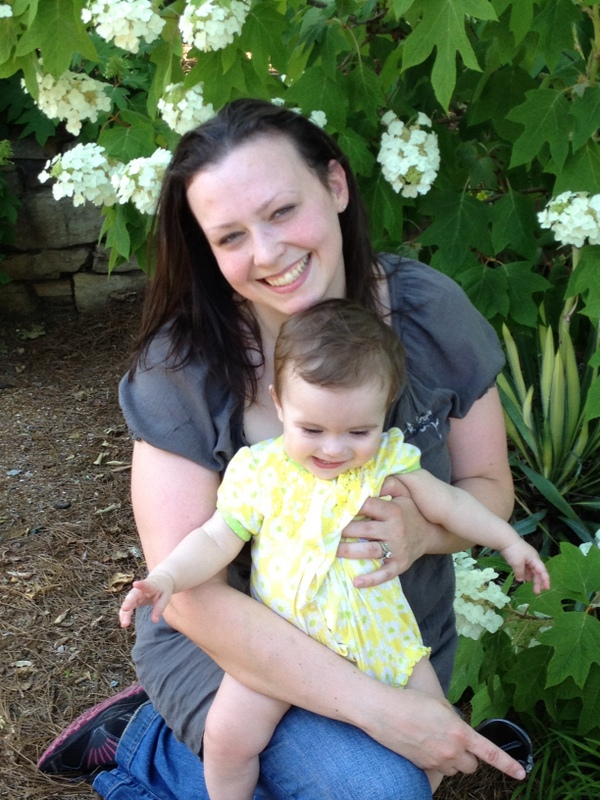
Mom and baby sharing a happy moment next to a flowering bush.
Sharing a happy moment after getting through very difficult times.
A month or so after I returned to work, my daughter and I got thrush. It's one of those chicken/egg deals. Who knows where it started, all I know is we had it.

It was so painful, I cried nursing, I cried pumping. My nipples were raw, red and even fabric hurt against my skin. And thus began the decline of the milk factory. Slowly, we were burning through my precious milk stash. My once ample supply, enough to feed multiple babies, dwindled down lower and lower. The pain I was having was preventing let downs while pumping, so I was no longer producing what I needed to produce for bottles during the day when I was at work. My in-laws were great, but they tended to be a bit liberal with the milk, always having a bottle on hand. Even if it was 4 in the afternoon, they preferred the security of a bottle in case Little Miss A started fussing. And since you shouldn't re-refrigerate a warmed bottle, we wasted quite a bit of milk in November and December.

Once Little Miss A started attending daycare in January, I was frantic for ideas. Hubby was about to leave to train for his promotion, and stress set in. If there's two things you should know about stress, it can affect your milk supply and affect your sleep patterns. I wasn't sleeping well, Little Miss A was still waking up multiple times a night and my milk supply suffered. Some days, I could pump 10-15oz when I was working. But most days days, I only pumped 3 or 4 oz total on my lunch hour. This was with galactalogues and extra pumping sessions.

I started testing formulas midway through January. I would make a bottle, she would either refuse, spit up, or take it. The ones she took, she ended up having such bad diaper rash that I would have to bust out the big chemicals. We tried four different formulas before I felt desperate. We tried three soy formulas. Little Miss A was NOT having it. She did not want a bottle, and she did not want it if it was not mommy's milk.
I started researching milk banks, figuring I could swing the purchase of milk through my flexible spending account. As long as I could get a physician's prescription, flexible spending would cover the majority of the cost. However, milk from a milk bank can cost around$4.50 per ounce, which could be anywhere between $300-$1200 per month depending on how much I needed to supplement. At that rate, I'd burn through our flexible spending in just a few months. Not only did the cost stop me, but milk from the milk banks are reserved for sick babies, usually preemies in the NICU. I was certain there would be a long waiting list for healthy babies to get milk. So, I was at an impasse. I wondered daily if I should wean entirely or if I should force formula supplement at daycare- I just did not know what to do. Now that I am thinking back, I cannot remember who told me about informal milk sharing, but I began connecting with other moms via Human Milk for Human Babies (HM4HB) and Eats on Feets.

I thought to myself: "If she can't get only mommy's milk, shouldn't it be milk from somebody's mommy?"

I met with a few women, one of whom is a nurse for one of the hospitals I work at, and is friends with some of my friends. You know, that whole small world thing? Totally felt that when talking with her. She has two children, a little one month old guy she was nursing and said she had over 100 oz to share. I felt safe feeding my child her milk- because she fed it to her daughter.

On Valentine's Day, I received our first milk donation. I finally could breathe again- I wasn't going to run out of milk for my daughter. This angel provided my daughter with over 150 oz milk. It was the BEST gift I received this year- nourishment for my daughter and with that, peace of mind. Over the next few months, we received a few more donations to fill in the gaps of what I was unable to produce. Now when I had a bad day with pumping, I didn't cry every time I pulled a bag of milk from the freezer. With the help of our "donor mom", as I affectionately call her, we made it to a year with breastfeeding. When I left my job in June, I still needed a little mama's milk for supplementation, but I have been able to rebuild my supply since and Little Miss A has been able to get all my milk again!

24 Sept 2012

Milksharing and La Leche League

In this post, Laura Spitzfaden, IBCLC and Leader with the breastfeeding support organization La Leche League, tackles LLL's stance on milksharing. I love that she also addresses an important yet rarely discussed risk of milksharing. An incredibly thought-provoking read!

I was inspired to write about milk-sharing when I read this article by Amber McCann, IBCLC.

Like Amber, I am an International Board Certified Lactation Consultant. I am also a La Leche League Leader. La Leche League’s position on milk-sharing discourages leaders from providing moms with information about informal milk-sharing unless the mother specifically requests such information. If mothers ask a LLL Leader how to obtain human milk supplements for their babies, they must be directed to milk banks, even though the cost of purchasing human milk from a milk bank is prohibitive. In most cases, there is not enough milk available for the ill or preterm babies who need it, let alone any excess available for purchase for healthy babies. This is simply not a viable option for most families.

Avoiding the topic of informal milk-sharing does not take into account the changing social environment of the moms we serve. Through social media and the internet, mothers are more informed than ever about the risks of artificial feeding and about what their babies are missing if they do not breastfeed. Over the last few years, I have observed that informal milk-sharing has rapidly become commonplace. I am witness to many instances of mothers offering their milk to other mothers who need or want supplemental milk. Mothers are sharing their milk whether or not any organization believes it is safe.

While there are risks involved with informally sharing breastmilk due to the potential to spread illness or to expose infants to drugs or chemicals, those risks can be mitigated. It seems disingenuous to be concerned about contamination of breastmilk, when it is well documented that artificial feeding carries significant risks for babies and that formula is often found to be contaminated with chemicals and pathogens.

One risk of informal milk-sharing that I have not seen addressed is that accepting donations of milk from another mother, may put a mother’s own milk supply at risk. Often a mother believes she does not have enough milk or that there is something inadequate about her milk and believes she needs to supplement. If it is simple to get milk from another mother, and she doesn’t have access to information about all the risks and benefits of supplementation, she may not explore the reasons for her own supply issues or discover there is no problem with her milk supply. She may supplement unecessarily and unintentionally reduce the amount of her own milk that is available to her baby. If providing information about informal milk-sharing is discouraged, and focus is placed on the risk of possible contamination, the more significant risk to a mother’s milk supply is potentially overlooked.

Research into mother and infant sleep practices by Kathleen Kendall-Tackett, P.h.D., IBCLC, RLC, has shown that dictating to mothers what they should and shouldn’t do, doesn’t work. Telling mothers that they shouldn’t sleep with their babies in adult beds, only results in mothers falling asleep with their babies in even less safe environments, or ignoring the advice while being deprived of the information needed to make bed-sharing safer. Just as many breastfeeding advocates support mothers in bed-sharing with their babies, due to the belief that bed-sharing benefits breastfeeding, and its practice can be made safer, we can also support human milk sharing by providing moms with the information they need to make informal milk-sharing safer. I believe it is time for child health advocates to stop telling moms what to do and instead, provide all the information that moms need in order to make their own informed choices about milk-sharing.

While it is not possible to make any infant feeding option risk-free, mothers can be provided with the information they need to evaluate and minimize the risks and make their own informed decisions. The World Health Organization offers a heirarchy for infant feeding if a baby cannot be breastfed by his or her mother, “..expressed breast milk from an infant’s own mother, breast milk from a healthy wet-nurse or a human-milk bank, or a breastmilk substitute…” in that order. It is up to infant health advocates to help mothers to be informed of the risks and benefits of each option, so they may choose for their own babies.

Laura Spitzfaden, LLLL, IBCLC

In March 2011, the LLLI Board of Directors adopted the following policy regarding the donation of human milk: http://www.llli.org/release/milksharing.html

Mother-Infant Sleep Locations and Nighttime Feeding: U.S. Data from the Survey of Mothers’ Sleep and Fatigue-Kathleen Kendall-Tackett Ph.D., IBCLC, RLC et.al.

21 Sept 2012

Supporting Families in Milksharing as an International Board Certified Lactation Consultant

This year's World Milksharing Week Blog Carnival includes posts by a wide variety of individuals, including donors, recipients, activists, academics, authors, and health professionals. I am thrilled to present this piece by Amber McCann, blogger and International Board Certified Lactation Consultant, about why she, as a health care provider, supports milksharing. She explains what people like her can do to help their clients make informed choices in milksharing, an area that many shy away from.

As an International Board Certified Lactation Consultant, I have, first and foremost, an ethical obligation to provide evidence-based information to my clients to support their breastfeeding relationship. Every day, for a variety of reasons, I encounter and encourage families who need to supplement their baby’s nutrition with something other than milk directly from the mother’s breast. Today, they have many options: pump and feed their own milk, supplement with some sort of donor milk, milk-based formulas, soy-based formulas, pre-digested formulas . . . lots of options, lots of questions, lots of opportunities for parents to be confused.

I believe that parents are capable of making the choices that are best for themselves and their families.
It is my job to make sure they have all the information to do so.

The World Health Organization, in its Global Strategy for Infant and Young Child Feeding, says,


“for those few health situations where infants cannot, or should not, be breastfed, the choice of the best alternative - expressed breast milk from an infant’s own mother, breast milk from a healthy wet-nurse or a human-milk bank, or a breastmilk substitute…depends on individual circumstance.”

Since this is coming from a global authority on health, I feel pretty darn confident using this hierarchy while supporting my clients in their supplementation decisions.

Most Ideal Option - Expressed breastmilk from the infant’s own mother.
Next Most Ideal Option - Breast milk from a healthy wet-nurse…SCCRREEEEECH!!!!


(do you see the virtual brakes going on???)

Wet nurse? Really? In this day and age? With HIV, hepatitis, and any number of undesirable diseases that can be passed through bodily fluids? What would wet-nursing even look like in today’s society? The first reaction of many is to simply pass off the idea as old fashioned, ancient, and outdated, not to mention dangerous. And in the United States, where I live, it is generally understood that if a mother’s own milk isn’t an option, formula is the obvious default. Why even bother?

Because we, as humans, are designed to consume human milk.

In our current environment, actual wet-nursing (a woman feeding another’s baby directly at her breast) is deemed by many to be inconvenient, too intimate, and—if you will—too gross. But what about the sharing of breast milk from one mother to another? Since most mothers have access to a breast pump, it has become increasingly easy to package milk in a shareable form. And with the formation of groups such as Human Milk 4 Human Babies (HM4HB) that provide a space for families in need to connect with families who want to give, doesn’t it make sense that we would at least explore the option? Can feeding a child the milk from a mother not his own be a viable solution to our supplementation needs? Is it an option that I, as an IBCLC, am willing to share with the families in my care? I answer with a strong and firm YES.

When I first became aware of milk sharing, it was a “secretive” practice, one not discussed openly and one that many organizations (breastfeeding supportive and not) chose to distance themselves from. When an article appeared on TIME.com in November of 2010 about the rise of the use of social media to facilitate milk sharing, I was quick to say “What can I do to help?” because the goal seemed obvious to me: get human milk into human babies.

What I wasn’t prepared for was the strong backlash from my own professional community saying, “But what if a baby gets sick or even dies?” Quite a number of IBCLCs I know were involved in milk sharing arrangements in their own breastfeeding years and some continue to be “closeted” about their own experiences. I attended the FDA meeting in December of that year discussing the regulations in regards to donor milk and while informal sharing wasn’t formally on the agenda, it certainly was on everyone’s lips in the room. There was palpable fear that one bad outcome from milk sharing would halt all the positive momentum that breastfeeding was gaining in our culture. One expert even spat out, “These women…these women who are doing this are going to hurt or even kill their babies.” I maintain that they are simply trying to feed them the food they were designed to eat.

But, what about the RISKS, with a capital R? Wouldn’t I be putting the health and lives of the babies I serve at risk if I offer milk sharing as an option? There is nothing in life that is without risk. Is milk sharing risk-free? Absolutely not. There are also risks to breastfeeding and formula feeding. Dr. Karleen Gribble and Dr. Bernice Hausman discuss these concerns in their paper Milk Sharing and Formula Feeding: Infant Feeding Risks in Comparative Perspective. In it, they discuss the issues of contamination of milk with pathogens, chemicals, concerns with milk collection and storage hygiene. The also discuss the risks to formula use that are not present when feeding human milk. In addition, there is a section devoted to the risk of HIV from the use of shared milk. I strongly advise every breastfeeding professional as well as any mother I am working with to read this paper and discuss their concerns. Drs. Gribble and Hausman conclude that “instead of proscribing peer-to-peer milk sharing, health authorities should provide parents with guidance on how to manage and minimize the risks of sharing human milk.”

How do IBCLCs instruct and inform clients about the risks and benefits of consuming or donating shared milk?

How do we advise our clients to mitigate those risks?
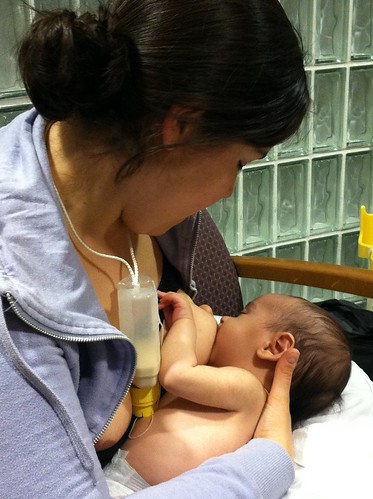
Mom nursing with a supplementer
Photo via World Milksharing Week on Flickr


For recipients: When one of my clients is in need of milk and is considering milk sharing, I strongly encourage them to think about whether people they already know might be willing to donate. They also might explore location-based online milk sharing groups (like HM4HB), and then groups that facilitate broader-range sharing and the shipping of donor breast milk (like MilkShare). I do not condone the sale and purchase of breastmilk and I strongly encourage my clients to not consider it as an option.

No matter where the milk is coming from, I encourage my clients to thoroughly research what sorts of screening they consider essential (such as blood work from pregnancy and questionnaires about lifestyle choices such as alcohol and medication use). It is important that both parties have clear expectations about what their milk sharing arrangement looks like. At no point do I, as an IBCLC, engage with the recipient family as a “milk broker.” The family is fully responsible for finding, contacting and making arrangements with their milk donors. As an IBCLC, my role with milk recipients is only to provide information and resources.

Of note, it is always my hope that supplementation of any type can be eliminated or minimized because of an increase in a mother’s own ability to make milk. The milk sharing community is often particularly in tune with the need and desire of mothers to work hard to rebuild their milk supply. Some families get a donor and a cheerleader-in-one! Many mothers feed donor milk through the use of a supplemental feeder, which can help mothers to produce increasing amounts of their own milk by stimulating the breast while delivering the supplement. There are many stories of those who were in need of donor milk, were able to rebuild their supply and then donate milk back into the community.
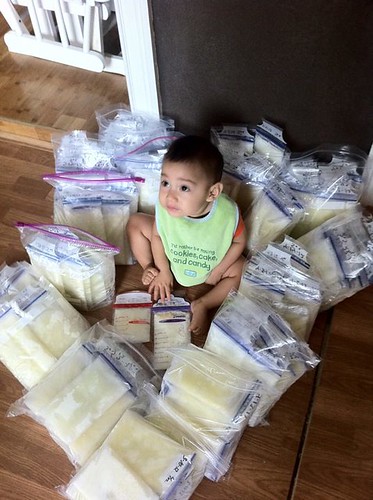
Baby sitting on the floor surrounded by bags of donor milk
Photo via World Milksharing Week on Flickr
For donors: I often have mothers, in their glee at how much milk their body is providing, send me an email saying they “had so much we had to dump it down the sink.” Nothing strikes panic into the heart of an IBCLC faster! If a mother tells me, as her lactation consultant, that she has more milk than she knows what to do with, I offer her information about donation. I share with her the options of contributing to a HMBANA milk bank, donating directly to another family or sharing her milk with a for-profit milk bank. (Though I have significant ethical concerns about these banks, I do share the information with my clients so that they can make the best decision for their family.)

I stress to the family that the milk they have is first and foremost for their own baby. I know that many families feel incredibly proud and thankful to be able to share of their excess. I encourage families to participate openly and honestly in all screening with their recipient family and to make sure that both parties have clear expectations about what their milk sharing arrangement looks like. At no point do I, as an IBCLC, engage with the donor family as a “milk broker.” They are fully responsible for finding, contacting and making arrangements with their milk recipients. As an IBCLC, my role with milk donors is only to provide information and resources.

An obvious question in all of this is why wouldn’t a mother in need of additional milk for her child simply obtain it from a milk bank? Then we wouldn’t be talking about risks of disease and contamination. In an ideal world, families would be able to receive ALL the milk they need from milk banks. Milk banks would be located in every community and have an unending supply of milk. I believe this can be a reality. I believe that there can be plenty of milk available to every baby that needs it. As a passionate advocate for getting human milk to human babies, Emma Kwasnica says, “milk is a free flowing resource.”

Unfortunately, in the United States, this isn’t yet the reality. As a nation, we need to drastically increase the number of milk banks and the amount of human donor milk available. The Human Milk Banking Association of North America (HMBANA) currently has 12 active banks. These banks do incredible work and, rightly so, their priority is on making sure that the MOST CRITICAL babies receive the milk that they process. For these little ones, having access to human milk can be, quite literally, a matter of life and death. Even this week, several milk banks, including those in Indiana and Utah, have issued pleas in the media for increased donations because their supplies are low. It is absolutely essential that these babies be the first to have access to processed donor milk.

Does every baby need its milk processed by a milk bank focused on the needs of vulnerable infants? For the most fragile babies, the complex processes of a milk bank (milk pooling, pasteurizing, and testing) are critical. The needs of a healthy term newborn are different. I liken it to this: If you had a dear friend who had recently received an organ transplant, you would do everything within your power to visit with them in a healthy manner by scrubbing arms and hands and wearing a mask. But, if that same friend has just gone through a “healthy” event, like birth, you would simply wash your hands. Different circumstances require different levels of caution.

Where does that leave healthy babies? In my practice, I see many mothers who, for of a variety of physical, emotional or circumstantial reasons don’t make the milk that their baby needs. At some milk banks, families of healthy babies can sometimes purchase donor milk but it is typically in limited quantities, and only available when supplies exist to meet the need of critical infants first. While the cost associated is reasonable, considering the cost of processing by the milk bank, it is often prohibitive to the families in need.

Is the only option for these families infant formula? I have every confidence that the human milk banking advocates all over the globe would affirm the belief that all babies have the right to human milk. I think that milk banking and milk sharing CURRENTLY serve very different populations of babies. Above all, my loyalties are not to milk banks or the milk sharing movement, but rather to babies and their families. There is room in the community for both methods of getting human milk to human babies.

Breastfeeding support that believes in you! Supporting families in milk sharing as an IBCLC. Nourishbreastfeeding.com 
I have been privileged to work with a number of families who were involved in milk sharing, both on the donor side and on the recipient side. I have seen milk donations have a significant impact on the health of a child. I have seen milk donations foster community that might not have happened otherwise. I have seen milk donations turn grief into hope. I have seen milk donations empower families and save babies’ lives.*

Milk sharing is not the right choice for every mother in need. Milk sharing is not the right choice for every mother who desires to donate her milk. But for many families, milk sharing facilitates health, community building, and an opportunity to reclaim the breastfeeding experience for those whose journey didn’t go as they planned.

Again, I affirm that parents are capable of making the choice that is best for their families.

It is my job to make sure they have all of the information to do so.

*A nod to Ursuline Singleton for her statement at the 2012 ILCA Conference that “IBCLCs empower mothers and save babies’ lives.” Thank you, Ms. Singleton, for so clearly helping to define what is essential to my profession.

17 Sept 2012

"I wish I'd Known About Milksharing When..."

In this post Dinnae Galloway, blogger from Complete Wellness Concept, touches on some of the many reasons people choose to give or receive donated milk.
I’ve heard time and time again from many many parents: “I wish I’d known about milksharing when - *insert specific situation here.*”

…. my baby was little - she couldn’t handle formula and was constantly sick until we got her on solids.

…. I was lactating - I had so much oversupply it was CRAZY!

…. I was pumping at work - my son wouldn’t take expressed milk, hated bottles, so ALL of my expressed milk got dumped down the drain!

…. my niece was little - she had eczema really bad, and my sister suspected it was the formula, but she had no other options!

…. my son was born - my wife got sick, and lost her supply, and we were unable to follow through with our plan to breastfeed him.

REALLY, these are things I hear and read ALL. THE. TIME. And multiple different variations of them all too.

World Milksharing Week was created to celebrate peer-to-peer milksharing, this grassroots movement of parents being empowered to make *informed decisions* about their infant feeding options. But not only do we want to celebrate, we also want to help educate - by getting the word out there about milksharing, people will get the info they need, and will understand that there ARE options for them!

What do YOU wish you had known before getting into this journey we call parenting?

31 Jul 2012

Public Health, Economics and Breastfeeding Goals

This morning I noticed that at the top of The New York Times' "most-emailed" articles list was yet another post about the hardships of breastfeeding and the bullies in the medical establishment who continue to berate us with the message, "breast is best." This particular one was entitled, "The Ideal and the Real of Breastfeeding," by Jane E. Brody. It closely mirrored the feminist arguments of Elisabeth Badinter's recently published book, The Conflict: How Modern Motherhood Undermines the Status of Women. These authors and their followers commonly suggest that doctors, nurses and public health officials should stop making breastfeeding seem like such an important factor in infant health so as to avoid inducing motherly guilt. It seems not to occur to any of them that perhaps what Americans need instead is a set of laws, government programs, and business practices that support babies and their families.

Telling us that breastfeeding isn't important because in some cases it's rather difficult to accomplish is like saying that, since they are having trouble doing it, our school-aged kids don't actually need to eat more vegetables and fewer fatty foods even though they are suffering from poor health. After all, we wouldn't want to hurt their feelings, would we? No, in this situation, I believe parents generally agree that schools should make an effort to remove nutritionally abysmal food and drink such as French fries and pop from cafeterias. We need to help our children develop healthy eating habits and we know that surrounding them with excellent choices will go a long way toward making this happen.

Why, then, do writers such as Jane Brody insist that we change our stated societal breastfeeding goals instead of doing better to support breastfeeding parents? In part, they argue that breastfeeding isn't really as beneficial for babies as parents are made to believe. After all, Brody says, "No randomized, controlled trials - the gold standard of scientific research - have proved that breast-fed babies fare better, at least in industrialized countries." This is in fact because such a study would be impossible to perform. No parent would agree to breastfeed or formula feed randomly as decided by a scientist. Even if they did, some in the group assigned to breastfeed would fail to do so since not everyone who wants to breastfeed succeeds.

Nevertheless, it's easy to find solid evidence that shows breastfeeding is good for infant health, and, not surprisingly, good for business. Breastfeeding support programs instituted by employers result in 62% fewer prescriptions as well as substantial health care savings and reduced absenteeism, according to the insurance company CIGNA. Companies with lactation support programs also enjoy much higher rates of employee retention than the national average. Of course, insurance companies exist to make money - if they are convinced that breastfeeding saves health care dollars, I'm inclined to believe them.

Another large part of Badinter's argument against breastfeeding concerns the time and energy that it takes on the part of the mother. As a breastfeeding dad, I have certainly experienced firsthand this kind of commitment. However, it has little to do with breastfeeding and everything to do with the fact that human babies are extraordinarily needy, dependent creatures who prefer a consistent caregiver. Infants cannot feed themselves, take care of their elimination needs, protect themselves, or move any real distance on their own. If I don't look after my baby, some other adult must do it for me regardless of whether he's slurping breast milk or formula. Rather than bemoaning what I have "given up" to take care of my baby, I try to consider his needs as an infant. After all, he didn't choose to be here; we brought him into this world. Fortunately for me, being Canadian, I was entitled to one year of parental leave with employment insurance that paid a decent chunk of my previous income.

I wish that these authors would demand longer paid parental leaves. The current US standard six week leave is laughable - it is hardly enough time to get to know and support a new family member. Most of my friends have said they didn't get into the groove of breastfeeding (or parenting!) until at least six months in. To meet the minimum breastfeeding goals outlined by public health officials, Americans need much longer parental leaves as well as workplace lactation support programs for those who choose to go back to work. Let's change our attitudes and programs to support family health rather than redefining good health to mean good enough.

30 Apr 2012

Shipping Bodily Fluids

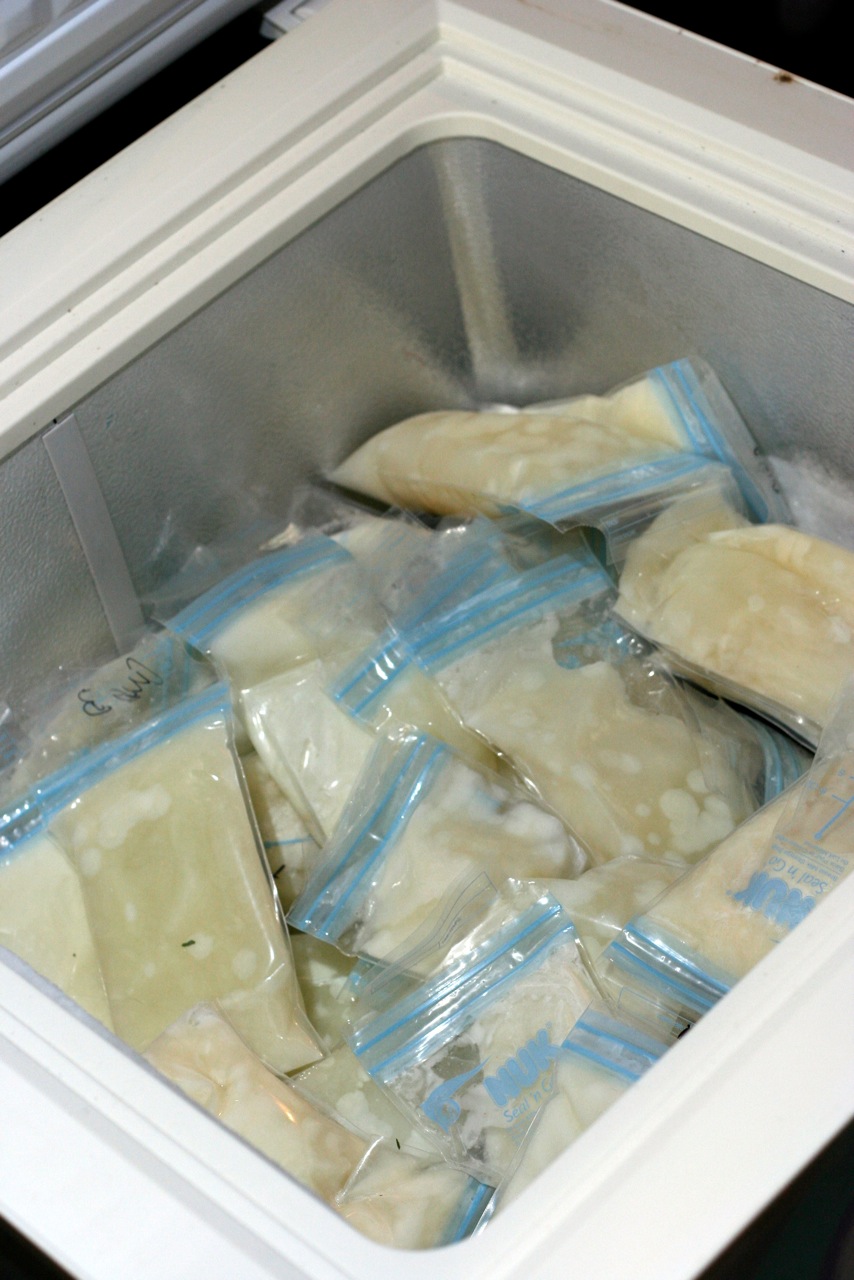
Our deep freezer piled high with donor milk
Breast milk storage bags!
My hubby is known to the local Greyhound employees as a human tissues guy - he collects frozen breast milk. I think we've used the company five times now to receive human milk arriving from out of town.

When Jacob was a few weeks old, a generous mom in Thunder Bay sent us her freezer stash. After a night of "sleep" with our newborn Ian went early in the morning to meet the incoming bus. We thought we were receiving the Holy Grail - this batch of milk would keep Jacob exclusively breastfed for his first month of life. We breathed a huge sigh of relief when we opened the cooler and saw that the milk was still frozen solid.

Shipping breast milk is obviously a time-sensitive endeavor. It also depends upon the milk being well-packed in a sturdy cooler, especially in the summer. If the amount is over about 500 ounces, there is no need to use dry ice, but in any case breast milk should be packed tightly. Any remaining air space in the cooler should be taken up by newspaper, foam, or other material. We always try to pick up shipped milk as soon as it has made it into town, although that sometimes involves a bit of convincing (shall we say prodding, even?) and educating about the importance and benefits of human milk.

Last summer when we were visiting Calgary, we asked friends back home in Winnipeg to ship us additional milk because Jacob had jumped into a growth spurt, quickly eating his way through what we'd brought with us. We struggled to reach the bus company on the phone, and when we did we were given an incorrect shipping schedule. In short, we realized at 6:40pm that the milk had already arrived and that the depot closed at 7pm. There was no way we would make it to the depot in time, but we got a friend who was closer to try to collect the milk for us.

"I can only release this package to Ian. That is, unless you have written permission from him to pick it up." Apparently the tracking number and confirmation via phone would not do.

My friend blurted out, "But this is breast milk for a very sick baby. It will go bad if we leave it here overnight. We have to get it into a freezer."

Of course, Jacob was fine, but we certainly didn't want to be tossing out spoiled breast milk the next day and feeding him formula. The woman gave up the parcel, and back at my friend's place we unpacked the milk to find it on the verge of starting to thaw.

More recently, we've been receiving breast milk from a prolific, amazing donor in Saskatoon and sharing the goods with several other local families in need. The bus from Saskatoon gets into Winnipeg at 9pm, exactly when the bus depot's counters close. Twice Ian has managed to convince an employee to keep one counter open just a little later.

"Well, how warm is your warehouse?" he asked the shipping guy.

"Does this stuff have to stay frozen or something?"

"Yes," he repeated, "It's frozen human breast milk. It will spoil if it thaws. You could help feed several babies tonight, you know!" Each time, the man at the counter relented and admitted that it didn't make much difference to him if he stayed open a few minutes longer - he had to be there still anyway.

Finally, this last time, one of the Greyhound employees saw Ian and said, "Oh, yeah, you're here for breast milk, right?"

He told Ian that they regularly keep a counter open late for a few doctors receiving samples and for the guys from Canadian Blood Services. How appropriate that, in the shipping world at least, breast milk is taking its place among other human medical necessities.


27 Feb 2012

A Bottlefeeding Guide?

I just finished reading a depressing, inaccurate, misleading book entitled When Breastfeeding Is Not an Option: A Reassuring Guide for Loving Parents by Peggy Robin. I happened to see it in my local public library and checked it out on a whim. The book was published in 1998 and I was dearly hoping that it is unavailable or out of print somehow, but I just looked on Amazon.com, and there it is...

Robin goes to great lengths to downplay the benefits of breast milk, saying she doesn't believe the studies that show formula-fed infants to be at greater risk of diabetes, allergies, and a whole host of other problems. She uses anecdotal evidence to support her claims, noting that of all the infants she personally knows about, the formula-fed ones are not any sicker than the breastfed ones - nya nya nya nya boo boo, so there, and take THAT fancy shmancy "science" (ok, so she doesn't exactly actually say that last bit, but you get the idea). How did this thing ever get published???

 Robin emphasizes and exaggerates the few physical problems in parents and babies that can cause breastfeeding to fail, and she claims that feeding with a supplemental nursing system (SNS) is impossibly difficult. If you can't breastfeed exclusively, then don't do it at all, is her message. This is the exact opposite of Diana West's gentle and encouraging advice in Defining Your Own Success: Breastfeeding After Reduction Surgery. West insists that any amount of breast milk is beneficial and something to be cherished. As the proud user of an SNS for the past ten months, I must argue that after an initial learning period, it is really not so bad, and it does save the breastfeeding relationship. And to me it is worth any kind of effort to give my baby even a teaspoon of my own body's milk since it is exactly right for him.

Of course, Robin makes no mention whatsoever of the possibility of finding donated human milk if the parent's own milk supply is insufficient. Instead, she moves quickly to praising the ease and complete nutrition of formula (because you'd never heard of it before, right?).

Robin cites many bottlefeeding parents who have felt personally attacked by "breastfeeding militants." I am very sorry for anyone who has been given a rough time for his/her feeding choices. We should never make assumptions about why someone may not be breastfeeding or what he/she may have been through. Furthermore, in our culture we cannot blame individuals for low breastfeeding rates across North America - there is too much wrong with hospital care, breastfeeding support, and attitudes in general. Many parents don't get breastfeeding figured out, and this is a shame, but the last thing we need to remedy the problem is a bottlefeeding support guide.

19 Feb 2012

Blog Review: Free Range Kids

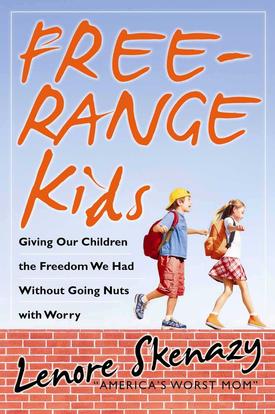
Cover of Free Range Kids
A friend told me today about Lenore Skenazy's blog, Free Range Kids.  I'd heard already a few times that various experts feel that children today do not have enough opportunities for unstructured, outdoor play. I'm personally alarmed to hear the shopping list of activities in which my neighbour's kids are required to participate - cross-country skiing, Ukranian dancing, horse back riding, piano, violin, biathlons, and every other sport or art you can think of. These kids love Jacob and are always wanting me to bring him over for a visit, but typically when I ask their Mom, the answer is, "well, today's no good, and neither is tomorrow, but I think two weeks from Friday you guys could come over for half an hour although it'll be a bit tight."

So, I was happy to peruse Skenazy's blog and see if she had any great ideas for how to give today's kids a more generous dose of unsupervised play. I wondered though, if the topic could really be worth blogging about. Do you actually have to do anything special, or is it more that you need to not do a few things and allow your kids to play on their own?

Skenazy argues that modern parents are terrified of letting their school age children out of sight. She blames much of this fearful attitude on the media and TV dramas that hype up child abductions. She coolly provides some data showing how American cities are in fact safer than they were a few decades ago, and suggests that we give our kids more independence so that they can grow up learning how to make their own decisions and run their own lives. All this sounds fine to me.

Skenazy loses me though, when she says that we needn't try so hard to be superparents, for example, by breastfeeding our babies. She writes,

 "80% of moms are using some formula by the time their children are 6 months old. That’s a lot of guilt about something very common and not harmful. A lot of parents today (including me) were raised on formula. It’s not rat poison."

Just because you're doing something very common doesn't mean it isn't harmful. Many people smoke, yet smoking is harmful. Many people spend too long at their desks, yet leading a sedentary life is harmful. The fact that 80% of people are failing to provide their babies with biologically normal food ought to be a serious wake-up call.

I agree with Skenazy that those who have ended up bottlefeeding their babies formula should not feel guilty over it. Breastfeeding is hard in a society where so few people practice it for a decent length of time. But this doesn't make bottlefeeding an acceptable choice for the majority of babies.

I am eternally grateful for all the support that I've received that has made it possible for me to breastfeed despite being a transgender man with virtually no breast tissue. During Jacob's first two days of life, my close friend and La Leche League Leader came over to our house to check on our latch about four times. She was also available by phone at any time, day or night. And it is now a total of more than twenty remarkable women who have donated breast milk so that Jacob can have the kind of food his little body fully expects and deserves. I wish that this wasn't an unusual or special or lucky or particularly fortunate situation to enjoy in this society of ours, but it really is. I am deeply appreciative, though I don't think I'm a superparent for being able to latch Jacob onto my chest. I'm feeding him in the most biologically normal way I can, despite the chest surgery that was part of my transition. And if I am capable of doing this, then anyone, with the right information and support, is too.


22 Nov 2011

"Good Thing He Takes Formula!"


My baby, Jacob, has been completely breastfed since his birth seven months ago. He is beginning to eat a few solid foods now, but he has never tasted formula. To make this happen, my partner Ian and I spent (and continue to spend) countless hours tracking down donors, driving all over town picking up milk, and meeting breast milk shipments at the Greyhound bus depot. We do this because we want the best for our little guy. So far, Jacob has had my milk as well as the breast milk of sixteen extremely generous women.

We often meet people who don't value breast milk anything the way that we do. Yesterday, for example, we ran into somebody I'd met a few months before at a local play group. In the course of normal chit-chat, she happened to ask me something or other about bottle feeding Jacob at night. I gave her a quizzical look and said that our baby was entirely breastfed. Then I realized that perhaps I'd never told her that I was transgendered. I know that my personal history is fascinating and highly memorable to most people, but it is also my normal life that I live every day. I don't always bother to mention it, and sometimes I just can't recall if I've come out to someone in particular or not. I quickly explained myself to this woman using my usual spiel. "I was born female, transitioned by taking hormones... I make some milk myself... we use a supplemental nursing system, know what that is?"

She caught herself up remarkably quickly, hardly missing a beat. She said we should get together some time soon, and I agreed. But then she said the unthinkable. "Yeah, my guy gets mostly the breast. Luckily he takes formula though, so his Dad can feed him too. I mean, I could pump my milk but I don't want to feel like a COW! My first would never take formula. Ugh, that was difficult. Sure glad this one does."

Black and white cow looking into the camera
Cow's milk is designed for baby cows; human milk is for baby humans.


I responded, "Well, I guess it tastes different, doesn't it?"

"Oh yes, formula tastes pretty gross while breast milk is so sweet."

I tried not to let my jaw clank too loudly when it dropped all the way down onto my chest. If only this woman had any idea the way that we search, scrounge, and beg for breast milk for our baby. She could just pump some out if she wanted her boy to have breast milk when she's gone, but formula is easier, so she doesn't.