Showing posts with label SNS. Show all posts

31 Oct 2012

Using an At-Chest Supplementer

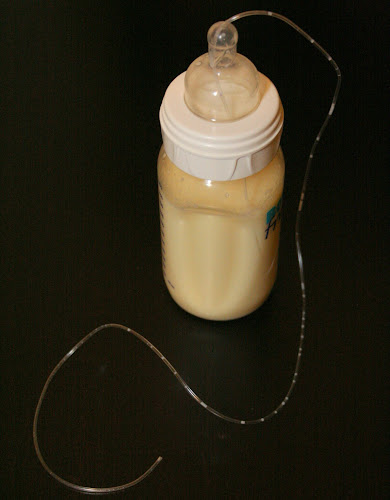
Homemade at-chest supplementer consisting of a bottle, nipple and tube.
Making an at-chest supplementer is easy and cheap.
Note that this post is not medical advice. I am sharing here what I have learned through personal experience. If you are concerned about your baby's health, seek help from a doctor.

Using an at-chest (at-breast) supplementer is a great way to feed your baby if you are unable to produce all of the milk he or she requires. This method is completely supportive of the nursing relationship, and does not involve your baby latching on to any artificial nipples, such as bottle nipples. As wonderful as it is, this kind of supplementer can be brutally hard to use at first. I've been using one for over eighteen months, so I'll share some tips!


First, let me explain what it is. All the different versions consist of a container to hold the supplement and a long, narrow tube. One end of the tube goes into the supplement, and the other end is placed right by your nipple. Your baby latches onto both the tube and your nipple simultaneously, drawing supplement from the container and getting all the milk that you are producing, too.


What's great about it? Using an at-chest supplementer allows you to do all feedings at your own chest. This is amazing for your nursing relationship and all the bonding that comes with it. It's also important for promoting normal jaw development in the infant - the physical action of chestfeeding develops a baby's muscles differently than bottlefeeding does. Using the supplementer helps you produce more milk, too, because even at times when your baby is only receiving supplement and you are not producing any milk, your chest tissue is being stimulated to make more. For those who produce little to zero milk, using the supplementer makes it possible to still have a nursing relationship.

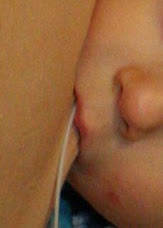
Jacob latches with the supplementer near the corner of his mouth.
How do I get one? You can buy a commercial supplementer, or you can easily and cheaply make your own. I prefer the homemade kind, so that's what I'll describe first. You can use any baby bottle to hold your supplement. Get gavage tubes from a pharmacy, or in bulk from a medical supply store. The kind to look for is 5 French (that's the diameter), 36 inches in length. You might want a tube with a bigger diameter if your baby has a weak suck, a complication of some conditions such as cleft palate or prematurity. Using a shorter tube is super irritating because it forces you to hold the supplement container so close to your baby's mouth (who has enough hands to do all that?!). Cut off the extra plastic bits, if there are any, on one end of the tube. The other end will be closed and rounded and will have two or three holes just before the tip - I cut off this part too because otherwise the supplement doesn't seem to come out easily. Some don't do this because they believe that cutting this end makes the tube sharp (we never experienced a problem with this). Thread one end of the tube through the bottle nipple (expand the opening of the nipple with a knife if required) so that it is sitting in the supplement. To clean the tube after use, just suck some hot water through it. Do not boil this kind of tube - it is not made from materials designed to withstand such a hot temperature.

The main difference between the homemade and commercial systems is cost. The Lact-Aid is $48.75 or $62.50, depending on whether you get the deluxe or standard model. The Supplemental Nursing System (SNS), made by Medela, was $42.99 on Amazon when I checked at the time of writing. It should be noted that Medela is a company that violates the World Health Organization's code on the marketing of bottles and artificial nipples. Unfortunately, its product name, SNS, is often incorrectly used as a generic name for a supplementer. You can make your own supplementer for the cost of any baby bottle and nipple and a $5.00 gavage tube. If you use this system in the long-term, you will end up spending a fair bit on tubes. They can be bought in bulk for about $1.00 a piece, and most people replace them once per week (or when they get too stiff to use) - so, you could spend $52 on tubes if you use the homemade supplementer for one year. I've been told by several people who used an SNS or Lact-Aid for over a year that both systems hold up very well to wear and tear and rarely need replacement parts.


With both the SNS and the Lact-Aid, the supplement container hangs around your neck. I like my homemade version because I can put the container down beside me on a table or hold it between my knees - I hated the idea of something relatively heavy dangling from my neck. I also like being able to have a decent amount of supplement on hand. The containers of the SNS (re-usable) and Lact-Aid (disposable bags) are smaller than most baby bottles. My number one reason for using my homemade version is that it is simpler - it has only three parts (bottle, nipple, and tube).


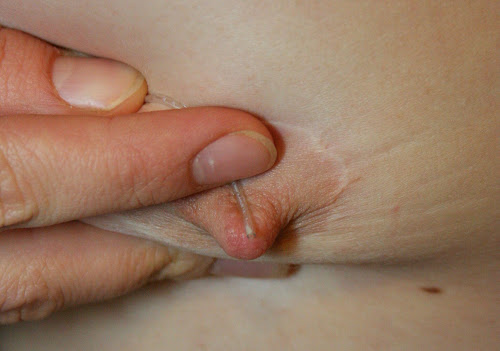
I mould my chest tissue using my middle finger and thumb, and position the tube with my forefinger. End of tube is in line with the end of my nipple.
Moulding the chest tissue and positioning the tube
How do you actually use this thing?? Some people latch the baby on first, and then sneak the tube in through the corner of the baby's mouth by moving a bit of breast tissue gently out of the way. This never worked for me. I have so little chest tissue that if I moved any part of it, my baby would lose his grip immediately. A downside of this method that a friend of mine learned the hard way is that it may become impossible to sneak the tube into your baby's mouth once he or she has teeth getting in the way.

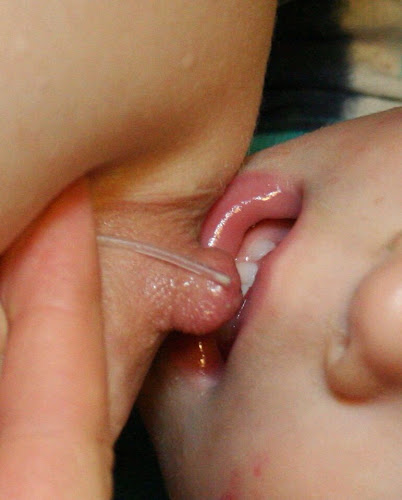
There's a lot to have to juggle between latching your newborn and placing a tube. This is how I do it: I get my baby in position and latch him first without the tube (otherwise he gets too antsy waiting for me to have everything ready). Then I take the end of the tube and get it near the end of my nipple. I briefly un-latch my baby. I use my thumb and middle finger to mould my chest tissue into a shape that my baby can latch to, and use my index finger to position the tube so that the end of it is in line with the tip of my nipple. The tube comes from above my nipple so that it points to the roof of my baby's mouth when he latches. I slip my index finger out of the way just as he is latching on and then I hold the tube in place for an extra second or two until the supplement is flowing up the tube. Some people tape the tube to their chest, but this didn't work for me. The tube would always flip in the wrong direction when I tried to mould my chest tissue for my baby to latch.

Immediately before latching, Jacob's mouth is open and the tube is already well-placed.
About to latch
Using a supplementer is initially very challenging. I couldn't position it on my own for the first two weeks! My partner had to help me with every single feeding until I developed this method of doing it on my own. It helped when my baby's latch became stronger. Nowadays, at eighteen months, I don't even think about it. My baby latches himself on, and I know exactly where the tube needs to go so that the supplement will come up easily.

Have you used a supplementer? Do you have any additional tips to share that we should know about?

10 Jun 2012

Petition to Ease Restrictions on Breast Milk in Carry-On Baggage

Last week we packed up yet again and got ready to make our trip out west to visit our relatives. We don't have any family in Winnipeg, but we believe it is very important for our child to have a strong relationship with his grandparents. So, as much as I hate it, we fly frequently.

We took along several bottles of donated breast milk in a cooler, as well as an ice pack. At security, they asked to open up our cooler as usual. All seemed normal. And then came the question, "But how old is your baby?"

"He's thirteen months."

"Oh, ok. This is fine. Go ahead."

The exchange seemed simple enough, but suddenly left me wondering, is there an age at which I won't be able to bring milk along for my baby? Is thirteen months ok, but say, eighteen months too old? Why did they ask my baby's age?

We rely upon donated breast milk to feed our baby. I nurse him using an at-breast supplementation system, and am able to enjoy a satisfying breastfeeding relationship as a result. I would like to keep breastfeeding my child as long as he needs it. Since the World Health Organization recommends breastfeeding for two years AND BEYOND, I am and will continue to be grateful for human milk donations. If and when we are no longer able to find donated human milk, we will probably move to using whole goat's milk in the supplementation system. Goat's milk is closer to human milk than cow's milk is, but it is probably not commonly available beyond airport security.

During our stay in Vancouver, I looked up the rules. In Canada, you may only bring extra liquid aboard a flight for a child UNDER the age of 2. So, I decided to start a petition on change.org. Please sign it and share widely!

http://www.change.org/petitions/canadian-air-transport-security-authority-ease-restrictions-on-breast-milk-in-carry-on-baggage#

"Canadian parents using expressed breast milk currently face greater restrictions when flying with their children than do their American counterparts. Only passengers traveling with infants UNDER the age of 24 months may bring aboard more than 100ml of liquid per container, inside a 1 litre plastic bag. Women traveling without their babies are not permitted to bring their expressed milk on board. Those traveling with children above age two are not exempt from restrictions on liquids.

"The World Health Organization recommends breastfeeding until age 2 AND BEYOND. For those parents who must express their milk and bottlefeed, or who use donated milk and an at-breast supplemental nursing system, carrying liquid on their persons is a must. Why should the Canadian Air Transport Security Authority decide at what age a child no longer needs breast milk, especially during potentially stressful travel?

"Passengers traveling without their babies should also be allowed to carry their precious breast milk rather than pump and dump. Breast milk, known in the birth world as "liquid gold" for its important health benefits, should be exempt from the usual restrictions on liquids.

"In the US, breast milk is treated as liquid medication and passengers may carry it on board in quantities greater than 3 ounces WITH OR WITHOUT A BABY OR TODDLER PRESENT. Sign this petition and tell the Canadian Air Transport Security Authority to start valuing breast milk as vitally important nutrition for babies and children!"

http://www.change.org/petitions/canadian-air-transport-security-authority-ease-restrictions-on-breast-milk-in-carry-on-baggage#


11 Apr 2012

Lactation Education: Age Four

My friend Ana and her four-year-old daughter, Lucy, visit us every week. We share food, the kids play with toys, and Ana and I always end up talking about breastfeeding at some point. Usually Ana and Lucy stay long enough that eventually Jacob wants to nurse, even though these days he mostly just likes to crawl about and play when we have guests over. Still, Lucy has seen me using the supplemental nursing system fairly frequently. Her Mom told me this story the other day:
Girl nursing her doll on a red couch.
At home, Lucy found a tube somewhere-or-other, and put the end of it in a bottle. Then she placed the other end of the tube next to her nipple, and proceeded to nurse her doll. Her Mom asked, "Oh, are you feeding your baby with an SNS?"
"Yes, I don't have enough oppai, so I'm giving my baby oppai but there's pumped milk in the bottle, too, see?"
I have no doubt that if Lucy has her own children, it will be second nature to her to breastfeed them. If she turns out to be one of the very few people who truly cannot make enough milk, she'll know that by using a supplemental nursing system she can feed her baby at her breast and maintain a satisfying nursing relationship. Even that will be second nature to her, too. And, of course, she'll know to ask her nursing friends if they might be able to donate some pumped milk for her baby.
This is why we must defend not only the right to nurse in public, but also the right of our children to see all kinds of people nursing in public.
*oppai is the term Lucy uses for nursing. It comes from the Japanese.

24 Mar 2012

Newborn Bliss All Over Again

A few days ago I enjoyed a most powerful deja vu with a teeny tiny baby. I can still see her little mouth gaping wide open searching for my nipple as she tries again and again to latch. Her hands make tight fists that press into my chest, pushing herself away from my nipple, and away from what she wants so desperately - the food source. Not having much, if any, breast tissue to accommodate her limbs, I gently move her arms out of the way to bring her lips in contact with my nipple. In hunger, she puts her finger in her mouth at the same time as my nipple. Again, I move her hand out of the way. Absolutely everything in her life is about wanting to suckle and swallow.
I nursed Lila using a supplementer.
Lila doesn't care that I'm transgender - she just wants to breastfeed.
And then I feel her finally grab hold and not let go. The pull of her lips is strong and determined, yet precarious. I don't dare move my arms for fear of unlatching her. I hear her rhythmic, satisfied gulping and know that I am the centre of her universe. Nothing can distract her from her desire to breastfeed. She doesn't know or care that I'm a transgender guy using a supplemental nursing system and donated breast milk. I share in her bliss.

Then my back starts to ache from the stiffness of my pose. I look at the clock and see that forty-five minutes have gone by and she's only taken an ounce or two. Those newborns take forever to eat! She sleeps for a brief few minutes and then is ready to nurse yet again. Now I remember the sheer exhaustion of the early weeks. Still, my day spent with this seven-week-old was a gift.

My friend had called us around 10am that morning to say that she was feeling very ill. Ian picked her up and brought her to the hospital. He took her infant, Lila, and toddler, Samuel, to our home where I was entertaining a number of friends and their babies. It turned out that the poor sick mom had appendicitis and would spend that night and the following day in the hospital.

First we tried to bottlefeed our tiny charge, but she choked and gagged on the fast-flowing milk. Then my friend Emily attempted to finger-feed her with an SNS tube - sometimes it worked, other times the milk wouldn't flow at all.

In the afternoon, Ian walked Lila over to the hospital to be nursed by her mother in the emergency waiting room. He suggested that I could breastfed Lila the next time around, and my friend agreed. So, a few hours later, after a failed attempt at finger-feeding, I did what was easiest for everyone and nursed the babe.

Breastfeeding Lila was beautiful and joyful, and also brought up some anxiety for me. I have so little breast tissue that latching on a baby takes tremendous focus and determination from both parties involved. Today I am suddenly in awe of myself for having done it, day in, day out, and never, ever giving in to a single bottle feeding when Jacob was little. And I got a good reminder this week of WHY I did it: even with all my specific challenges, nursing was obviously a happier and more comforting experience to Lila, who surely must have been missing her mother.

My own Jacob is almost a year old, and I breastfeed him with ease. He crawls into my lap, pulls my usually open, button-down shirt out of the way, and latches on by himself whenever he wants. If he seems tired, or upset, or out of sorts, or even if I'm just sick of running after him and badly want to sit down for a few minutes, I get out the SNS and nurse him. I wish that more people knew about the pleasures of nursing an older baby or toddler. Gone is all that intensity and effort of feeding a newborn, and what is left, for us anyway, is a comforting, easy relationship.

After my friend received her diagnosis and a surgery was planned for later in the evening, her husband came over to pick up their kids. Lila was full and fast asleep, and Samuel, the toddler, grinned from ear to ear at the sight of his Dad. We were thanked profusely, but in all honesty I just about feel guilty: I got to nurse a precious, heart-melting seven-week-old baby and hang around with her sweet, surprisingly helpful toddling brother while their Mom was dealing with a ton of pain. I'm pretty sure I got the long end of the stick on that one.

5 Mar 2012

Tips for Transgender Breastfeeders and Their Lactation Educators

 This information is free for personal use. Any trans folk are welcome to print it out and give a copy to their health care provider! However, if you wish to publish any part of it or quote this material in a presentation you must obtain formal permission. Thanks!

I'm not a health care professional and this blog entry does not constitute or replace medical advice. Please consult your doctor if you need medical advice. 

**** This blog post has been updated and now comes in three parts: 1) general information 2) assisting trans men 3) assisting trans women

Transgender/transsexual/genderfluid Tip Sheet - General Information
Prepared by Trevor MacDonald

This tip sheet provides some key details you should be aware of when offering reproductive/lactation support to transgender, transsexual, or genderfluid individuals. Keep in mind that in most ways, medically and otherwise, trans people are just like everyone else. There is a list of key terms and their definitions at the end of this sheet. 

Gender vs. Sex

Our reproductive organs and sexual anatomy define our physical sex - male, female, or intersex. Gender, however, is a person's inner awareness of their femininity/masculinity. Gender expression has to do with how an individual presents their gender to others within a given cultural context. For example, within western culture the colour pink has gone from being a traditional boys' colour to one for girls in only a few generations.

In most cases, a persons biological sex conforms to their gender and gender expression. The term for such people is cisgender. Transgender, transsexual, and genderfluid people have a gender identity or gender expression that does not match what their particular society expects of them according to their anatomy. Some trans people choose to use medical therapies such as hormone treatments and/or surgeries to alter their bodies. Others do not want or are unable to obtain such interventions, but may express their gender in other ways such as choices of clothing or makeup.

Gender Identity vs Sexual Orientation

A person's gender identity has to do with how they self-identify. Their sexual orientation refers to what kind of person they are sexually attracted to. A person can be trans and gay, or trans and straight, or trans and bisexual, etc.

Asking Questions

It may be essential to ask questions regarding an individual's gender identity or history of medical transition in order to provide adequate care. However, only ask those questions that are relevant. Do not ask questions solely out of curiosity.

Language

Always use the pronouns that refer to an individual's expressed gender, not their assigned birth sex. For example, a male-to-female transsexual woman is 'she'. If you are unsure of which pronouns a particular individual may prefer, simply ask in a respectful manner. If you make a mistake, apologize promptly and move on. Some people prefer gender-neutral pronouns, such as 'them' and 'they' or 'ze' and 'zir'.

The following terms are derogatory. Do not use: tranny, he-she, she-male, gender-bender, or transvestite.

Do not refer to someone 'masquerading', 'pretending', 'disguising', etc. in their gender.

Use transgender as an adjective, not a noun or verb.
            He is a transgender person, not "He is a transgender." (similar to how it is best           to say             "He is a black person", rather than "He is a black")
            A person is transgender, not transgendered. It is never necessary to add the suffix 'ed' to transgender.

Common terms

*Note that these definitions explain how the following terms are generally understood. However, individuals within the trans community may define them differently or may self-identify outside of these labels.

cisgender: someone whose gender identity matches their assigned birth sex (they are not transgender)

FtM: female-to-male trans person

MtF: male-to-female trans person

gender binary: The notion that there are two genders, male and female. Many trans people understand gender as a spectrum. 

gender expression: a person's outward presentation of their gender through physical traits, clothing, makeup, etc.

genderfluid/genderqueer: someone who identifies between or beyond the extremes of female and male on the gender spectrum, or who identifies as both female and male at once or as some combination of genders.

gender identity: a person's inner sense of their gender.

intersex: a condition in which an individual is born with reproductive and/or sexual anatomy that does not fit the usual male or female definition.

trans: an umbrella term meant to include transgender, transsexual and genderfluid people

transgender: a person whose gender identity or expression does not match the typical societal expectations of their birth-assigned gender. Transgender people may or may not wish to modify their bodies to varying degrees by taking hormones or having surgery.

transition: a change in one's public gender identity (one's inner gender identity may have been the same since birth).

transsexual: a person whose gender identity does not match their sex as it was assigned at birth. Transsexual people usually wish to modify their bodies in order to alleviate this incongruence.


Tip sheet for assisting trans men

Trans men are individuals who were born with anatomy typical of females but identify on the masculine side of the gender spectrum. Some choose to give birth and/or nurse their babies, and may require lactation support.

Language

Although both men and women have breast tissue, the word 'breast' is most often associated with women. Trans men may be more comfortable referring to their 'chest' and 'chestfeeding' or 'nursing' their infants, rather than 'breastfeeding'. Trans men may refer to themselves as 'dad', 'papa', or another term, rather than 'mom'. Don't make assumptions. Remember that if you are unsure, it is best to ask about which names and pronouns an individual prefers to be used. If you make a mistake, apologize promptly and move on.

Testosterone Use

Many, but not all, trans men choose to take testosterone. Testosterone normally causes the cessation of menstruation and ovulation, and brings about male secondary sex characteristics such as deepening of the voice, growth of facial hair, and male pattern baldness.

When a trans man stops taking testosterone, his cycles are likely to return after several weeks or months, depending on how long he took the medication and his own physical particularities. However, most of his male secondary sex characteristics will remain. For example, once testosterone has stimulated the growth of hair follicles in a person's face, those follicles will stay there and hair will keep growing unless extensive electrolysis treatments are undertaken (a common element of male-to-female individuals' transitions).

Although very rare, some trans men have been known to become pregnant accidentally while taking testosterone. Testosterone is highly toxic to the fetus and should never be used during pregnancy. However, because the body metabolizes and clears testosterone rapidly, it is considered safe to conceive within a few months of discontinuing most forms of testosterone therapy.

Testosterone use during the period of lactation would likely interfere with the hormones required to produce milk and achieve let-down.

Top Surgery

Some trans men choose to have male chest-contouring surgery, also known as 'top surgery'. This is different from a mastectomy (a cancer treatment), or a breast reduction, which is performed to make a smaller but still female chest. The goal of top surgery is to create a male-appearing chest. In order to do this some, but not all, of the client's mammary tissue is removed. Complete removal of the mammary tissue would result in a sunken chest shape.

The preferred surgical technique for top surgery is variable, depending on factors such as volume of tissue and skin elasticity of the client. The 'double incision' technique usually involves nipple grafts, and is not ideal for maintaining nipple sensation nor preserving milk ducts. The 'peri-areolar' approach, with incisions that go around the outer borders of the areolae, leaves the nipple stalks intact and likely has better results in terms of future breastfeeding and milk production.

Binding

A trans man who has not had top surgery may choose to bind his chest in order to flatten it, thereby managing his gender dysphoria. Many years of binding may adversely affect the glandular tissue. Binding during the immediate postpartum period will increase the risk of blocked ducts and mastitis and may damage the milk supply. However, some individuals have had success with occasional, careful binding once the milk supply is well established and regulated. Anyone who practices binding during the lactation period should be advised of the risks of doing so, and should monitor the health of their chest closely.

Chestfeeding Goals

Some trans men who give birth do not want to chestfeed at all, in some cases for reasons to do with mental health. Others do, and opt to postpone desired top surgery so that they will be able to produce a full milk supply. Others who have had top surgery may still wish to develop a nursing relationship and may do so using an at-chest (at-breast) supplementer.

Gender Dysphoria and Chestfeeding

Gender dysphoria occurs when an individual feels discomfort due to parts of their body that do not match their gender identity. Growth (or re-growth after top surgery) of chest tissue during pregnancy may bring up extreme feelings of gender dysphoria in some individuals, possibly causing anxiety or even depression. Chestfeeding can do the same. For this reason, deciding to chestfeed is a very personal choice.

Supporting the Decision NOT to Nurse

Support an individual who has chosen not to chestfeed by sharing how he can quickly reduce his milk supply after the birth. Explain the supply and demand system that governs lactation. Encourage the client to remove only as much milk as necessary to feel relatively comfortable, since removing more milk will cause the body to increase production. Cold compresses and cold cabbage leaves may help reduce pain and swelling. The parent should NOT bind at this time due to the increased risk of pain, blocked ducts, and mastitis. Several herbs such as sage, peppermint, and parsley are said to decrease milk supply.

Discuss the many other ways of bonding with baby, such as bed-sharing, babywearing, and loving, attentive feeding. You may wish to let the client know about the possibility of obtaining human milk through milk sharing sites such as Human Milk 4 Human Babies or Eats on Feets.

Supporting the Decision TO Nurse

Be respectful when providing hand-on care. As in most health care situations, ask permission before touching an individual's body, explaining what you are planning to do and why. If an individual is not comfortable being touched, find other ways to help, such as demonstrating on yourself.

Watch for signs of postpartum depression. Trans individuals may be particularly at risk due to struggling with gender dysphoria in addition to the usual challenges of giving birth and caring for a newborn.

When assisting those who wish to chestfeed after a previous top surgery, it is essential to remember that nursing a baby is not only about the milk. An individual who has had surgery may produce a surprising amount of milk, or only drops, or nothing at all. Any amount of milk is valuable. By using a supplementer, the parent and baby can gain the benefit of bonding through a nursing relationship even in the absence of milk production. In addition, the action of nursing helps promote the normal development of the jaws and teeth in the infant.

Latching may be challenging for the parent who has had previous top surgery due to a relative lack of pliable tissue and skin. The parent may need to learn how to vigorously mould the chest tissue (make a 'sandwich'). When providing assistance, be creative and expect to try many different grasps from varying angles in order to find what works.

A reclining position may unfortunately cause the chest tissue to become even more taut and difficult to latch to. In this case, football hold or cross cradle may be easier.

Support Meetings

Encourage the trans breastfeeding parent to attend group meetings and ensure that a safe and positive environment is provided. We know that peer support is an important predictor of a parent's success achieving their personal breastfeeding goals. Trans parents may already feel isolated, especially if they do not know other LGBT families. Group meetings can be tremendously beneficial.

Those facilitating the meeting should know the location of a men's washroom or gender neutral washroom near the meeting room. They should use gender-neutral language such as "breastfeeding parent" instead of "mother" when addressing the group.

Other Support and Resources

The community of trans individuals interested in birth and various infant feeding methods is growing fast. At this time, the only online support group is the Facebook-based Birthing and Breastfeeding Transmen and Allies, with over 500members worldwide. The group includes many interested and supportive lactation consultants and LLL Leaders.

Toronto's LGBT Parenting Network runs a weekend course once every few years for transmasculine individuals considering pregnancy.

Diana West's book, Defining Your Own Success: Breastfeeding After Reduction Surgery, contains information relevant to trans men who have had top surgery. Also see her web site, bfar.org.


Tip sheet for assisting trans women

Trans women are individuals who were born with anatomy typical of males but identify on the feminine side of the gender spectrum. Some trans women may wish to breastfeed their children via induced lactation and/or using a supplementer.

Inducing Lactation

Trans women may induce lactation by following the Newman-Goldfarb protocol. A physician would need to prescribe the appropriate medications. Birth control pills should be started about six months before the baby is expected or as soon as possible. Domperidone is also suggested in the protocol. 6-8 weeks before the birth, the birth control pills should be stopped, and the woman should begin pumping frequently to stimulate glandular tissue and to remove milk. The domperidone is normally continued for the duration of the lactation period.

A trans woman should discuss with a physician, such as a reproductive endocrinologist, what kind of hormone treatment is best to take during lactation. Unfortunately, there has been little to no research done in this area. Some trans women have successfully taken a decreased dose of their usual estrogen while lactating. Any medications, such as anti-androgens or estrogens, should be carefully considered for safety during lactation on an individual basis.

Expectations

Some trans women have induced lactation with impressive results, providing nearly a full supply to their babies. The amount of milk that is produced will depend somewhat on how many years the women used hormones prior to inducing lactation, and how fully her glandular tissue developed during that time. If the woman had implant surgery, she may encounter some difficulty with severed ducts, damaged nerves, compressed glandular tissue, and/or scarring.

As is the case with chestfeeding trans men, the amount of milk that is produced is not as important as the nursing relationship itself. An at-breast supplementer may be used to support a nursing relationship.

Support Meetings

Encourage the trans breastfeeding parent to attend group meetings and ensure a safe and positive environment is provided. We know that peer support is an important predictor of a parent's success achieving their personal breastfeeding goals. Trans parents may already feel isolated, especially if they do not know other LGBT families. Group meetings can be tremendously beneficial.

Resources and Further Information

"Trans Women and Breastfeeding: A Personal Interview" by Trevor MacDonald, available at http://www.milkjunkies.net/2013/05/trans-women-and-breastfeeding-personal.html.

"Trans Women and Breastfeeding: The Health Care Provider" by Trevor MacDonald, available at http://www.milkjunkies.net/2013/07/trans-women-and-breastfeeding-health.html

Facebook-based Birthing and Breastfeeding Transmen and Allies group welcomes trans women interested in nursing their infants.

Diana West's book, Defining Your Own Success: Breastfeeding After Reduction Surgery, contains information relevant to trans women who have had breast surgery. Also see her web site, bfar.org.