Showing posts with label at-chest supplementer. Show all posts

5 Apr 2017

Parenting Survival: When My Toddler Can't Sleep

The Toddler was up at 2am so we went out to listen for frogs. Unfortunately, the frogs in the ditch seemed to be fast asleep. We settled for waking up all the animals in the barn. We got the rooster crowing nicely and the goats got up to pee and poop. Then we turned off the barn light and went out again, leaving them all wide awake. None of it woke the frogs.

Inside the house, we cooked plantain because the Toddler was famished. 
 
Toddler: Friends X and Y were here, but not right now.

Me: No, not right now. You know why?

Toddler: X and Y are sleeping!

Me: YES!!!

Smiles and cuddles. Yawn.
 
ALL this started because Toddler woke up wanting to nurse and in my groggy state I didn't notice that the damn supplementer tube was pulled out of the water and not working, which led to much screaming. Not your average breastfeeding problems, yet somehow I am certain every parent has been there done that in some similar fashion.

Now she has nursed back to sleep and is using my belly for her pillow.

Supplementer? Toddler? Yes. After relying on it heavily when she was an infant, we just have not been able to shed the tube. It is part of our nursing relationship, even though the "supplement" is water. She is about the best hydrated kid I know, and I suspect the water is alright for her teeth, too.

11 Feb 2013

Using a Supplementer Long-Term

I've been thinking about this post for ages and was finally inspired to sit down and write it when someone asked me for advice on the matter. So, thank you for the question!

On demand, supplemented nursing sessions with a newborn or young baby seemed obvious enough. When Jacob was hungry, we fed him. When he wanted more, we gave him more. I almost always used supplement during our nursing sessions.

When we introduced solid foods, we assumed that food would take the place of some of the donated breast milk we were continually struggling to find. To our surprise and dismay, it didn't seem to work that way. Jacob took a long time to really get good at eating solids, and even once he did, he never seemed to want any less milk. I sometimes tried to nurse him without using supplement, but he strongly preferred the fast flow that he was used to. Some people suggested not using supplement at night, yet I found that if I didn't he would get increasingly frustrated until he was wide awake. If I used the supplement, I could get him back down to sleep much more easily in the middle of the night (not that it has ever been easy, per se...).

I casually asked friends what they thought I should do, and several pointed out that if a parent with normal milk making capacity nurses frequently, he or she will continue to produce plenty of milk even as the child gets older. In contrast, a La Leche League Leader explained that as the baby gets older, the parent's milk supply naturally decreases. Others noted that babies who were bottlefed typically still get, even as toddlers, a large bottle of milk before going to bed and another one for nap time.

Around the time I was trying to figure out how to proceed, I saw a post in my parenting group from a mom of a 14 month old baby. She was newly pregnant, and her milk supply had disappeared. Her 14 month old still badly wanted to nurse, but this was painful for the mom. They went through a challenging weaning process and the mom started giving bottles of donated breast milk. Her child needed both the milk and the nursing relationship, but it was not possible for her to give. They did the best they could under the circumstances.

I know of another parent who, like myself, is breastfeeding after having had chest surgery. She makes enough milk to have the occasional let-down, but does not have a full supply. Her toddler is two and a half years old and nurses a lot AND gets a significant amount of milk in bottles. Early on, they used a supplementer, but they eventually got to a point where the child no longer wanted it. Their nursing relationship is still very strong.

In another example, the parent of a friend of mine used a supplementer due to her diagnosis of insufficient glandular tissue (IGT), and continued nursing until her child was three. As a toddler, the child would ask for "big milk" when she wanted to nurse using the supplementer, and "little milk" when she wanted to bare nurse. Given the variety of stories I'd heard, I decided to just keep doing what we were doing, since it seemed to work okay for both of us. We switched to putting cow's milk in the supplementer when we could no longer get donated human milk, with no apparent ill effects.

The issue came up again last fall when Diana West came to Winnipeg for a conference. She is the author of Defining Your Own Success: Breastfeeding After Reduction Surgery, and, of course, she is an expert on at-breast supplementation. She stayed with us for a few nights, and was shocked to see just how much supplement we prepared to take to bed with us in the evenings. I felt so busted! If I remember correctly, the much-admired breastfeeding authority said that Jacob doesn't need much milk at this point - it is the nursing relationship that he wants and needs. She reminded me that he was getting some milk from me. She also enthused about how much easier my life would become if I no longer needed to carry supplement around on outings or take it with me to bed at night.

I tried harder this time to wean ourselves from our crutch, but with the same result as before. If I didn't use the supplement, Jacob would quickly get frustrated. The universal and incredibly irritating toddler habit of nipple twiddling got infinitely worse (not surprisingly, this is something babies do to try to get a let-down!), and I again couldn't get him back to sleep at night. To add to the troubles, nursing without much coming out was quite uncomfortable for me, too. Jacob will be two in April, and this is where things stand: we still use lots of supplement at night, during naps, and to re-connect at other points during the day. Sometimes we go on outings without it and I nurse him as needed, but often I take it along for back-up, and then don't end up using it.

As Jacob's vocabulary increases, he is beginning to express how he would like to nurse. He says "nay-nay" for nursing, but also "milk" when he wants to use the supplementer. Sometimes he pleads with me "up!" and "fridge!", until I get up and grab the supplement from the fridge. Other times I ask him if he wants me to get the extra milk and he shakes his head "no" while he is latched on. Ultimately, Diana and everyone else said that we have to do what works for us, and I couldn't agree more. We'll let you know as we go.

31 Oct 2012

Using an At-Chest Supplementer

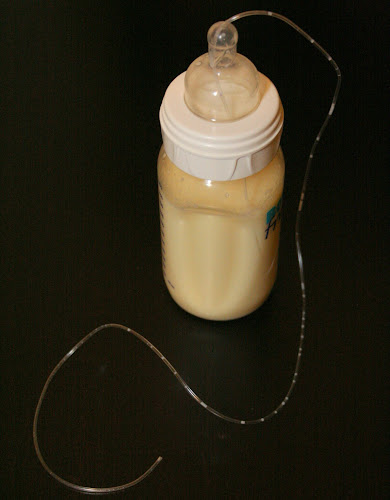
Homemade at-chest supplementer consisting of a bottle, nipple and tube.
Making an at-chest supplementer is easy and cheap.
Note that this post is not medical advice. I am sharing here what I have learned through personal experience. If you are concerned about your baby's health, seek help from a doctor.

Using an at-chest (at-breast) supplementer is a great way to feed your baby if you are unable to produce all of the milk he or she requires. This method is completely supportive of the nursing relationship, and does not involve your baby latching on to any artificial nipples, such as bottle nipples. As wonderful as it is, this kind of supplementer can be brutally hard to use at first. I've been using one for over eighteen months, so I'll share some tips!


First, let me explain what it is. All the different versions consist of a container to hold the supplement and a long, narrow tube. One end of the tube goes into the supplement, and the other end is placed right by your nipple. Your baby latches onto both the tube and your nipple simultaneously, drawing supplement from the container and getting all the milk that you are producing, too.


What's great about it? Using an at-chest supplementer allows you to do all feedings at your own chest. This is amazing for your nursing relationship and all the bonding that comes with it. It's also important for promoting normal jaw development in the infant - the physical action of chestfeeding develops a baby's muscles differently than bottlefeeding does. Using the supplementer helps you produce more milk, too, because even at times when your baby is only receiving supplement and you are not producing any milk, your chest tissue is being stimulated to make more. For those who produce little to zero milk, using the supplementer makes it possible to still have a nursing relationship.

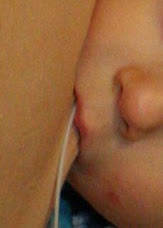
Jacob latches with the supplementer near the corner of his mouth.
How do I get one? You can buy a commercial supplementer, or you can easily and cheaply make your own. I prefer the homemade kind, so that's what I'll describe first. You can use any baby bottle to hold your supplement. Get gavage tubes from a pharmacy, or in bulk from a medical supply store. The kind to look for is 5 French (that's the diameter), 36 inches in length. You might want a tube with a bigger diameter if your baby has a weak suck, a complication of some conditions such as cleft palate or prematurity. Using a shorter tube is super irritating because it forces you to hold the supplement container so close to your baby's mouth (who has enough hands to do all that?!). Cut off the extra plastic bits, if there are any, on one end of the tube. The other end will be closed and rounded and will have two or three holes just before the tip - I cut off this part too because otherwise the supplement doesn't seem to come out easily. Some don't do this because they believe that cutting this end makes the tube sharp (we never experienced a problem with this). Thread one end of the tube through the bottle nipple (expand the opening of the nipple with a knife if required) so that it is sitting in the supplement. To clean the tube after use, just suck some hot water through it. Do not boil this kind of tube - it is not made from materials designed to withstand such a hot temperature.

The main difference between the homemade and commercial systems is cost. The Lact-Aid is $48.75 or $62.50, depending on whether you get the deluxe or standard model. The Supplemental Nursing System (SNS), made by Medela, was $42.99 on Amazon when I checked at the time of writing. It should be noted that Medela is a company that violates the World Health Organization's code on the marketing of bottles and artificial nipples. Unfortunately, its product name, SNS, is often incorrectly used as a generic name for a supplementer. You can make your own supplementer for the cost of any baby bottle and nipple and a $5.00 gavage tube. If you use this system in the long-term, you will end up spending a fair bit on tubes. They can be bought in bulk for about $1.00 a piece, and most people replace them once per week (or when they get too stiff to use) - so, you could spend $52 on tubes if you use the homemade supplementer for one year. I've been told by several people who used an SNS or Lact-Aid for over a year that both systems hold up very well to wear and tear and rarely need replacement parts.


With both the SNS and the Lact-Aid, the supplement container hangs around your neck. I like my homemade version because I can put the container down beside me on a table or hold it between my knees - I hated the idea of something relatively heavy dangling from my neck. I also like being able to have a decent amount of supplement on hand. The containers of the SNS (re-usable) and Lact-Aid (disposable bags) are smaller than most baby bottles. My number one reason for using my homemade version is that it is simpler - it has only three parts (bottle, nipple, and tube).


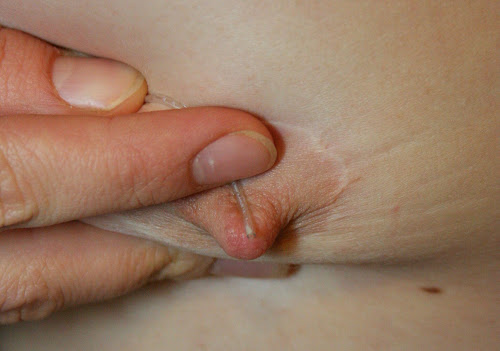
I mould my chest tissue using my middle finger and thumb, and position the tube with my forefinger. End of tube is in line with the end of my nipple.
Moulding the chest tissue and positioning the tube
How do you actually use this thing?? Some people latch the baby on first, and then sneak the tube in through the corner of the baby's mouth by moving a bit of breast tissue gently out of the way. This never worked for me. I have so little chest tissue that if I moved any part of it, my baby would lose his grip immediately. A downside of this method that a friend of mine learned the hard way is that it may become impossible to sneak the tube into your baby's mouth once he or she has teeth getting in the way.

There's a lot to have to juggle between latching your newborn and placing a tube. This is how I do it: I get my baby in position and latch him first without the tube (otherwise he gets too antsy waiting for me to have everything ready). Then I take the end of the tube and get it near the end of my nipple. I briefly un-latch my baby. I use my thumb and middle finger to mould my chest tissue into a shape that my baby can latch to, and use my index finger to position the tube so that the end of it is in line with the tip of my nipple. The tube comes from above my nipple so that it points to the roof of my baby's mouth when he latches. I slip my index finger out of the way just as he is latching on and then I hold the tube in place for an extra second or two until the supplement is flowing up the tube. Some people tape the tube to their chest, but this didn't work for me. The tube would always flip in the wrong direction when I tried to mould my chest tissue for my baby to latch.

Immediately before latching, Jacob's mouth is open and the tube is already well-placed.
About to latch
Using a supplementer is initially very challenging. I couldn't position it on my own for the first two weeks! My partner had to help me with every single feeding until I developed this method of doing it on my own. It helped when my baby's latch became stronger. Nowadays, at eighteen months, I don't even think about it. My baby latches himself on, and I know exactly where the tube needs to go so that the supplement will come up easily.

Have you used a supplementer? Do you have any additional tips to share that we should know about?