Showing posts with label activism. Show all posts

1 Sept 2012

Ian's Letter to LLLI

Update, May 2016: LLL changed its policy about the eligibility of Leader Applicants in 2014. Trevor became accredited as a Leader in May, 2016.

My partner wrote his own letter of support to the La Leche League International board:
Dear LLLI Board,

I am an LLL stakeholder. I am an “LLL Father” as defined in your Concept Policy Statements and my partner is an LLL member. These policies seem to fit me well. I support LLL, and I support my baby and partner’s breastfeeding dyad. These policies don’t need to change a bit in order to describe my role in our family.

Unfortunately, I see that these policies don’t fit a lot of people’s circumstances and cultures. They don’t fit my partner: he’s Trevor MacDonald, and he’s been breastfeeding our son for almost seventeen months.

As our son grows into toddlerhood, I watch as he comes back to the comfort and ease that breastfeeding brings. I cannot imagine anything else being so beneficial to him, and our dearest LLL friends are to be thanked. It was a difficult road to breastfeeding success. Trevor’s a devoted parent and I know his commitment makes him a skilful advocate of the art of breastfeeding. He was thrilled when he was asked to step forward and apply to be a volunteer Leader.

This sounds like a letter of recommendation and perhaps it is. Many have been skeptical of his motives, and have attacked what they imagine to be “our way of life”. Transgendered and gay people are excluded from the veneration of family life that is easily afforded to all others. Many people believe that GLBT people should have no reproductive rights to parent and raise children. Perhaps that is starting to change as more people recognize that GLBT people are not separate from humanity in general, in our activities and aspirations.

With that in mind, I am writing to request that you rewrite your policies so as not to exclude any breastfeeding family. Please allow Trevor and other GLBT people to participate in all levels of LLL.

Where we live, there is a human rights code that acknowledges gender identity and sexual orientation as protected characteristics. Would that were true in every nation. Although many human rights agencies have proposed this to the UN (in the Yogyakarta Principles), several nations are blocking this from being adopted. GLBT people are being routinely prosecuted, harassed, and killed in countries where LLL operates.

I am not asking LLLI to enter the fray and express an opinion about this worldwide struggle. However, I do believe that by emphasizing gender roles for parents, LLLI unwittingly facilitates discrimination against some breastfeeding families. This includes not only GLBT people, but also other cultural viewpoints and family circumstances.

I hope you will amend LLLI’s basic policy statements so as not to exclude any breastfeeding dyads and social situations. I urge LLLI affirm its support of breastfeeding without regard for any other defining characteristic.

Respectfully,
"Ian MacDonald"

26 Aug 2012

LLL to Revisit Policies: Write Letters!

Update, May 2016: LLL changed its policy about the eligibility of Leader Applicants in 2014. Trevor became accredited as a Leader in May, 2016.

Exciting news! La Leche League International announced that it will revisit its policy regarding transgender leaders. Please support a change of policy by contacting La Leche League now! LLLI says that they want to consider all points of view, so now is the time to make sure that your voice is heard.

 (If the button doesn't work, try another browser or cut-and-paste the message. Addresses are below it.)
Dear La Leche League,

As the world's most important breastfeeding support organization, it is vital that you include all kinds of breastfeeding families. Regardless of any other issues, LLL should support breastfeeding relationships. I was very disappointed to hear that a transgender dad in Canada was told not to apply for leadership because of his gender identity.

To note that LLL is open to helping anyone who wants to breastfeed is excellent, but not enough. LGBTQ individuals, which includes those who are transgender, should be able to participate in the organization at any level, so long as they meet appropriate requirements. Many families today do not fit the traditional model of one mother and one father, yet this does not prevent them from "mothering" and breastfeeding their babies and children in the most nurturing of ways. What all La Leche League leaders should have in common is their experience of parenting through breastfeeding.

I applaud La Leche League for committing itself to revisiting its policies regarding transgender leader applicants. I urge you to find a way to interpret LLL philosophy broadly and to include qualified leader applicants regardless of their gender identity. This would bring your organization in line with progressive human rights codes. It would send a wonderful message to the LGBTQ community as well as other minorities and all kinds of parents that they are not only welcome but truly included - and that LLL is simply about babies getting the milk and breastfeeding relationships they deserve.

Thank you for supporting an inclusive vision of breastfeeding families.

You can also call LLLI at 1-800-525-3243 or mail La Leche League International, 957 N. Plum Grove Road, Schaumburg, IL 60173 USA. Their Executive Director, Barbara Emanuel may be reached at ed(at)llli.org. Please feel free to send a copy via email to me at milkjunkies(at)ymail.com.
________________________

Meanwhile, Breastfeeding USA clarified that it is explicitly inclusive of transgender breastfeeding counselors. Breastfeeding USA wrote in a post in our Facebook group, Birthing and Breastfeeding Transmen and Allies:

"Each application for Breastfeeding USA Counselor is reviewed by a team, and the applicant's qualifications are evaluated on a case by case basis within our centralized education system. Without explicit knowledge of one's personal experiences, or expressed permission from that individual, we cannot comment further about someone's eligibility.

"We know that Trevor is Canadian, and at this time Breastfeeding USA is not prepared to accredit individuals outside the confines and laws of the US, US territories and commonwealths, or US military installations. We are not an international organization.

"Breastfeeding USA is committed to the mission: to provide evidence-based breastfeeding information and support, and to promote breastfeeding as the biological and cultural norm. As a membership organization, the voting members can and do influence policies. Breastfeeding USA remains open to being an evolving, inclusive, diverse and modern organization. Breastfeeding USA would consider a trans parent's application without prejudice."
________________________

It is awesome to see these organizations working to ensure that their policies are welcoming toward queer families. If La Leche League does decide to accept transgender leaders, this will send a wonderful message not only to the LGBTQ community but to other minorities and all kinds of parents that they are valued equally in their breastfeeding journeys - that it's about babies getting the milk and breastfeeding relationships they deserve.

24 Aug 2012

Why I Can Support Breastfeeding Women

Update, May 2016: LLL changed its policy about the eligibility of Leader Applicants in 2014 to be inclusive of transgender people. Trevor became accredited as a Leader in May, 2016.

In the past few days, some have mentioned they are concerned that women would not feel comfortable seeking breastfeeding advice from a man, or even attending a meeting when a man is present. Fortunately, I have not personally encountered anything like this at my local La Leche League meetings. I have attended a number of meetings together with brand-new, first-time moms, and these moms have shared openly at meetings and returned to meetings. I believe that a man who breastfeeds is perceived very differently from a man who does not.

What those of us who attend meetings have in common is that we want to breastfeed our kids. Early in my pregnancy, I did tons of reading about breastfeeding, and one thing that came up over and over again was this: a huge predictor of whether or not you will succeed in breastfeeding as long as you want to is if you have good community, peer support. I used to read that and say to myself, "Except for me. I don't count." When I did in fact get to go to an LLL meeting before my baby was born, I was incredibly grateful. I walked into the meeting shaking with nerves. I could barely speak when it was my turn to introduce myself and I explained my unique situation. I was terrified of what people would think of me and how they would react. I looked up at a certain point and realized that the women there were smiling at me and nodding their heads as they listened to me.

When we talk about experiences of oppression and fear, I feel that I have those in common with breastfeeding women. I was yelled at by a WOMAN for breastfeeding my baby in public - she said I was ruining my child. I spoke calmly to her at the time but cried for quite a while after it was over, feeling terrible. I get stared at when I breastfeed. There are some places where I don't breastfeed because it simply isn't safe. As a transgender guy nursing in public, I am not exactly in a position of power over others. I believe that any woman who learns in 30 seconds or so that I breastfeed my baby (and of course, having breastfed is a requirement for being a volunteer leader) will know that I have been through the same grief as any other breastfeeding person.

Men who have never breastfed have not experienced firsthand what breastfeeding parents have. Similarly, if a bunch of judgemental female OB's showed up at an LLL meeting, the breastfeeding women would probably not feel comfortable. In our chapter, when a non-breastfeeding medical professional wants to attend a meeting, she must gain special permission and she is asked not to contribute to discussion. I believe this whole issue is not simply about sex or gender, but about the common experience of breastfeeding, which in our society seems unfortunately to have a lot to do with oppression.

I try to keep my attitude in life, as well as my writing, positive. On the whole, our family has received FAR more support and well-wishes than any other kind of comment (I'm talking about personal emails, Facebook messages, and blog comments - I never read comments on news articles). However, I don't think that anyone breastfeeding in public in North America today can do so without at least a hint of fear or doubt, and I am certainly no exception. This is why we need La Leche League - a safe space to share accurate, science-based information about breastfeeding without judgement.

22 Aug 2012

Why Go Public?

Update, May 2016: LLL changed its policy about the eligibility of Leader Applicants in 2014 to be inclusive of transgender people. Trevor became accredited as a Leader in May, 2016.

Because of comments like this one, posted in my new Facebook group, Birthing and Breastfeeding Transmen and Allies. Heather Ling gave me permission to share her words:

"Thank you so much for accepting my request to join this group. You are all an inspiration to me. I am the mother of a young ftm [female-to-male] and knowing that trailblazers like all of you are breaking down the barriers gives me hope that my son will be able to make a supported decision in his adult years on how to create and raise a family.
I nursed my kids and would never want that wonderful bonding experience to be missed by anyone, regardless of their identifying gender."

UPDATE! LLL International has announced they will reconsider their policies.
Please support an inclusive vision of breastfeeding families by sending the Board a message!

16 Aug 2012

My LLL Rejection Letter

Update, May 2016: LLL changed its policy about the eligibility of Leader Applicants in 2014 to be inclusive of transgender people. Trevor became accredited as a Leader in May, 2016.
Following my previous post, many people have asked to read what La Leche League actually wrote to me and their reasons for stating that I cannot become a leader. After some careful thought, I've decided to post the full text of LLL's response, as well as the letter I'd written hoping to convince them. In reading, please remember this: I LOVE La Leche League. Its books, meetings and online resources made breastfeeding possible for me. My experiences with my local LLL chapter have been fantastic and I am extremely grateful for this.

It seems that the decision regarding my leadership application comes down to policy: "Since an LLLC leader is a mother who has breastfed a baby, a man cannot become an LLLC Leader." I understand that I don't fit into LLL's definition here, I just think that their definition is poor. I believe that the point of the above statement is that in order to be a leader, you must have breastfed a baby for a certain length of time. It is your experience that counts in peer-to-peer support. At the time the policy was written, the authors assumed that men wouldn't/couldn't breastfeed, so they defined a leader as a woman. I kinda doubt that many people envisioned my own scenario. I think that the interpretation of the policy should evolve.

If you believe that LLL needs to change its policies in order to become more inclusive, please consider writing to the LLL board with your concerns. Don't simply withdraw your support from the organization - there are TONS of amazing, forward-thinking Leaders. Let's not forget about them and the great work they do!

Here is the first response LLL sent to me:
Dear Trevor,

Firstly I want to thank you for your interest in leadership, in sharing your experience with mothers and in expanding the reach of LLL in the community. Your contribution to the Group is clearly greatly valued. Thank you also for your patience while I consulted with members of the Boards of La Leche League Canada (LLLC) and La Leche League International (LLLI).

Our policies do preclude men from becoming Leaders. LLLC Policy states:

4.14 MEN AS LEADERS

Since an LLLC Leader is a mother who has breastfed a baby, a man cannot become an LLLC Leader. (March 1994)

The wording echoes LLLI policy:

Leader Eligibility - (second paragraph) Since an LLL Leader is a mother who has breastfed a baby, a man cannot become an LLL Leader.

LLLI's policies and mission statement consistently speak of Leaders as mothers, giving mother-to-mother support.

There are also Concept Policy Statements which include the mother/baby relationship and the father's role. The Concept Policy Statement on the father's role speaks of "... understanding of the father's role, not as a mother substitute, but as a unique figure in the baby's life."

You told me that you do not identify as a mother. You are your baby's father. According to LLL philosophy the roles of mothers and fathers are not interchangeable. I think that this would make it difficult for you to represent LLL philosophy. You acknowledge that some women may not be comfortable working with a male Leader. A Leader needs to be able to help all women interested in breastfeeding. Fathers are able to help in other ways, for example an informed LLL father who is supportive of LLL philosophy might present a fathers' meeting.

I'd also like to share with you some of the wording of LLLI's policy on donated milk:

A Leader shall never initiate the suggestion of an informal milk-donation arrangement or act as an intermediary in such a situation. If a mother wishes to discuss these options - which may include donating expressed milk, wet-nursing or cross-nursing - the Leader’s role is to provide information about the benefits and risks, as mentioned above, including the limitations of home sterilization of expressed breast milk.

This would mean that a La Leche League Leader would be able to share information about your experience with another mother, but as a Leader you would not be free to initiate or recommend this suggestion. If you wanted to share this experience with others, another way of helping, other than LLL leadership could be a better fit for you.

I would also like to address your interest in leading an LGBT LLL meeting. I think that it is important for you to know that we do not accredit specialty Leaders. So for example Leaders often say that they need a working mother as a Leader for their Group because she can relate to the mothers in the population the Group serves - I would disagree - what qualifies a Leader to relate to those mothers is her experience of mothering, not her experience of separation. Similarly in this case it is the experience of mothering through breastfeeding which qualifies a Leader to help others. Any Leader can help anyone who is interested in breastfeeding. LLL has accredited a number of lesbian mothers as Leaders. They lead Groups for all mothers. I think that the group that you envisage would work better not as an LLL Group because its scope is beyond breastfeeding and LLL is concerned specifically with breastfeeding. Other topics may come up at meetings as they relate to breastfeeding, but we do not, for example, recommend any particular method of or setting for childbirth, sleeping arrangements, diet or educational philosophy and (as noted above) we could not recommend using donated milk. There is definitely a place for groups with a different focus, such as attachment parenting groups, but these are not LLL Groups. Thanks for sharing information on your Facebook group. This is the kind of thing that would definitely work better not as an LLL affiliated Group, since there are guidelines on how LLL Facebook groups can be run.

One thing you said which I must respond to is that "LLL now supports working mothers, women breastfeeding after reduction surgery, women who are inducing lactation, single mothers, and lesbian families". I wondered if you think that this is new - that we did not support them before. In fact we have always supported all of these mothers. We support all women interested in breastfeeding. I think there may be confusion between whom we support and who can be a Leader. You mention "LLL's conservative, Christian roots" as if LLL has moved away from its roots. In my view LLL's roots are in our philosophy which has not changed and has not needed to change in order for us to accept and help all mothers, irrespective of their background. ALthough LLL was founded by seven women who attended the same Roman Catholic group and hatched the idea that became LLLI at a church picnic, they never ascribed a religious sponsorship to LLLI, never required any religious affiliation, whether Catholic, Christian or other. The mission, the philosophy, the concepts - those are the roots of LLLI and they are what you and I value so much about LLL.

I would welcome your comments or any questions you might have.

Thank you again for your interest in LLL and in helping others. I look forward to hearing your thoughts.

And here's my original letter:

Through communication with my local LLL leader, I understand that you have some concerns over my potential leader application. It is true that I do not identify as a mother. I am a transgender man - I birthed my baby and have been breastfeeding him for 13 months, but I am a father. However, I certainly "mother" my baby by caring for him in all the traditional ways that a mother would. I have benefited tremendously from my participation in La Leche League, and I would love to be able to give back as a leader as well.

Without the support and information provided to me by LLL, I doubt that I would be breastfeeding today. During my pregnancy, a leader told me about Diana West's Defining Your Own Success: Breastfeeding After Reduction Surgery. I learned that despite my own dramatic chest surgery, it might be possible for me to produce some milk, and to have a satisfying breastfeeding relationship by using an SNS. I attended LLL meetings at ------------, where I received a warm welcome both from leaders and other breastfeeding parents. After the birth of my baby, I gratefully accepted intensive one-on-one help from a leader to ensure a good latch even with my meagre chest tissue.

It is my hope that I could some day reciprocate the compassion, encouragement, and expertise that made such a difference to my personal breastfeeding experience. I overcame significant challenges in order to breastfeed and I believe that this background, combined with leader training, will enable me to effectively help others. I acknowledge that some women may not be comfortable working with a male leader. Nevertheless, I wonder if there may be a way to facilitate meetings with those who feel they could benefit. My local Leader suggested holding meetings oriented toward gay, lesbian, bisexual, and transgender parents interested in breastfeeding. I know that these individuals need support and that they do already turn to LLL to try to find it. For example, a transgender man reached out to me via my blog and mentioned that he had attended LLL meetings where he lives in California. He was sadly unable to latch his baby. I'm sure that my situation and his, although very unique today, will become increasingly common in the future. Queer-positive meetings that include the possibility of Skype access could provide meaningful assistance to parents in need around the world.

I understand that LLL's current philosophy emphasizes mother-to-mother support, and that the idea of a breastfeeding dad is entirely new territory. In recent articles as well as her new book, Elisabeth Badinter has emphasized LLL's conservative, Christian roots. However, I was disappointed that she doesn't recognize the ways in which the organization has grown. In fact, LLL now supports working mothers, women breastfeeding after reduction surgery, women who are inducing lactation, single mothers, and lesbian families, even though these situations were controversial as little as a few decades ago. I very much hope that LLL will continue to evolve and meet the needs of today's families - including any breastfeeding dyad wishing to find support and information.

Please let me know if you have any further questions about my situation. Also, feel free to read my blog and published articles. I consider them available for anyone to read, but I have changed my name and my child's name in these materials in order to protect my family's privacy. I look forward to your response.

14 Aug 2012

Queer Breastfeeding Support via Skype!


UPDATE ... LLL International has announced they will reconsider their policies. 
Please support an inclusive vision of breastfeeding families by sending a letter to the board!
(If the button doesn't work, please try another browser, or cut and paste the letter found here).

We returned from an amazing, beautiful trip to Toronto and rural Nova Scotia with only ten ounces of donated milk to spare! We were away for over three weeks. The dry ice worked its magic and protected our precious supply for 24 hours while we made our way to a 100-acre farm that was a long, fussy drive from Halifax.

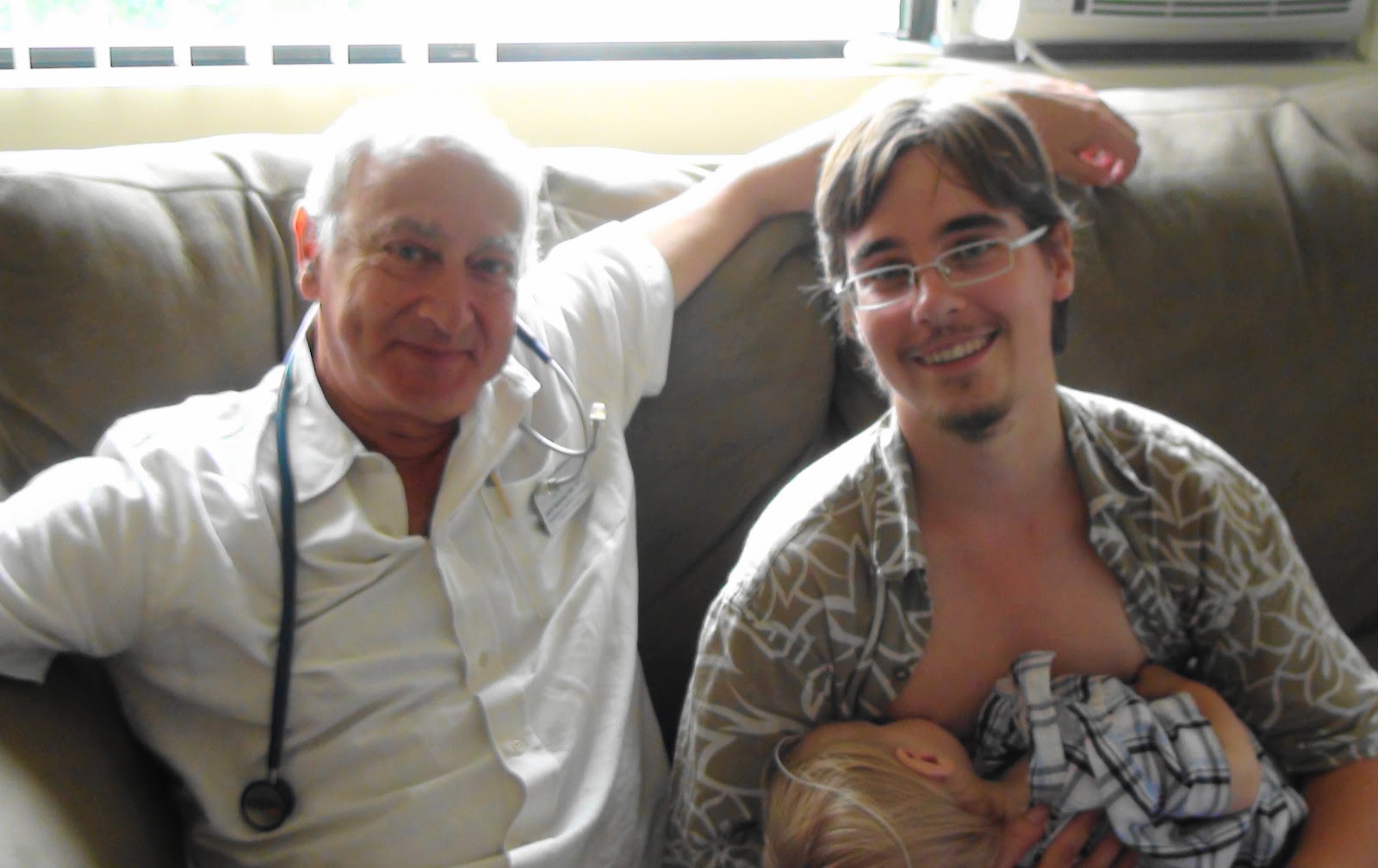
Dr. Newman, wearing a stethoscope, sits beside me on a couch as I nurse Jacob.
With Dr. Newman, author of Dr. Jack Newman's Guide to Breastfeeding
Mostly we visited family on this expedition, but we also met Dr. Jack Newman and lactation consultant Mary Lynne Biener at the International Breastfeeding Centre in Toronto.

Mary Lynne and I have decided to start a queer-friendly breastfeeding group with access by Skype! The idea originally came to me from a La Leche League Leader friend of mine. She thought it would be fantastic for me to lead LLL meetings to help support trans guys, queer folks, and allies in their breastfeeding endeavours. Her brilliant thought to include Skype access means that people would be able to connect to such a group from all over the world. I have heard from a number of trans men who badly wanted to breastfeed but didn't manage to do it, and I am convinced that there is real need for this kind of resource.

I was very excited to begin leader training, but unfortunately, my application was rejected. Men cannot become La Leche League Leaders. I was told that LLL is all about mothering through breastfeeding, not simply supporting anyone who wishes to breastfeed. This is certainly different from what I've experienced with my local LLL group - I've always felt fully welcome at meetings (and am grateful to have learned a TON). The leaders here were encouraging of my application. I believed that what would qualify me for training would be my experience of breastfeeding my baby for the past 16 months, regardless of my gender, since LLL is a peer-to-peer breastfeeding support group. However, the LLL Canada and International boards disagreed. On the bright side, they did recognize me as male despite the fact that the Canadian government doesn't.

Instead, I'm starting my own breastfeeding support group with Mary Lynne, a passionate ally, mother and lactation consultant. Skype allows up to ten participants in a video conference, although quality is best with fewer than that. Please send me an email at milkjunkies(at)ymail.com if you're interested, or reply in the comments section here so I can let you know when the first meeting will occur!

I've also started a Facebook group called Birthing and Breastfeeding Transmen and Allies. Check it out!

31 Jul 2012

Public Health, Economics and Breastfeeding Goals

This morning I noticed that at the top of The New York Times' "most-emailed" articles list was yet another post about the hardships of breastfeeding and the bullies in the medical establishment who continue to berate us with the message, "breast is best." This particular one was entitled, "The Ideal and the Real of Breastfeeding," by Jane E. Brody. It closely mirrored the feminist arguments of Elisabeth Badinter's recently published book, The Conflict: How Modern Motherhood Undermines the Status of Women. These authors and their followers commonly suggest that doctors, nurses and public health officials should stop making breastfeeding seem like such an important factor in infant health so as to avoid inducing motherly guilt. It seems not to occur to any of them that perhaps what Americans need instead is a set of laws, government programs, and business practices that support babies and their families.

Telling us that breastfeeding isn't important because in some cases it's rather difficult to accomplish is like saying that, since they are having trouble doing it, our school-aged kids don't actually need to eat more vegetables and fewer fatty foods even though they are suffering from poor health. After all, we wouldn't want to hurt their feelings, would we? No, in this situation, I believe parents generally agree that schools should make an effort to remove nutritionally abysmal food and drink such as French fries and pop from cafeterias. We need to help our children develop healthy eating habits and we know that surrounding them with excellent choices will go a long way toward making this happen.

Why, then, do writers such as Jane Brody insist that we change our stated societal breastfeeding goals instead of doing better to support breastfeeding parents? In part, they argue that breastfeeding isn't really as beneficial for babies as parents are made to believe. After all, Brody says, "No randomized, controlled trials - the gold standard of scientific research - have proved that breast-fed babies fare better, at least in industrialized countries." This is in fact because such a study would be impossible to perform. No parent would agree to breastfeed or formula feed randomly as decided by a scientist. Even if they did, some in the group assigned to breastfeed would fail to do so since not everyone who wants to breastfeed succeeds.

Nevertheless, it's easy to find solid evidence that shows breastfeeding is good for infant health, and, not surprisingly, good for business. Breastfeeding support programs instituted by employers result in 62% fewer prescriptions as well as substantial health care savings and reduced absenteeism, according to the insurance company CIGNA. Companies with lactation support programs also enjoy much higher rates of employee retention than the national average. Of course, insurance companies exist to make money - if they are convinced that breastfeeding saves health care dollars, I'm inclined to believe them.

Another large part of Badinter's argument against breastfeeding concerns the time and energy that it takes on the part of the mother. As a breastfeeding dad, I have certainly experienced firsthand this kind of commitment. However, it has little to do with breastfeeding and everything to do with the fact that human babies are extraordinarily needy, dependent creatures who prefer a consistent caregiver. Infants cannot feed themselves, take care of their elimination needs, protect themselves, or move any real distance on their own. If I don't look after my baby, some other adult must do it for me regardless of whether he's slurping breast milk or formula. Rather than bemoaning what I have "given up" to take care of my baby, I try to consider his needs as an infant. After all, he didn't choose to be here; we brought him into this world. Fortunately for me, being Canadian, I was entitled to one year of parental leave with employment insurance that paid a decent chunk of my previous income.

I wish that these authors would demand longer paid parental leaves. The current US standard six week leave is laughable - it is hardly enough time to get to know and support a new family member. Most of my friends have said they didn't get into the groove of breastfeeding (or parenting!) until at least six months in. To meet the minimum breastfeeding goals outlined by public health officials, Americans need much longer parental leaves as well as workplace lactation support programs for those who choose to go back to work. Let's change our attitudes and programs to support family health rather than redefining good health to mean good enough.

6 Jul 2012

Google Bomb: "Breastfeeding Is..."

Motherwise pointed out on Facebook this week that when you Google "Breastfeeding is", the search engine comes up with some very disappointing suggestions:

- child abuse

- gross

- creepy

- exhausting

- agony

- a nightmare

- offensive

This is absolutely NOT what somebody looking for information about breastfeeding needs to see. Those who are new to breastfeeding or who are struggling to breastfeed deserve to find encouragement, good information, and positive attitudes.

A few weeks ago at a La Leche League meeting I attended, participants were asked to say in one word what breastfeeding meant to them. Admittedly, the word "hard" did come up a few times, but people also said "convenient," "easy," "natural," "amazing," "beautiful," "bonding." Now, this is more like it!

If you have a couple of minutes to spare, type in a few of your favourite positive descriptors. Let's Google bomb breastfeeding!


10 Jun 2012

Petition to Ease Restrictions on Breast Milk in Carry-On Baggage

Last week we packed up yet again and got ready to make our trip out west to visit our relatives. We don't have any family in Winnipeg, but we believe it is very important for our child to have a strong relationship with his grandparents. So, as much as I hate it, we fly frequently.

We took along several bottles of donated breast milk in a cooler, as well as an ice pack. At security, they asked to open up our cooler as usual. All seemed normal. And then came the question, "But how old is your baby?"

"He's thirteen months."

"Oh, ok. This is fine. Go ahead."

The exchange seemed simple enough, but suddenly left me wondering, is there an age at which I won't be able to bring milk along for my baby? Is thirteen months ok, but say, eighteen months too old? Why did they ask my baby's age?

We rely upon donated breast milk to feed our baby. I nurse him using an at-breast supplementation system, and am able to enjoy a satisfying breastfeeding relationship as a result. I would like to keep breastfeeding my child as long as he needs it. Since the World Health Organization recommends breastfeeding for two years AND BEYOND, I am and will continue to be grateful for human milk donations. If and when we are no longer able to find donated human milk, we will probably move to using whole goat's milk in the supplementation system. Goat's milk is closer to human milk than cow's milk is, but it is probably not commonly available beyond airport security.

During our stay in Vancouver, I looked up the rules. In Canada, you may only bring extra liquid aboard a flight for a child UNDER the age of 2. So, I decided to start a petition on change.org. Please sign it and share widely!

http://www.change.org/petitions/canadian-air-transport-security-authority-ease-restrictions-on-breast-milk-in-carry-on-baggage#

"Canadian parents using expressed breast milk currently face greater restrictions when flying with their children than do their American counterparts. Only passengers traveling with infants UNDER the age of 24 months may bring aboard more than 100ml of liquid per container, inside a 1 litre plastic bag. Women traveling without their babies are not permitted to bring their expressed milk on board. Those traveling with children above age two are not exempt from restrictions on liquids.

"The World Health Organization recommends breastfeeding until age 2 AND BEYOND. For those parents who must express their milk and bottlefeed, or who use donated milk and an at-breast supplemental nursing system, carrying liquid on their persons is a must. Why should the Canadian Air Transport Security Authority decide at what age a child no longer needs breast milk, especially during potentially stressful travel?

"Passengers traveling without their babies should also be allowed to carry their precious breast milk rather than pump and dump. Breast milk, known in the birth world as "liquid gold" for its important health benefits, should be exempt from the usual restrictions on liquids.

"In the US, breast milk is treated as liquid medication and passengers may carry it on board in quantities greater than 3 ounces WITH OR WITHOUT A BABY OR TODDLER PRESENT. Sign this petition and tell the Canadian Air Transport Security Authority to start valuing breast milk as vitally important nutrition for babies and children!"

http://www.change.org/petitions/canadian-air-transport-security-authority-ease-restrictions-on-breast-milk-in-carry-on-baggage#


20 Apr 2012

One Step Forward For Human Rights

A momentous decision for transgender people has come out of Ontario today: the Ontario Human Rights Tribunal has ordered the provincial government to amend its legal requirement for sex designation change within 180 days. Currently, Ontario's Vital Statistics Act stipulates that a trans person must undergo sex reassignment surgery before his/her gender marker can be changed. The human rights tribunal declared this to be discriminatory.

Male symbol
Today's decision is huge for transgender people across the country, including myself. I transitioned from female to male by taking testosterone and having a chest surgery. I have a beard and my voice is deep - no stranger on the street would ever think that I am anything other than a regular guy. But since I have not had a complete ovariohysterectomy (or in veterinary language, a spaying), I am legally female. My driver's license has an F on it, and my passport blares FEMALE in giant print. When we applied for Jacob's birth certificate, we had to check off the "mother" box for me, and then we attached an essay in explanation.

Your birth certificate is the go-to document that must be used to apply for passports or to make changes to any other document. I am required to out myself as transgender every time I present my ID or other legal documents.

So why didn't I just get bottom surgery? Well, it is hugely expensive, rather risky, and involves a long recovery. And... I would not have the family I do now if I had removed my female organs. I live happily and comfortably as male, and what is between my legs is nobody's business besides my partner and my doctor.

Sometimes the discrepancy between my appearance and my documents is just an annoyance and a hassle, but in other situations it is a matter of personal safety. Two years ago Ian and I traveled to India and Nepal - every time I showed my passport to board a plane or even apply for a park pass, I worried that someone would notice the word FEMALE. In those countries, could I be harassed by police or customs officials? Could I be detained? Before we left for our trip, my doctor wrote me a note of explanation, and that's all we had to depend upon. Luckily, my fears were never realized and I am grateful.

It is my hope that the tribunal's decision will quickly help to change regulations in other provinces as well as at the federal level. I know I will breathe a great sigh of relief on the day when my legal documents finally match my gender identity. I look forward to being recognized by my government as my son's Dad.


11 Apr 2012

Lactation Education: Age Four

My friend Ana and her four-year-old daughter, Lucy, visit us every week. We share food, the kids play with toys, and Ana and I always end up talking about breastfeeding at some point. Usually Ana and Lucy stay long enough that eventually Jacob wants to nurse, even though these days he mostly just likes to crawl about and play when we have guests over. Still, Lucy has seen me using the supplemental nursing system fairly frequently. Her Mom told me this story the other day:
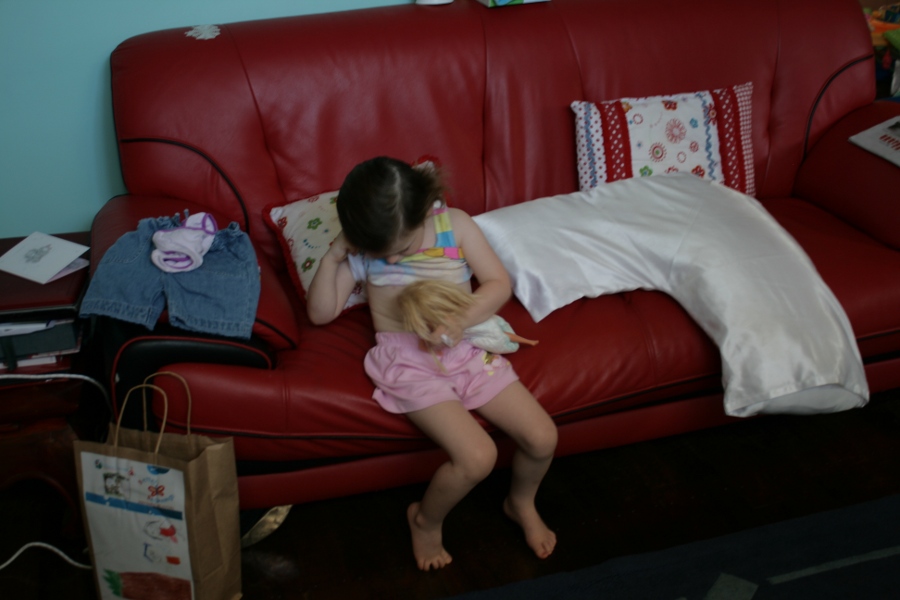
Girl nursing her doll on a red couch.
At home, Lucy found a tube somewhere-or-other, and put the end of it in a bottle. Then she placed the other end of the tube next to her nipple, and proceeded to nurse her doll. Her Mom asked, "Oh, are you feeding your baby with an SNS?"
"Yes, I don't have enough oppai, so I'm giving my baby oppai but there's pumped milk in the bottle, too, see?"
I have no doubt that if Lucy has her own children, it will be second nature to her to breastfeed them. If she turns out to be one of the very few people who truly cannot make enough milk, she'll know that by using a supplemental nursing system she can feed her baby at her breast and maintain a satisfying nursing relationship. Even that will be second nature to her, too. And, of course, she'll know to ask her nursing friends if they might be able to donate some pumped milk for her baby.
This is why we must defend not only the right to nurse in public, but also the right of our children to see all kinds of people nursing in public.
*oppai is the term Lucy uses for nursing. It comes from the Japanese.