Showing posts with label transgender. Show all posts

13 Apr 2017

Trevor’s diverse library for kids


The popular children’s song by Raffi, called “Like Me And You” is supposed to be about how we’re all alike. For years it has irritated me to no end. My family loves Raffi, particularly his song, “Baby Beluga”, but Raffi doesn’t love us. He shows no sign of ever having considered a family like ours. “Like Me And You” names children from countries around the world, saying “Each one is much like another / The child of a mother and a father”.

When my son was about two years old and we listened to the song for the first time, we paused after that lyric to explain that Raffi forgot our family. And then we proceeded to sing loudly on each repetition, “The child of a DADA and a PAPA”.

It’s important for children who belong to marginalized or underrepresented communities to have access to books and other media with characters that are like them and their families. I’m a transgender guy in a gay relationship, and I want my kids to read books that include two-mom or two-dad families, or characters who express their gender as non-binary or trans.

I also desperately want my kids’ friends who come from typical mom-and-dad families to see families like mine reflected in the literature they read. Kids notice everything. All our kids will notice if every single book they read is about a family with a mom and a dad, and they will naturally extrapolate that families like mine, which are not in the books, are lesser than, not worth featuring.

The same goes for race, ethnicity, culture, and (dis)ability. Kids notice skin colour, whether parents like it or not. If all the good guys on TV are white, and the bad guys are Black, kids will absorb that and it will become part of their worldview.  I need my able-bodied, neurotypical white kids with blue eyes and blond hair to access books that feature main characters including those in wheelchairs, or who are nonverbal, who are indigenous and people of colour. This is one of my most important parenting jobs in my journey to raise decent, anti-racist (simply non-racist is not good enough) human beings.

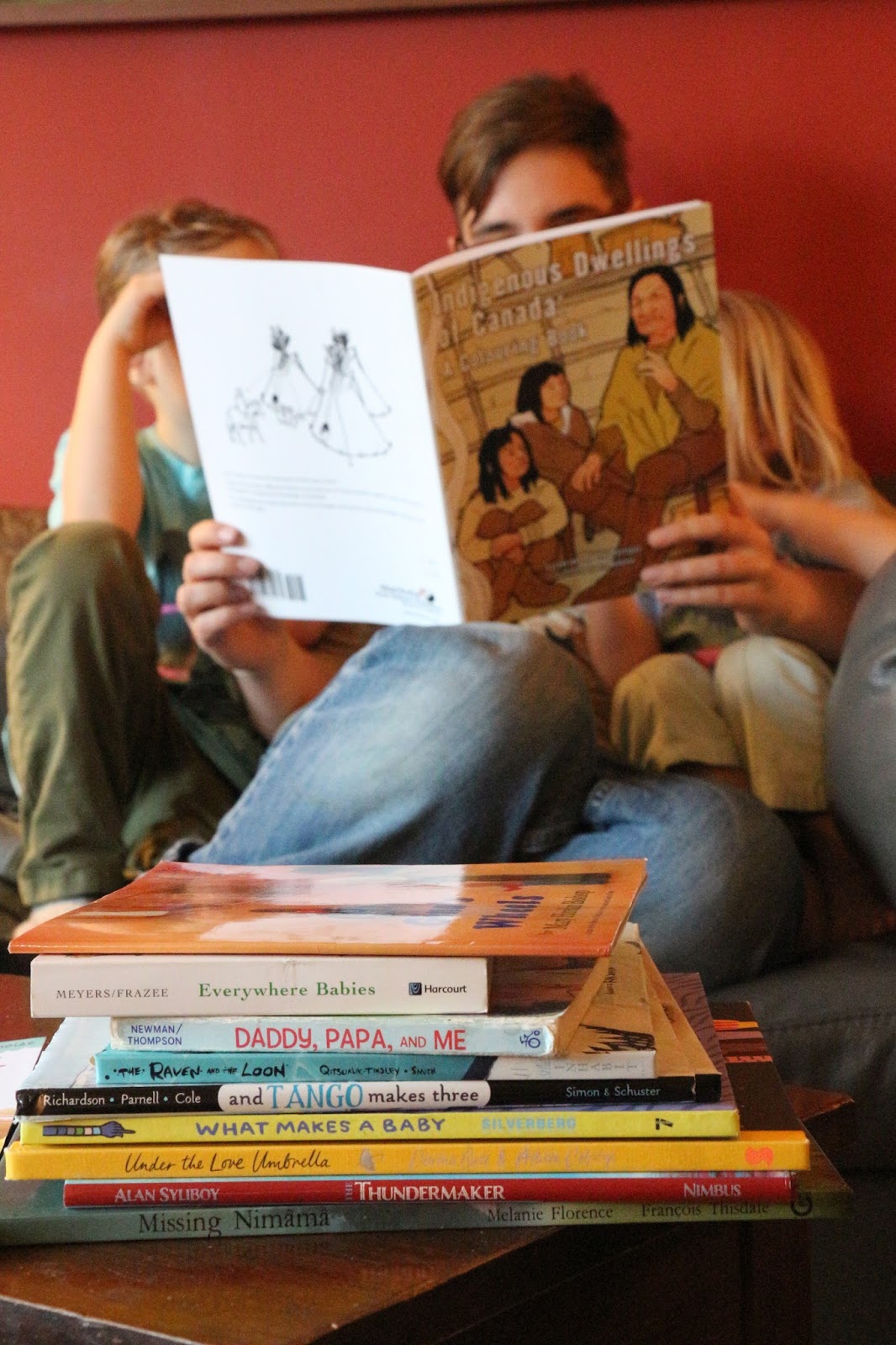
Today I’m writing in celebration of my little collection of diverse children’s books, magazines, and music. I have built it thoughtfully over the last few years. It is by no means exhaustive but I do feel that each work on this list is valuable in its own right as a piece of literature and art, as well as including and centering marginalized voices. Sometimes it can be hard to tell from a glance online whether a “diverse” book is truly as diverse as it claims, or even if the story, writing, and illustrations are decent. I hope that sharing some of the legwork I’ve done will be helpful to others.

Do you have favourite diverse kids’ books not on this list? Please mention them in the comments!

Indigenous

All the books on this list have indigenous authors. (Yes, white people are still publishing books about indigenous people written by white people. Beware of those.)

Sometimes I Feel Like a Fox by Danielle Daniel

Ages 2 and up

This book is dedicated “to the thousands of Métis and Aboriginal children who grew up never knowing their totem animal.” Each page spread depicts a different totem animal in the Anishinaabe tradition and describes the animal’s character.

My toddler, like many her age, loves animals. “Fox Book”, as she calls it, was her first true favourite book. My 6-year-old gets a lot out of the rich, descriptive vocabulary, including words like, “confident”, “purposeful”, “delicate,” and “intuitive.”

My Heart Fills With Happiness by Monique Gray Smith, illustrations by Julie Flett

Singing, drumming, baking bannock, and holding hands are among the beautiful (and easy to sound out!) activities that “fill my heart with happiness.” My toddler loves it and my six-year-old is capable of reading it to her. Win/win. Illustrations show kids who indigenous children will notice look like themselves.

Indigenous Dwellings of Canada: A Colouring Book published by Manitoba First Nations Education Resource Centre

This booklet states it may be copied for educational, non-commercial purposes with appropriate credit given to the publisher, so you can order a copy and share with friends. Each page spread depicts a different indigenous dwelling and includes a written explanation of the dwelling’s features. We’ve read it and looked at it at length with our six-year-old because there is so much to explore, but he hasn’t coloured in it yet.

The Raven and the Loon by Rachel and Sean Qitsualik-Tinsley, illustrated by Kim Smith

An Inuit story told by Inuit story-tellers. A toddler can begin to grasp the narrative through the bright pictures and direct emotional language, but there’s plenty going on to keep my six-year-old interested.


The Thundermaker written and illustrated by Alan Syliboy

Most amazing illustrations ever! The artist lives in Millbrook First Nation in Nova Scotia, and draws inspiration from the Mi’kmaw petroglyph tradition as well as mixed-media work. In this story, Little Thunder learns about the importance of making thunder for his people, and makes some dramatic mistakes along the way. The simple sentences are packed with action, like throwing around thunderbolts, holes that open up to swallow monsters, and animals and objects that change form.


The Rainbow Serpent by Dick Roughsey

I picked up this book at an airport in Australia. It was the only book in the store about an aboriginal story that wasn’t written by some white guy descended from colonizers. Despite being published by an imprint of HarperCollins, it has a few obvious typos. Nevertheless, my six-year-old and I LOVE this book. It tells an exciting story, in Aboriginal tradition of Australia, about how the land was formed into the hills and mountains of today, and how some people turned into different species of animals. The narrative explains that since animal species originated from humans, we must always protect them; these animals came from us and are our relatives. This offers a way of understanding the human relationship to the environment that contrasts sharply with assumptions inherent in capitalist, Christian-dominated society.

Missing Nimama by Melanie Florence, Illustrated by Francois Thisdale

Parents need to pre-read this one before deciding if it is appropriate for their kid. The story is about a child whose mother is missing, like far too many missing and murdered aboriginal women in Canada. The narrative shifts perspective subtly between the child, the missing mother, and the grandmother in a way that will probably be confusing for most kids under age eight or so. I hand this book (and a tissue) to most adults who come to visit us. It’s a hard, sad read that we absolutely must read to bring awareness to the crisis of missing and murdered aboriginal women. This book reminds us that these women have families - they are daughters, sisters, and mothers who are deeply missed.


When the Rain Sings: Poems by Young Native Americans edited by Lee Francis

The poems in this collection, published in 1999, were written by Native kids ages 7 to 17. These young poets tackle a wide range of topics from sunshine, sunset, and raindrops to missing family members, changing or lost culture, and police. A photograph accompanies each poem (examples include a traditional cradleboard, a camp scene from 1890, and dancers in 2006). One direct and brutally honest poem by a 17-year-old begins with, “My name belongs to a dead white woman. How it got down to me?” The poet goes on to describe the meaning of her aboriginal name, Spotted Feather.

LGBT

Daddy, Papa and Me, by Leslea Newman, Illustrated by Carol Thompson

Daddy, Papa, and Me are a Caucasian, two-dad family that have a busy day full of activities. By the end of it, Daddy and Papa are exhausted. This board book has decent rhymes and is suitable for babies, toddlers or kids learning to read and sound out simple words.

And Tango Makes Three, by Justin Richardson and Peter Parnell, Illustrated by Henry Cole

Based on a true story about two male penguins that hatched an egg and raised a chick together at a zoo in Central Park, New York City. The illustrations are beautiful, and the story is interesting and informative. The human families depicted visiting the zoo are ethnically diverse.

What Makes a Baby, by Cory Silverberg, Illustrated by Fiona Smyth

We relied heavily on this book to explain the creation of baby number two to our first child. Silverberg explains about the uterus, sperm, and eggs, but doesn’t connect them to genders or “mommy” and “daddy.” What Makes a Baby works for everyone, including folks who make their families using assisted reproductive technology or surrogacy, as well as lesbian couples and transgender men who carry a pregnancy. The narrative also explains both vaginal (“through a part of the boy that most people call the vagina”) and surgical births.

My only (slight) complaint has to do with consent and medical procedures. One sentence in the book reads, “Sometimes a midwife or a doctor will be the one to say it is time for the baby to be born.” Ideally, I’d prefer a more nuanced phrasing that includes some mention of the parent whose body is doing the gestating and birthing.

Rainbow Train (CD) by Chana Rothman

The music on this album is of such decent quality that the professional musicians in our household can mostly tolerate the fact that the toddler insists on listening to it on repeat in the car (for months now). Musical styles include hip-hop, pop, folk, and disco. For those who need to know, the pitch and rhythm are excellent and phrasing is capable.

The songs celebrate gender diversity and also provide kids with some words to deal with dogma they might encounter. For example, a kid on one track explains that, “there’s no such thing as boy colours or girl colours.” Songs also mention historical figures who challenged norms and changed our society.

We’ve been listening to Rainbow Train for a few years, and the kids get more and more out of it as they mature. Both my kids thought for a LONG time that the lyric “gender, gender gender, put it in a blender” was all about blending up some ginger. I recently explained to the six-year-old that the lyric is, in fact, GENDER, and we talked about the difference between gender and sex.


(Dis)Ability

Gina’s Wheels, by Mary Harelkin Bishop

Gina’s Wheels addresses disability explicitly. As in, the whole book is entirely focused on disability, which is okay-ish, though I ought to hunt around for some books that simply include disabled characters being who they are.

Gina, an able-bodied young girl with orange hair, becomes fascinated with wheelchairs after meeting the Paralympian Colette Bourgonje. We learn about Colette’s injury and her tremendous athletic achievements, which, again, is okay-ish. However, I need to find some stories with disabled characters that aren’t all about achieving physical prowess despite disability (known as the disabled hero, or “supercrip” narrative).

When Gina goes to kindergarten and meets a classmate in a wheelchair, she is ready to be friends. D’aww. The classroom includes a girl wearing a hijab and a Black boy, but they don’t say words or have roles in the narrative. All the main characters are Caucasian.

Hmmm.

Books that fit into more than one category!!!

What?! What will we do?

Yes, it’s true. There are some books that celebrate a wonderful range of diversity on more than one level.

Everywhere Babies, by Susan Meyers, illustrated by Marla Frazee

This sweet board book is lovely for babies, toddlers, kids who are learning to read, and those expecting new siblings. The text highlights all the different ways that babies are loved and cared for by their families and caregivers. The illustrations include two mom and two dad families, grandparent caregivers, teenage caregivers, and male caregivers in addition to the more common mom-and-dad family unit. There are depictions of Asian, Brown, Black (some with natural African hairstyles), and Caucasian children and families. One of my favourite pages describes the many ways babies are fed, including pictures of breastfeeding, bottlefeeding, cup feeding, spoon feeding, and beginning solid foods (along with giant messes!).

Under the Love Umbrella by Davina Bell, Illustrated by Allison Colpoys

This is a story about feeling connected to our loved ones, when we are excited, scared, shy, hesitant, tired, or even apart. No matter where you are, you’re always under your loved one’s “love umbrella”. The illustrations are bright and detailed. The main characters depicted include people of colour and a two-mom family.

KAZOO Magazine

This is sold as a “magazine for girls age 5 to 10”, but we all need to get it for our boys, too. My boy needs to see representations of strong, intelligent, creative, powerful women just as much as my girl does. If we’re ever going to improve on our patriarchal rape culture, surely we must educate our boys.

I LOVE this mag. It comes out 4 times per year and includes stories, poems, articles, word puzzles, colouring, and lots of suggested activities. Every item in the magazine is girl or woman-focused. For instance, January’s issue was all about building stuff, and included an interview with a female engineer.

The editor’s approach is obviously intersectional, and care is taken to include women from typically underrepresented groups. In the last issue we received, a story featured a girl in a wheelchair as a main character. Unlike Gina’s Wheels, disability was not the focus of the story, but was incorporated into the narrative. As readers, we got a sense of how disability made the girl’s lived experience different from the world of able-bodied folks - without making her into a rarified hero or a pitiful dependent.

Fair warning to parents: My 6-year-old needs plenty of help in reading this mag and trying out the various projects. There’s lots to discuss and not much that he can do alone at his age. 

Did you find this post helpful or entertaining? Please consider donating to Trevor's blog using the button on the side.

23 Aug 2016

Publishers Weekly: Ultra Queer Book Review

I'm excited to report that Publishers Weekly reviewed my book, Where's the Mother: Stories from a Transgender Dad.

And, the reviewer appreciated the ways that I draw attention to varying degrees of privilege, including my own. It's a rad, queer review!

From Publishers Weekly: "MacDonald’s debut memoir tells a tale noticeably absent from the plethora of parenting and breastfeeding books available: that of a transgender man in a gay marriage to a cisgender man who was himself adopted, both desperately trying to feed their biological child nothing but human milk... MacDonald owns his identity, using his elevated platform to call attention to issues faced by transwomen and transmen, people of color, and those living in poverty. Most importantly, his story of transitioning is frank, clever, and easy to process, providing plenty of parallels to his later struggles with nursing for curious cis readers... a refreshing and insightful narrative."


16 Jun 2016

Parenting Through a Vigil for Orlando


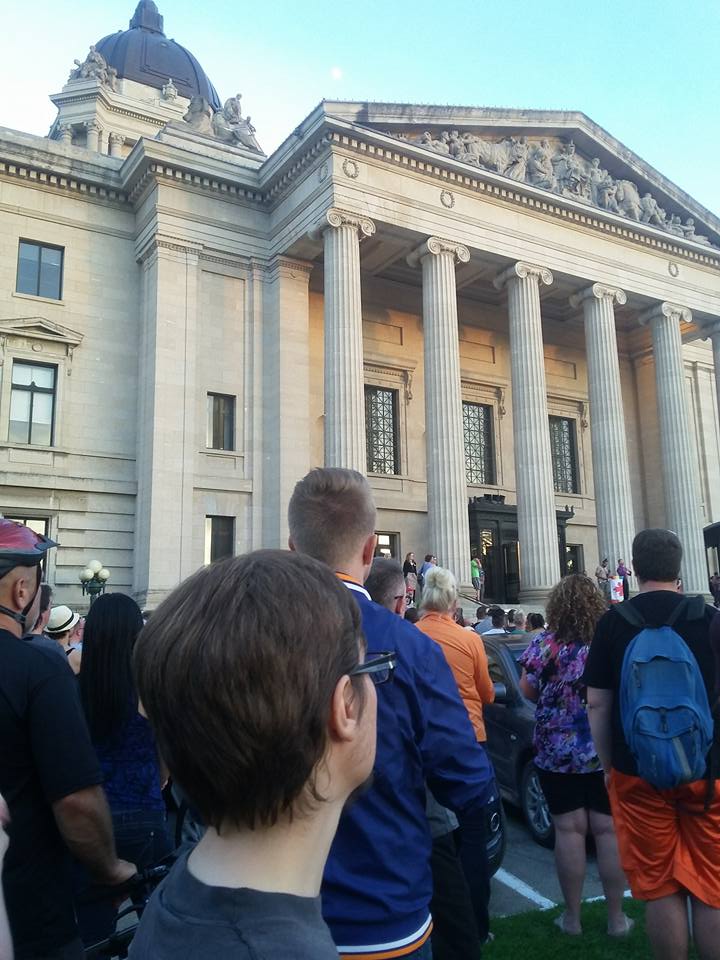
As queer parents, my partner and I carefully discussed whether to attend our local vigil in Winnipeg, Canada for the LGBT people of colour who were victims in Orlando. I’m a gay, transgender man, married to a gay man, and we are privileged to be raising a five-year-old boy, Jacob, and a twenty-month-old girl, Emily. We needed to consider how to talk to our children about what happened, if the event would be safe for them, and if we could convince our kids to behave appropriately given the circumstances that were the reason for the vigil.
 
Our twenty-month-old toddler is going through painful teething and prefers my arms at all times, so leaving her with someone else during the vigil was not an option. The event started at 8:30pm, when our kids would usually be winding down for bed. But we wanted desperately to be there, to find our community and exchange hugs, and to show our support for the victims who were mostly young, LGBT, Latinx people.

My partner and I decided that we must get there. We talked to our five-year-old about what happened using simple but honest language. We emphasized that the violence occurred in another country, and that as white people living in Canada, we are lucky to have more privilege than those who were killed or injured in Orlando. It is important for us to stand up in support of our queer siblings of colour.

But as we said these things, we were also aware that other LGBT events could be targeted. A trans friend of mine who lives in Philadelphia told me that he and his partner decided not to risk taking their own young child to any pride events due to safety concerns. One parent or the other might go, but not both, and never their child. The calculations we make about personal safety and risks feel dramatically different now that we are parents.

At the vigil in Winnipeg, hundreds of queer people and allies gathered, surrounded by a heavy police presence as well as ambulances and fire trucks that lined the block. I felt deeply moved by the words of an officer who spoke on behalf of police to let us know that they and other first responders are here for our community, doing their best to keep us safe.
Simultaneously, I thought of trans friends I know who have experienced discrimination and violence at the hands of police. I’m not talking about decades ago at the Stonewall riots, but personal friends in Canada and in the US who continue to endure police brutality.

As politicians and community leaders spoke and lit candles, we struggled to find the right balance as parents at the event. A family sitting next to ours on the grass had brought ninja turtles for their children to play with. After a few minutes of trying to listen to the speeches whilst our children gazed with rapt attention at the other children’s sickeningly inappropriate gunplay, we moved elsewhere. My toddler needed to pee about half a dozen times, so I kept whisking her over to some nearby bushes and then returning to the crowd. She and her brother ran up and down a small hill, but didn’t make too much noise, and hopefully didn’t disturb others. At one point, a man with a walker came through and I hastily grabbed both children to prevent them from tripping him, while listening to a community organizer speaking out against Islamophobia.

After the main speeches were over and some balloons released to the sky, our kids were absolutely finished. It was 10 pm. A lawyer we hadn’t seen for years approached to greet us but we had to hurry away. During the car ride home, when all I wanted to do was reflect quietly, I sang cheerfully to our toddler who was constantly on the verge of screaming from exhaustion but could not seem to fall asleep.

After becoming parents we got busy and our priorities changed. We haven’t been to a gay bar in years. We connect to our queer community much more easily online than we do in person. Other queer parents we know posted to Facebook to say they were at the vigil in spirit but needed to stay home for bedtime. For any parent, often already tired from sleepless nights and working during the day, it takes a huge amount of energy to get kids out to an event like this one and address their many questions and various behaviors while paying one’s own respects. Add to this the daily stresses of being a trans or non-binary person and it can become overwhelming.

Yet, my partner and I are fearful of what our kids will face when they enter the public school system http://www.milkjunkies.net/2016/04/teaching-my-child-about-transphobia-our.html and broader society. Now more than ever, we feel motivated to do our best to be involved in our community and to promote tolerance and diversity. First, we must take care of ourselves and survive. And then when we can, for the sake of our own children and LGBT youth everywhere, we must attend the vigils, we must speak out, we must stand up for vulnerable people, we must lead by example, and change the world for the better.

17 May 2016

Chestfeeding Research Published!


In this University of Ottawa study, funded by the Canadian Institutes of Health Research, I interviewed 22 transmasculine individuals.


Here’s a quick overview of what’s new and exciting about this paper:


1)     Discussion of pregnancy and chestfeeding after top surgery. Out of 22 participants, 9 had chest surgery before they became pregnant. They experienced different amounts of mammary growth during pregnancy. Some chose to chestfeed and others didn’t. This is the first paper to discuss experiences of chestfeeding after chest surgery!


2)     The paper includes the first academic reference to a transmasculine individual binding during the lactation period, and taking testosterone during the lactation period. As the paper states, the participant reported that his child had normal testosterone levels, i.e., it appears that the child was not exposed to any effects of testosterone through the milk. Also, the participant reported that there seemed to be no decrease in his milk supply. Binding and taking testosterone allowed the participant to chestfeed for longer because these actions helped mitigate his gender dysphoria.


3)     Zero of the participants’ surgeons discussed the potential for future chestfeeding before performing top surgery. Equally important, participants reported that they didn’t feel comfortable bringing the topic up, either. They cited their surgeons’ strong and obvious belief in the gender binary and the feeling that they needed to tell the right story in order to access chest surgery.


4)     Changes in secondary sex characteristics during pregnancy. References in the academic and medical literature state that a low-pitched voice and facial hair are permanent results of taking testosterone. However, in this paper, we report the experience of one participant who found that when he stopped taking testosterone and became pregnant, his facial hair literally fell out and his voice became higher in pitch. 


5)     Experiences of gender dysphoria. As you might expect, some study participants reported experiencing gender dysphoria when chestfeeding. Some of them stopped chestfeeding due to gender dysphoria. However, others did not gender the process of feeding their babies from their chests at all. Nine of 16 participants who initiated chestfeeding reported experiencing no gender dysphoria while chestfeeding. Three of them didn’t experience gender dysphoria during chestfeeding but they DID experience it after they weaned their babies. The usefulness of chestfeeding in terms of nutrition and bonding was cited frequently as a reason for doing it. 


6)     Unexpected and unwanted lactation. Several participants who had had chest surgery and chose not to chestfeed their babies experienced problems with milk coming in. One had early symptoms of mastitis. Both the participants and their health care providers were unprepared. 


7)     How gender dysphoria can be triggered by health professionals. We tend to think of gender dysphoria as something that a trans person experiences because of their body. In this study, we found dysphoria could be triggered, in a person who otherwise was not experiencing it, by the way they are treated by others. From the paper: “care providers and others are capable of causing gender dysphoria in a patient by misgendering them. Conversely, care providers can affirm a patient’s gender identity through appropriate language, respectful touch, and other intentional actions, and thus alleviate distress associated with gender dysphoria.” In other words, the act of chestfeeding itself might not cause gender dysphoria for a transgender guy, but a health care provider talking about putting baby to “mom’s breast” might do so. 


8)     Using donor milk. Seven of the 22 participants said they used or intended to use donor milk, and one donated milk to others. 


9)     The language. This study was trans led, and the language used throughout the paper is appropriate for our community. We didn’t say in this paper, “some trans men use this word chestfeeding” and then ourselves use breastfeeding or nursing after that when we wrote in our own words. We used chestfeeding throughout the paper, as THE word. Why? Some trans guys are okay with “breastfeeding,” but some are very triggered by it. We didn’t think any trans guys would be triggered by “chestfeeding,” so we decided to use that term throughout.


What a way to celebrate the International Day Against Homophobia, Transphobia and Biphobia!


With so much thanks to the study participants who made this possible, and my research team members Joy Noel-Weiss, Diana West, Michelle Walks, MaryLynne Biener, Alanna Kibbe, and Elizabeth Myler. Big thank you as well to Karleen Gribble for her detailed comments in the open peer review process!

17 Apr 2016

Questions Not to Ask a Pregnant Transgender Person*


* Or any pregnant person whose gender identity you are not absolutely 100% certain about, so really, ANY pregnant person.

I came out as a transgender guy and transitioned by changing my legal name, taking testosterone, and having top surgery. Friends and colleagues were generally awesome with that, and highly supportive. Virtually everyone I knew used male pronouns for me as I asked them to, and many made special efforts to help me feel accepted.

A few years later, I stopped taking testosterone and became pregnant, and my allies’ world was turned upside down. These are real questions that real people asked me. Let me explain why they are damaging, and what would be better. 

1.    Have you had surgery “down there”?

This one is a sign that somebody hasn’t thought things through, and I think it comes from the assumption that all transgender people want to transition “all the way.” Transition for a female-to-male individual must involve hysterectomy, right? Wrong! We transition in a variety of ways, to whatever degree makes us comfortable (or that we can afford). For some trans people, transition is not linear, either. You really don’t need to know whether your pregnant trans friend has had or desires any other kind of bottom surgery, such as clitoral release, urethral lengthening, or phalloplasty. Read about those procedures by Googling to your heart’s content.

2.    Are you going to keep the baby?

The person asking wants to know if the pregnancy was planned. Just like the rest of the population, some transgender people who become pregnant didn’t intend to have babies, but that’s not the case for all of us. The unpleasant implication behind the question is that a transgender person shouldn’t want to have (or shouldn’t have) a baby. A much better question would be “How are you feeling?” Your pregnant trans friend will disclose as much as they are comfortable with and might indicate how you can help.

3.    How do you know this is safe?

A lot of people assumed that because I had a beard and a low voice, I was still taking testosterone despite being pregnant. People asked me this as though I had never considered the issue before. To me, the question suggested that I was ignorant or didn’t care about my baby, or both. Even health care providers asked repeatedly if I was taking testosterone, seemingly not believing my answer.

Before trying to get pregnant, I talked to my endocrinologist (hormone doctor) and family doctor about any risks they could foresee. My endocrinologist advised me to stop taking testosterone and wait until my menstrual cycles became regular. He said that, in the form I was taking it, testosterone leaves the tissues quite quickly, typically within about ten days. He told me that my eggs should not be affected by my previous testosterone use. My family doctor just shrugged and reminded me to take folic acid!

If you have a transgender friend or acquaintance who is pregnant, you don’t need to ask this. If you’re a health care provider, knowing whether or not your patient is still taking testosterone is important. You also need to realize that for some of us at least, a beard doesn’t disappear when testosterone use is halted.

4.    Did you enjoy the process of making your baby?

This is just another way of asking a transgender person how they have sex. It’s weird and awkward. And for folks who don’t have simple access to sperm in their relationship, conceiving a baby might be separate from making love anyway.


5.    But what about breastfeeding?

I think breastfeeding is awesome, and I have been breastfeeding my kids for five years straight - but having a baby doesn’t hinge on it. I was asked about breastfeeding when I was pregnant, as if not being able to breastfeed should make me reconsider my pregnancy. The question itself put an immense amount of pressure on me. It turned out that I am able to make a small amount of milk despite having had chest surgery, and I deeply value my breastfeeding relationship with my child. However, lots of people, transgender or not, choose not to breastfeed, and that is their choice.

For friends and health care providers alike, a more open-ended question would be better, such as “how do you plan to feed your baby?” If you are lactating and interested in helping, you could ask if your transgender friend might wish to accept donated milk. 

6.    Do you know the baby’s gender?

During my pregnancies, people asked me this obsessively. I always thought to myself, do you know who you’re asking? Identifying a baby as male or female based on its genitalia has to do with its sex, not its gender. Furthermore, I never cared during my pregnancies about what my babies’ genitals might look like. I wondered if they would be healthy, happy, sleepy, curious, affectionate, serious, light-hearted, optimistic or any number of other characteristics before I thought about whether they had a penis or vulva. A better question to ask would be whether your friend has felt their baby move yet or heard the heartbeat - both are indescribably beautiful and intimate ways to connect with the being growing inside the belly.

Finally, I want to mention that a few friends have come out to me as transgender or genderqueer during or after their pregnancies. Friends, family, and health care providers interacting with a pregnant person might be unaware of that person’s gender identity. Be careful about the assumptions contained in your questions no matter who you’re talking to.

17 Sept 2015

What is Really Behind the “Woman-Centred Midwifery” Letter


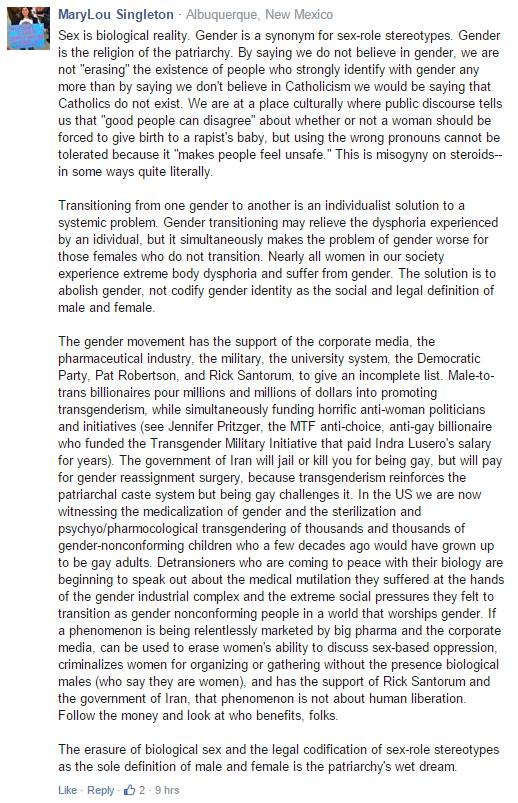
A few days ago, I wrote a blog post attempting to claim a middle ground between gender inclusivity and feminism in the midwifery community. I am a gay, transgender man, and I am a feminist. A vicious response by a lead midwife from the group Woman-Centred Midwifery was posted and then deleted later in the day. Have no fear, I obtained a screen capture of it so we can all read it and discuss.

Here’s a quick synopsis of the issue: The Midwives Alliance of North America (MANA) formerly referred to clients as "women" and "mothers," but in 2014 changed some (but not all) language in its core competencies document to refer to "pregnant people" and "birthing individuals." On August 20th, a dissenting group of midwives calling themselves "Woman-Centred Midwifery" wrote a letter to MANA protesting the “erasure” of the word “woman” from the documents.

I proposed that organizations like MANA can and should continue to use the words “woman” and “mother” in addition to gender neutral terms like “all birthing people” or “people of all genders.” There can be respect for women’s struggles against patriarchy and inclusivity of transgender, genderqueer and intersex individuals at the same time.

In response, Mary Lou Singleton, the first signatory on the Open Letter to MANA, wrote a comment on my blog post that is the most bizarre and hostile piece of misinformation I’ve ever seen. Her opinion about transgender people is made abundantly clear by her use of terms such as "medical mutilation" and "gender industrial complex."

But there's still more. Ms. Singleton asserts, "Male-to-trans billionaires pour millions and millions of dollars into promoting transgenderism, while simultaneously funding horrific anti-woman politicians and initiatives." Yes, it is true that there is one trans billionaire in the world. She doesn’t represent all trans people, who in general face high rates of poverty and are frequently victims of violence. I love a good conspiracy theory as much as the next person, but painting one of our society’s most oppressed groups as the oppressors is not only far-fetched, it contributes further to the transphobia and discrimination we already encounter.

Ms. Singleton continues: “transgenderism reinforces the patriarchal caste system but being gay challenges it... The erasure of biological sex and the legal codification of sex-role stereotypes as the sole definition of male and female is the patriarchy's wet dream. ” What about individuals like myself who are both transgender AND gay? What about transgender women who are lesbians? And, let’s remember the topic at hand - midwifery care during pregnancy, birth and post partum. I can say from personal experience that being a guy with a beard, a low voice and a pregnant belly does not constitute conforming to sex-role stereotypes in our society. Nursing a baby while sporting facial hair does not constitute conforming to sex-role stereotypes in our society.

As the first signatory on the Open Letter to MANA, I assume that Ms. Singleton must have a good deal to do with the motivation behind it. I fear that we have now seen the true colours of this particular “woman-centred midwifery” group - hateful yet utterly confused.  I hope that others who signed will carefully consider the implications and will withdraw their support of such a brutal ideology.

Many thanks to Sion Jesse for providing this screen capture:


1 Jan 2014

Resolution: Tackle Inner Transphobia


The hardest part about nursing my child as a trans person is that doing so forces me to come out to anyone who sees it happening.  If I nurse in public, people come up to me and ask what I’m doing. I guess they think that because I’m doing it where they can see it, this means that I am willing and available for questioning. It doesn’t occur to them that Jacob and I are nursing because we need to, because he has hurt himself or is very tired and I need to calm him down. If I nurse in front of a guest in my home, I feel obligated to explain a bit of our backstory.

Those of you who follow me on Facebook might have noticed that I’m rather dog-obsessed these days. We have a rowdy ten-month-old puppy that was having major behavior problems until he recently was diagnosed with a thyroid condition. I hired a professional trainer to come to our home and work with us. Of course, she could only come during Jacob’s usual nap-time, when he nurses a fair bit.

The trainer began her evaluation and then Jacob woke up crying. I brought him into the living room, and as I sat down to nurse him, I said something horribly awkward like, “Uh, we’re a bit of an unusual family. Ummm… I’m transgender. I was born female but took testosterone. Anyway, so I birthed him myself and I still nurse him.”

The trainer was wonderful about it. She said, “Oh, that’s fine. Now I want to show you how to teach Tadoo to accept a muzzle.”

Unfortunately, I found this trainer difficult for unrelated reasons, and located another one who was a better match for us in terms of our doggy issues. She, too, was only able to work with us at a time when Jacob was exhausted and badly needed to nurse. I could choose to either nurse him, or not hear a word the trainer was saying to us due to continuous crying. I said another explanatory spiel and started to nurse him in front of her.

The trainer said, “Oh, I’ve seen everything, don’t worry. I used to work as a nurse. A guy [sic] I used to work with was trans [a trans woman].  He [sic] and I got along really well.”

Then came the questions.

“How much milk do you make?”

Fairly innocuous. I didn’t mind to answer that. I explained that since I had chest surgery, I don’t have a full supply.

“Oh! I thought you’d gone the other way. I don’t know as much about female to male.”

Then she said something like, “When are you going to go all the way?” or maybe it was, “when are you going to complete your transition?”

Ian, my partner, told her that bottom surgery wouldn’t be very good for our hopes of having another child. I mumbled something about the risks of such a major surgery and then tried to get her back onto the topic of dog training.

There was so much in what she’d said that made me uncomfortable. I personally knew the woman that she had worked with, and I knew she would be horrified at the trainer’s use of male pronouns for her. Further, I don’t think of my transition as incomplete, but there would be no way to explain that in brief to someone who believes that gender is firmly binary.

There was something eerily familiar to me about her questioning. After her visit I remembered that medical professionals have asked me those sorts of questions, and she was indeed a retired nurse. In a clinical setting such questions are difficult because I can’t tell whether the practitioner needs to know the answers to take care of my health concerns, or if they are simply being curious (and inappropriate).  I feel like I am supposed to respond fully.

Why did I feel that I had to tell my dog trainer I am trans before nursing my child in front of her? It certainly doesn’t help normalize what I’m doing. If it is normal, then why do I need to explain it?

Coming out to her started a conversation that I didn’t want to have and led to her asking questions that made me uncomfortable. My intention was to share this as one piece of information and to get it out of the way, but that was not what happened. That said, I don’t believe that coming out to someone should give that person a right to ask intrusive questions. If a new acquaintance tells me, for instance, that she is a single mother, I do not respond by asking her, “What happened to your husband? Did he pass away, or did he leave you, or did you split up?”

My New Year’s Resolution: I am going to stop doing preemptive explaining in this sort of situation. I am going to do what I need to do, what is best for my child, and if someone is curious or confused about it, I will hand them a card with my blog on it, where I have laid everything out. I want to be an advocate and an educator, but I don’t need to continually open myself up to personal questioning in my day-to-day life. I will be brave and strong, and I will let go of my inner transphobia, embracing my own normalcy.

The trainer was excellent with our dog, by the way, and we have been making great progress.

27 Sept 2012

Overcoming Difference Through Milksharing

I've been having tons of fun reading and posting everyone's pieces for World Milksharing Week's Blog Carnival. After musing on it forever, I finally wrote my own today, about finding my place in the milksharing community.

I am a transgender man. I am in a gay relationship. I breastfeed my kiddo.

And I can tell you right now that I feel a deeper connection to our Mormon and Mennonite milk donors than I do to many of my other friends and community.

My past experiences as an LGBT person encountering religious folk have generally not been pleasant. Among many other comments, a Muslim friend once told me that being gay is worse than committing murder (I hadn't yet transitioned at the time), and a Christian noted that queer people burn in hell forever. My partner and I posted on Human Milk 4 Human Babies that we were a gay couple looking for milk for our baby, and assumed that LGBT-friendly donors would self select. We hoped that others would remain silent.

When I first realized that one of our milk donors, we'll call her Sherry, was Mormon, I was totally shocked that she would want anything to do with us. We had received her milk through a friend, and I thought that perhaps the original donor just didn't know much about us. We met for the first time a few days later, and Sherry gushed over our ten day old boy. In fact, I believe she said to him something like, "You make my uterus ache! Holding you makes me want another baby."

At that moment, I realized that Sherry and I had much in common. We both love holding babies, we are both attachment-minded parents, and we both really care about the health of babies - all babies. Sherry's milk maintained my son's normal gut flora on his fifth day of life, while a feeding of formula would have altered it, for the worse, for weeks to come.

Some Christian donors have told us that they don't understand everything about who we are, but they are open to learning, and they have a whole lot of respect for our commitment to breastfeeding and human milk. I am learning that there is great variety amongst individuals' religious paths. Not every Christian I meet is like the woman who once hurled the phrase "Jesus loves you" at me as if it was some kind of insult.

Outside the milksharing community, I often get comments like, "You're sure letting the baby run the show, aren't you? You know he would be fine. Formula isn't evil. It's ok to cry." I am simply responding to my son's needs - to be picked up, to nurse, to have human milk. I feel misunderstood, defensive and embarrassed when someone criticizes my parenting in this way. I know that I have done my own reading about everything from the risks of formula feeding to the effect of excessive cortisol in the brain of a baby who is left to cry. It's not that I lose confidence in what I'm doing when I listen to such remarks, but I very quickly feel that I am an unwelcome, "other" kind of person ("other" being a word I had previously associated only with being transgender in a cisgender world.)

A few years ago, I would never have guessed that my family's strongest, most supportive parenting community would include people who are aligned with religions that have deeply conservative threads. The milksharing community is incredibly diverse in terms of ethnicity, family structure, sexual orientation, financial status, religion, and language - it is expanding rapidly all over the world.

When one parent goes to the trouble to express and store her milk, and she posts on a social network to find someone to give it to so it won't go to waste, we know that she values human milk. When another parent responds to her post and drives across the city to pick up that milk rather than buying a can of formula from the corner store, we know that he or she prioritizes normal infant nutrition. Donors and recipients meet on the common ground of good health. It is that simple.

1 Sept 2012

Ian's Letter to LLLI

Update, May 2016: LLL changed its policy about the eligibility of Leader Applicants in 2014. Trevor became accredited as a Leader in May, 2016.

My partner wrote his own letter of support to the La Leche League International board:
Dear LLLI Board,

I am an LLL stakeholder. I am an “LLL Father” as defined in your Concept Policy Statements and my partner is an LLL member. These policies seem to fit me well. I support LLL, and I support my baby and partner’s breastfeeding dyad. These policies don’t need to change a bit in order to describe my role in our family.

Unfortunately, I see that these policies don’t fit a lot of people’s circumstances and cultures. They don’t fit my partner: he’s Trevor MacDonald, and he’s been breastfeeding our son for almost seventeen months.

As our son grows into toddlerhood, I watch as he comes back to the comfort and ease that breastfeeding brings. I cannot imagine anything else being so beneficial to him, and our dearest LLL friends are to be thanked. It was a difficult road to breastfeeding success. Trevor’s a devoted parent and I know his commitment makes him a skilful advocate of the art of breastfeeding. He was thrilled when he was asked to step forward and apply to be a volunteer Leader.

This sounds like a letter of recommendation and perhaps it is. Many have been skeptical of his motives, and have attacked what they imagine to be “our way of life”. Transgendered and gay people are excluded from the veneration of family life that is easily afforded to all others. Many people believe that GLBT people should have no reproductive rights to parent and raise children. Perhaps that is starting to change as more people recognize that GLBT people are not separate from humanity in general, in our activities and aspirations.

With that in mind, I am writing to request that you rewrite your policies so as not to exclude any breastfeeding family. Please allow Trevor and other GLBT people to participate in all levels of LLL.

Where we live, there is a human rights code that acknowledges gender identity and sexual orientation as protected characteristics. Would that were true in every nation. Although many human rights agencies have proposed this to the UN (in the Yogyakarta Principles), several nations are blocking this from being adopted. GLBT people are being routinely prosecuted, harassed, and killed in countries where LLL operates.

I am not asking LLLI to enter the fray and express an opinion about this worldwide struggle. However, I do believe that by emphasizing gender roles for parents, LLLI unwittingly facilitates discrimination against some breastfeeding families. This includes not only GLBT people, but also other cultural viewpoints and family circumstances.

I hope you will amend LLLI’s basic policy statements so as not to exclude any breastfeeding dyads and social situations. I urge LLLI affirm its support of breastfeeding without regard for any other defining characteristic.

Respectfully,
"Ian MacDonald"

24 Aug 2012

Why I Can Support Breastfeeding Women

Update, May 2016: LLL changed its policy about the eligibility of Leader Applicants in 2014 to be inclusive of transgender people. Trevor became accredited as a Leader in May, 2016.

In the past few days, some have mentioned they are concerned that women would not feel comfortable seeking breastfeeding advice from a man, or even attending a meeting when a man is present. Fortunately, I have not personally encountered anything like this at my local La Leche League meetings. I have attended a number of meetings together with brand-new, first-time moms, and these moms have shared openly at meetings and returned to meetings. I believe that a man who breastfeeds is perceived very differently from a man who does not.

What those of us who attend meetings have in common is that we want to breastfeed our kids. Early in my pregnancy, I did tons of reading about breastfeeding, and one thing that came up over and over again was this: a huge predictor of whether or not you will succeed in breastfeeding as long as you want to is if you have good community, peer support. I used to read that and say to myself, "Except for me. I don't count." When I did in fact get to go to an LLL meeting before my baby was born, I was incredibly grateful. I walked into the meeting shaking with nerves. I could barely speak when it was my turn to introduce myself and I explained my unique situation. I was terrified of what people would think of me and how they would react. I looked up at a certain point and realized that the women there were smiling at me and nodding their heads as they listened to me.

When we talk about experiences of oppression and fear, I feel that I have those in common with breastfeeding women. I was yelled at by a WOMAN for breastfeeding my baby in public - she said I was ruining my child. I spoke calmly to her at the time but cried for quite a while after it was over, feeling terrible. I get stared at when I breastfeed. There are some places where I don't breastfeed because it simply isn't safe. As a transgender guy nursing in public, I am not exactly in a position of power over others. I believe that any woman who learns in 30 seconds or so that I breastfeed my baby (and of course, having breastfed is a requirement for being a volunteer leader) will know that I have been through the same grief as any other breastfeeding person.

Men who have never breastfed have not experienced firsthand what breastfeeding parents have. Similarly, if a bunch of judgemental female OB's showed up at an LLL meeting, the breastfeeding women would probably not feel comfortable. In our chapter, when a non-breastfeeding medical professional wants to attend a meeting, she must gain special permission and she is asked not to contribute to discussion. I believe this whole issue is not simply about sex or gender, but about the common experience of breastfeeding, which in our society seems unfortunately to have a lot to do with oppression.

I try to keep my attitude in life, as well as my writing, positive. On the whole, our family has received FAR more support and well-wishes than any other kind of comment (I'm talking about personal emails, Facebook messages, and blog comments - I never read comments on news articles). However, I don't think that anyone breastfeeding in public in North America today can do so without at least a hint of fear or doubt, and I am certainly no exception. This is why we need La Leche League - a safe space to share accurate, science-based information about breastfeeding without judgement.

16 Aug 2012

My LLL Rejection Letter

Update, May 2016: LLL changed its policy about the eligibility of Leader Applicants in 2014 to be inclusive of transgender people. Trevor became accredited as a Leader in May, 2016.
Following my previous post, many people have asked to read what La Leche League actually wrote to me and their reasons for stating that I cannot become a leader. After some careful thought, I've decided to post the full text of LLL's response, as well as the letter I'd written hoping to convince them. In reading, please remember this: I LOVE La Leche League. Its books, meetings and online resources made breastfeeding possible for me. My experiences with my local LLL chapter have been fantastic and I am extremely grateful for this.

It seems that the decision regarding my leadership application comes down to policy: "Since an LLLC leader is a mother who has breastfed a baby, a man cannot become an LLLC Leader." I understand that I don't fit into LLL's definition here, I just think that their definition is poor. I believe that the point of the above statement is that in order to be a leader, you must have breastfed a baby for a certain length of time. It is your experience that counts in peer-to-peer support. At the time the policy was written, the authors assumed that men wouldn't/couldn't breastfeed, so they defined a leader as a woman. I kinda doubt that many people envisioned my own scenario. I think that the interpretation of the policy should evolve.

If you believe that LLL needs to change its policies in order to become more inclusive, please consider writing to the LLL board with your concerns. Don't simply withdraw your support from the organization - there are TONS of amazing, forward-thinking Leaders. Let's not forget about them and the great work they do!

Here is the first response LLL sent to me:
Dear Trevor,

Firstly I want to thank you for your interest in leadership, in sharing your experience with mothers and in expanding the reach of LLL in the community. Your contribution to the Group is clearly greatly valued. Thank you also for your patience while I consulted with members of the Boards of La Leche League Canada (LLLC) and La Leche League International (LLLI).

Our policies do preclude men from becoming Leaders. LLLC Policy states:

4.14 MEN AS LEADERS

Since an LLLC Leader is a mother who has breastfed a baby, a man cannot become an LLLC Leader. (March 1994)

The wording echoes LLLI policy:

Leader Eligibility - (second paragraph) Since an LLL Leader is a mother who has breastfed a baby, a man cannot become an LLL Leader.

LLLI's policies and mission statement consistently speak of Leaders as mothers, giving mother-to-mother support.

There are also Concept Policy Statements which include the mother/baby relationship and the father's role. The Concept Policy Statement on the father's role speaks of "... understanding of the father's role, not as a mother substitute, but as a unique figure in the baby's life."

You told me that you do not identify as a mother. You are your baby's father. According to LLL philosophy the roles of mothers and fathers are not interchangeable. I think that this would make it difficult for you to represent LLL philosophy. You acknowledge that some women may not be comfortable working with a male Leader. A Leader needs to be able to help all women interested in breastfeeding. Fathers are able to help in other ways, for example an informed LLL father who is supportive of LLL philosophy might present a fathers' meeting.

I'd also like to share with you some of the wording of LLLI's policy on donated milk:

A Leader shall never initiate the suggestion of an informal milk-donation arrangement or act as an intermediary in such a situation. If a mother wishes to discuss these options - which may include donating expressed milk, wet-nursing or cross-nursing - the Leader’s role is to provide information about the benefits and risks, as mentioned above, including the limitations of home sterilization of expressed breast milk.

This would mean that a La Leche League Leader would be able to share information about your experience with another mother, but as a Leader you would not be free to initiate or recommend this suggestion. If you wanted to share this experience with others, another way of helping, other than LLL leadership could be a better fit for you.

I would also like to address your interest in leading an LGBT LLL meeting. I think that it is important for you to know that we do not accredit specialty Leaders. So for example Leaders often say that they need a working mother as a Leader for their Group because she can relate to the mothers in the population the Group serves - I would disagree - what qualifies a Leader to relate to those mothers is her experience of mothering, not her experience of separation. Similarly in this case it is the experience of mothering through breastfeeding which qualifies a Leader to help others. Any Leader can help anyone who is interested in breastfeeding. LLL has accredited a number of lesbian mothers as Leaders. They lead Groups for all mothers. I think that the group that you envisage would work better not as an LLL Group because its scope is beyond breastfeeding and LLL is concerned specifically with breastfeeding. Other topics may come up at meetings as they relate to breastfeeding, but we do not, for example, recommend any particular method of or setting for childbirth, sleeping arrangements, diet or educational philosophy and (as noted above) we could not recommend using donated milk. There is definitely a place for groups with a different focus, such as attachment parenting groups, but these are not LLL Groups. Thanks for sharing information on your Facebook group. This is the kind of thing that would definitely work better not as an LLL affiliated Group, since there are guidelines on how LLL Facebook groups can be run.

One thing you said which I must respond to is that "LLL now supports working mothers, women breastfeeding after reduction surgery, women who are inducing lactation, single mothers, and lesbian families". I wondered if you think that this is new - that we did not support them before. In fact we have always supported all of these mothers. We support all women interested in breastfeeding. I think there may be confusion between whom we support and who can be a Leader. You mention "LLL's conservative, Christian roots" as if LLL has moved away from its roots. In my view LLL's roots are in our philosophy which has not changed and has not needed to change in order for us to accept and help all mothers, irrespective of their background. ALthough LLL was founded by seven women who attended the same Roman Catholic group and hatched the idea that became LLLI at a church picnic, they never ascribed a religious sponsorship to LLLI, never required any religious affiliation, whether Catholic, Christian or other. The mission, the philosophy, the concepts - those are the roots of LLLI and they are what you and I value so much about LLL.

I would welcome your comments or any questions you might have.

Thank you again for your interest in LLL and in helping others. I look forward to hearing your thoughts.

And here's my original letter:

Through communication with my local LLL leader, I understand that you have some concerns over my potential leader application. It is true that I do not identify as a mother. I am a transgender man - I birthed my baby and have been breastfeeding him for 13 months, but I am a father. However, I certainly "mother" my baby by caring for him in all the traditional ways that a mother would. I have benefited tremendously from my participation in La Leche League, and I would love to be able to give back as a leader as well.

Without the support and information provided to me by LLL, I doubt that I would be breastfeeding today. During my pregnancy, a leader told me about Diana West's Defining Your Own Success: Breastfeeding After Reduction Surgery. I learned that despite my own dramatic chest surgery, it might be possible for me to produce some milk, and to have a satisfying breastfeeding relationship by using an SNS. I attended LLL meetings at ------------, where I received a warm welcome both from leaders and other breastfeeding parents. After the birth of my baby, I gratefully accepted intensive one-on-one help from a leader to ensure a good latch even with my meagre chest tissue.

It is my hope that I could some day reciprocate the compassion, encouragement, and expertise that made such a difference to my personal breastfeeding experience. I overcame significant challenges in order to breastfeed and I believe that this background, combined with leader training, will enable me to effectively help others. I acknowledge that some women may not be comfortable working with a male leader. Nevertheless, I wonder if there may be a way to facilitate meetings with those who feel they could benefit. My local Leader suggested holding meetings oriented toward gay, lesbian, bisexual, and transgender parents interested in breastfeeding. I know that these individuals need support and that they do already turn to LLL to try to find it. For example, a transgender man reached out to me via my blog and mentioned that he had attended LLL meetings where he lives in California. He was sadly unable to latch his baby. I'm sure that my situation and his, although very unique today, will become increasingly common in the future. Queer-positive meetings that include the possibility of Skype access could provide meaningful assistance to parents in need around the world.

I understand that LLL's current philosophy emphasizes mother-to-mother support, and that the idea of a breastfeeding dad is entirely new territory. In recent articles as well as her new book, Elisabeth Badinter has emphasized LLL's conservative, Christian roots. However, I was disappointed that she doesn't recognize the ways in which the organization has grown. In fact, LLL now supports working mothers, women breastfeeding after reduction surgery, women who are inducing lactation, single mothers, and lesbian families, even though these situations were controversial as little as a few decades ago. I very much hope that LLL will continue to evolve and meet the needs of today's families - including any breastfeeding dyad wishing to find support and information.

Please let me know if you have any further questions about my situation. Also, feel free to read my blog and published articles. I consider them available for anyone to read, but I have changed my name and my child's name in these materials in order to protect my family's privacy. I look forward to your response.