Showing posts with label chestfeeding. Show all posts

26 Jun 2018

Breastfeeding/Chestfeeding and Gradual Weaning: A Snapshot in Time


Three-year-old: Waaaaaaa! I need uppy [being picked up] and nursing!
Purple fleece pants

Me: Ugh, I have to get the seven-year-old ready for school. I think you might be verrrrry hungry since you haven't eaten breakfast yet. Here, have a peach.

Her: Oh yeah! SO hungry. [Sigh. Eats peach.]

Ten minutes later.

Her: Waaaaaaaa! I need uppy and nursing!!

Me: Ugh. I was planning to try to do stuff, and things. So many things. Oh, I know what it is. You're super hot in those fleece-lined winter pants you picked out. How about we help you find something cooler to wear?

Her: Oh, yeah! I'm SO hot!!

After changing clothes.

Her: I need uppy and nursing!!!

Me: To deal with the aftermath of having felt so hot.

Her. Yeah.

Me: [Sigh] Ok.

5 Apr 2017

Parenting Survival: When My Toddler Can't Sleep

The Toddler was up at 2am so we went out to listen for frogs. Unfortunately, the frogs in the ditch seemed to be fast asleep. We settled for waking up all the animals in the barn. We got the rooster crowing nicely and the goats got up to pee and poop. Then we turned off the barn light and went out again, leaving them all wide awake. None of it woke the frogs.

Inside the house, we cooked plantain because the Toddler was famished. 
 
Toddler: Friends X and Y were here, but not right now.

Me: No, not right now. You know why?

Toddler: X and Y are sleeping!

Me: YES!!!

Smiles and cuddles. Yawn.
 
ALL this started because Toddler woke up wanting to nurse and in my groggy state I didn't notice that the damn supplementer tube was pulled out of the water and not working, which led to much screaming. Not your average breastfeeding problems, yet somehow I am certain every parent has been there done that in some similar fashion.

Now she has nursed back to sleep and is using my belly for her pillow.

Supplementer? Toddler? Yes. After relying on it heavily when she was an infant, we just have not been able to shed the tube. It is part of our nursing relationship, even though the "supplement" is water. She is about the best hydrated kid I know, and I suspect the water is alright for her teeth, too.

27 Sept 2016

La Leche League Celebrations!


2016 is La Leche League’s 60th anniversary, so this worldwide breastfeeding support organization is having some big celebrations. I’m honoured to be participating in two of these events, one online and the other in Chicago! 

Here’s the info:

We’re having an online global LLL meeting for 24 hours straight on October 1st.  Any person, regardless of gender, who is breast or chestfeeding or planning to breast or chestfeed in the future is welcome to join us. This is just like a local chapter support meeting, but online. The meeting is happening on Facebook, and you can join the group for it here. LLL leaders from around the world are hosting different hours, including volunteers based in Canada, New Zealand, Japan, Slovenia, Italy, France, Israel, USA, Mexico, Korea, Netherlands, and more. We’ll post discussion threads, and folks can ask questions, comment, and share information and support. My hour, with co-leaders Melissa Kent and Linda Mellway McIntyre, is taking place at 10pm Greenwich Mean Time.


An in-person celebration is taking place in Chicago on October 15th. I’ll be speaking on a panel with five other leaders, talking about my journey with LLL and why I’m so passionate about this amazing organization. I’m extra super excited about the evening dinner with LLL founders, including Marian Tompson. We’ve talked on the phone a few times, and Marian has been a staunch supporter of my path to breastfeeding. I have long been inspired not only by her work founding LLL, but also her advocacy around breastfeeding and HIV. This will be my first time meeting her in real life! I’ll leave you with my favourite Marian Tompson quote from an interview by the Pioneer Press for the Wilmette Life:

When Tompson gave birth to her third child, a group of 17 hospital employees—externs, interns, even the receptionist—came to watch. "They circled my delivery table," Tompson said. "After it was over, one of the residents walked up to my doctor and said, 'Doctor, how did you do it?'"

23 Aug 2016

Publishers Weekly: Ultra Queer Book Review

I'm excited to report that Publishers Weekly reviewed my book, Where's the Mother: Stories from a Transgender Dad.

And, the reviewer appreciated the ways that I draw attention to varying degrees of privilege, including my own. It's a rad, queer review!

From Publishers Weekly: "MacDonald’s debut memoir tells a tale noticeably absent from the plethora of parenting and breastfeeding books available: that of a transgender man in a gay marriage to a cisgender man who was himself adopted, both desperately trying to feed their biological child nothing but human milk... MacDonald owns his identity, using his elevated platform to call attention to issues faced by transwomen and transmen, people of color, and those living in poverty. Most importantly, his story of transitioning is frank, clever, and easy to process, providing plenty of parallels to his later struggles with nursing for curious cis readers... a refreshing and insightful narrative."


17 May 2016

Chestfeeding Research Published!


In this University of Ottawa study, funded by the Canadian Institutes of Health Research, I interviewed 22 transmasculine individuals.


Here’s a quick overview of what’s new and exciting about this paper:


1)     Discussion of pregnancy and chestfeeding after top surgery. Out of 22 participants, 9 had chest surgery before they became pregnant. They experienced different amounts of mammary growth during pregnancy. Some chose to chestfeed and others didn’t. This is the first paper to discuss experiences of chestfeeding after chest surgery!


2)     The paper includes the first academic reference to a transmasculine individual binding during the lactation period, and taking testosterone during the lactation period. As the paper states, the participant reported that his child had normal testosterone levels, i.e., it appears that the child was not exposed to any effects of testosterone through the milk. Also, the participant reported that there seemed to be no decrease in his milk supply. Binding and taking testosterone allowed the participant to chestfeed for longer because these actions helped mitigate his gender dysphoria.


3)     Zero of the participants’ surgeons discussed the potential for future chestfeeding before performing top surgery. Equally important, participants reported that they didn’t feel comfortable bringing the topic up, either. They cited their surgeons’ strong and obvious belief in the gender binary and the feeling that they needed to tell the right story in order to access chest surgery.


4)     Changes in secondary sex characteristics during pregnancy. References in the academic and medical literature state that a low-pitched voice and facial hair are permanent results of taking testosterone. However, in this paper, we report the experience of one participant who found that when he stopped taking testosterone and became pregnant, his facial hair literally fell out and his voice became higher in pitch. 


5)     Experiences of gender dysphoria. As you might expect, some study participants reported experiencing gender dysphoria when chestfeeding. Some of them stopped chestfeeding due to gender dysphoria. However, others did not gender the process of feeding their babies from their chests at all. Nine of 16 participants who initiated chestfeeding reported experiencing no gender dysphoria while chestfeeding. Three of them didn’t experience gender dysphoria during chestfeeding but they DID experience it after they weaned their babies. The usefulness of chestfeeding in terms of nutrition and bonding was cited frequently as a reason for doing it. 


6)     Unexpected and unwanted lactation. Several participants who had had chest surgery and chose not to chestfeed their babies experienced problems with milk coming in. One had early symptoms of mastitis. Both the participants and their health care providers were unprepared. 


7)     How gender dysphoria can be triggered by health professionals. We tend to think of gender dysphoria as something that a trans person experiences because of their body. In this study, we found dysphoria could be triggered, in a person who otherwise was not experiencing it, by the way they are treated by others. From the paper: “care providers and others are capable of causing gender dysphoria in a patient by misgendering them. Conversely, care providers can affirm a patient’s gender identity through appropriate language, respectful touch, and other intentional actions, and thus alleviate distress associated with gender dysphoria.” In other words, the act of chestfeeding itself might not cause gender dysphoria for a transgender guy, but a health care provider talking about putting baby to “mom’s breast” might do so. 


8)     Using donor milk. Seven of the 22 participants said they used or intended to use donor milk, and one donated milk to others. 


9)     The language. This study was trans led, and the language used throughout the paper is appropriate for our community. We didn’t say in this paper, “some trans men use this word chestfeeding” and then ourselves use breastfeeding or nursing after that when we wrote in our own words. We used chestfeeding throughout the paper, as THE word. Why? Some trans guys are okay with “breastfeeding,” but some are very triggered by it. We didn’t think any trans guys would be triggered by “chestfeeding,” so we decided to use that term throughout.


What a way to celebrate the International Day Against Homophobia, Transphobia and Biphobia!


With so much thanks to the study participants who made this possible, and my research team members Joy Noel-Weiss, Diana West, Michelle Walks, MaryLynne Biener, Alanna Kibbe, and Elizabeth Myler. Big thank you as well to Karleen Gribble for her detailed comments in the open peer review process!

1 Jan 2014

Resolution: Tackle Inner Transphobia


The hardest part about nursing my child as a trans person is that doing so forces me to come out to anyone who sees it happening.  If I nurse in public, people come up to me and ask what I’m doing. I guess they think that because I’m doing it where they can see it, this means that I am willing and available for questioning. It doesn’t occur to them that Jacob and I are nursing because we need to, because he has hurt himself or is very tired and I need to calm him down. If I nurse in front of a guest in my home, I feel obligated to explain a bit of our backstory.

Those of you who follow me on Facebook might have noticed that I’m rather dog-obsessed these days. We have a rowdy ten-month-old puppy that was having major behavior problems until he recently was diagnosed with a thyroid condition. I hired a professional trainer to come to our home and work with us. Of course, she could only come during Jacob’s usual nap-time, when he nurses a fair bit.

The trainer began her evaluation and then Jacob woke up crying. I brought him into the living room, and as I sat down to nurse him, I said something horribly awkward like, “Uh, we’re a bit of an unusual family. Ummm… I’m transgender. I was born female but took testosterone. Anyway, so I birthed him myself and I still nurse him.”

The trainer was wonderful about it. She said, “Oh, that’s fine. Now I want to show you how to teach Tadoo to accept a muzzle.”

Unfortunately, I found this trainer difficult for unrelated reasons, and located another one who was a better match for us in terms of our doggy issues. She, too, was only able to work with us at a time when Jacob was exhausted and badly needed to nurse. I could choose to either nurse him, or not hear a word the trainer was saying to us due to continuous crying. I said another explanatory spiel and started to nurse him in front of her.

The trainer said, “Oh, I’ve seen everything, don’t worry. I used to work as a nurse. A guy [sic] I used to work with was trans [a trans woman].  He [sic] and I got along really well.”

Then came the questions.

“How much milk do you make?”

Fairly innocuous. I didn’t mind to answer that. I explained that since I had chest surgery, I don’t have a full supply.

“Oh! I thought you’d gone the other way. I don’t know as much about female to male.”

Then she said something like, “When are you going to go all the way?” or maybe it was, “when are you going to complete your transition?”

Ian, my partner, told her that bottom surgery wouldn’t be very good for our hopes of having another child. I mumbled something about the risks of such a major surgery and then tried to get her back onto the topic of dog training.

There was so much in what she’d said that made me uncomfortable. I personally knew the woman that she had worked with, and I knew she would be horrified at the trainer’s use of male pronouns for her. Further, I don’t think of my transition as incomplete, but there would be no way to explain that in brief to someone who believes that gender is firmly binary.

There was something eerily familiar to me about her questioning. After her visit I remembered that medical professionals have asked me those sorts of questions, and she was indeed a retired nurse. In a clinical setting such questions are difficult because I can’t tell whether the practitioner needs to know the answers to take care of my health concerns, or if they are simply being curious (and inappropriate).  I feel like I am supposed to respond fully.

Why did I feel that I had to tell my dog trainer I am trans before nursing my child in front of her? It certainly doesn’t help normalize what I’m doing. If it is normal, then why do I need to explain it?

Coming out to her started a conversation that I didn’t want to have and led to her asking questions that made me uncomfortable. My intention was to share this as one piece of information and to get it out of the way, but that was not what happened. That said, I don’t believe that coming out to someone should give that person a right to ask intrusive questions. If a new acquaintance tells me, for instance, that she is a single mother, I do not respond by asking her, “What happened to your husband? Did he pass away, or did he leave you, or did you split up?”

My New Year’s Resolution: I am going to stop doing preemptive explaining in this sort of situation. I am going to do what I need to do, what is best for my child, and if someone is curious or confused about it, I will hand them a card with my blog on it, where I have laid everything out. I want to be an advocate and an educator, but I don’t need to continually open myself up to personal questioning in my day-to-day life. I will be brave and strong, and I will let go of my inner transphobia, embracing my own normalcy.

The trainer was excellent with our dog, by the way, and we have been making great progress.

11 Feb 2013

Using a Supplementer Long-Term

I've been thinking about this post for ages and was finally inspired to sit down and write it when someone asked me for advice on the matter. So, thank you for the question!

On demand, supplemented nursing sessions with a newborn or young baby seemed obvious enough. When Jacob was hungry, we fed him. When he wanted more, we gave him more. I almost always used supplement during our nursing sessions.

When we introduced solid foods, we assumed that food would take the place of some of the donated breast milk we were continually struggling to find. To our surprise and dismay, it didn't seem to work that way. Jacob took a long time to really get good at eating solids, and even once he did, he never seemed to want any less milk. I sometimes tried to nurse him without using supplement, but he strongly preferred the fast flow that he was used to. Some people suggested not using supplement at night, yet I found that if I didn't he would get increasingly frustrated until he was wide awake. If I used the supplement, I could get him back down to sleep much more easily in the middle of the night (not that it has ever been easy, per se...).

I casually asked friends what they thought I should do, and several pointed out that if a parent with normal milk making capacity nurses frequently, he or she will continue to produce plenty of milk even as the child gets older. In contrast, a La Leche League Leader explained that as the baby gets older, the parent's milk supply naturally decreases. Others noted that babies who were bottlefed typically still get, even as toddlers, a large bottle of milk before going to bed and another one for nap time.

Around the time I was trying to figure out how to proceed, I saw a post in my parenting group from a mom of a 14 month old baby. She was newly pregnant, and her milk supply had disappeared. Her 14 month old still badly wanted to nurse, but this was painful for the mom. They went through a challenging weaning process and the mom started giving bottles of donated breast milk. Her child needed both the milk and the nursing relationship, but it was not possible for her to give. They did the best they could under the circumstances.

I know of another parent who, like myself, is breastfeeding after having had chest surgery. She makes enough milk to have the occasional let-down, but does not have a full supply. Her toddler is two and a half years old and nurses a lot AND gets a significant amount of milk in bottles. Early on, they used a supplementer, but they eventually got to a point where the child no longer wanted it. Their nursing relationship is still very strong.

In another example, the parent of a friend of mine used a supplementer due to her diagnosis of insufficient glandular tissue (IGT), and continued nursing until her child was three. As a toddler, the child would ask for "big milk" when she wanted to nurse using the supplementer, and "little milk" when she wanted to bare nurse. Given the variety of stories I'd heard, I decided to just keep doing what we were doing, since it seemed to work okay for both of us. We switched to putting cow's milk in the supplementer when we could no longer get donated human milk, with no apparent ill effects.

The issue came up again last fall when Diana West came to Winnipeg for a conference. She is the author of Defining Your Own Success: Breastfeeding After Reduction Surgery, and, of course, she is an expert on at-breast supplementation. She stayed with us for a few nights, and was shocked to see just how much supplement we prepared to take to bed with us in the evenings. I felt so busted! If I remember correctly, the much-admired breastfeeding authority said that Jacob doesn't need much milk at this point - it is the nursing relationship that he wants and needs. She reminded me that he was getting some milk from me. She also enthused about how much easier my life would become if I no longer needed to carry supplement around on outings or take it with me to bed at night.

I tried harder this time to wean ourselves from our crutch, but with the same result as before. If I didn't use the supplement, Jacob would quickly get frustrated. The universal and incredibly irritating toddler habit of nipple twiddling got infinitely worse (not surprisingly, this is something babies do to try to get a let-down!), and I again couldn't get him back to sleep at night. To add to the troubles, nursing without much coming out was quite uncomfortable for me, too. Jacob will be two in April, and this is where things stand: we still use lots of supplement at night, during naps, and to re-connect at other points during the day. Sometimes we go on outings without it and I nurse him as needed, but often I take it along for back-up, and then don't end up using it.

As Jacob's vocabulary increases, he is beginning to express how he would like to nurse. He says "nay-nay" for nursing, but also "milk" when he wants to use the supplementer. Sometimes he pleads with me "up!" and "fridge!", until I get up and grab the supplement from the fridge. Other times I ask him if he wants me to get the extra milk and he shakes his head "no" while he is latched on. Ultimately, Diana and everyone else said that we have to do what works for us, and I couldn't agree more. We'll let you know as we go.

31 Oct 2012

Using an At-Chest Supplementer

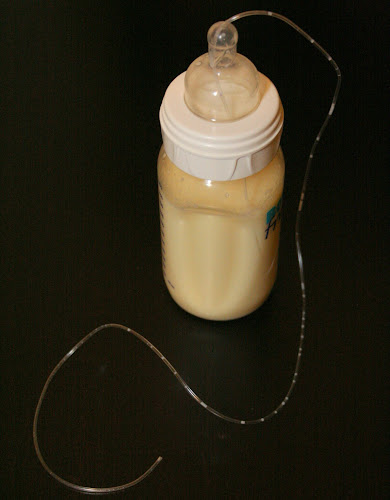
Homemade at-chest supplementer consisting of a bottle, nipple and tube.
Making an at-chest supplementer is easy and cheap.
Note that this post is not medical advice. I am sharing here what I have learned through personal experience. If you are concerned about your baby's health, seek help from a doctor.

Using an at-chest (at-breast) supplementer is a great way to feed your baby if you are unable to produce all of the milk he or she requires. This method is completely supportive of the nursing relationship, and does not involve your baby latching on to any artificial nipples, such as bottle nipples. As wonderful as it is, this kind of supplementer can be brutally hard to use at first. I've been using one for over eighteen months, so I'll share some tips!


First, let me explain what it is. All the different versions consist of a container to hold the supplement and a long, narrow tube. One end of the tube goes into the supplement, and the other end is placed right by your nipple. Your baby latches onto both the tube and your nipple simultaneously, drawing supplement from the container and getting all the milk that you are producing, too.


What's great about it? Using an at-chest supplementer allows you to do all feedings at your own chest. This is amazing for your nursing relationship and all the bonding that comes with it. It's also important for promoting normal jaw development in the infant - the physical action of chestfeeding develops a baby's muscles differently than bottlefeeding does. Using the supplementer helps you produce more milk, too, because even at times when your baby is only receiving supplement and you are not producing any milk, your chest tissue is being stimulated to make more. For those who produce little to zero milk, using the supplementer makes it possible to still have a nursing relationship.

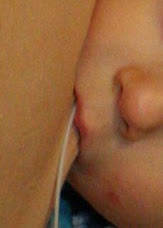
Jacob latches with the supplementer near the corner of his mouth.
How do I get one? You can buy a commercial supplementer, or you can easily and cheaply make your own. I prefer the homemade kind, so that's what I'll describe first. You can use any baby bottle to hold your supplement. Get gavage tubes from a pharmacy, or in bulk from a medical supply store. The kind to look for is 5 French (that's the diameter), 36 inches in length. You might want a tube with a bigger diameter if your baby has a weak suck, a complication of some conditions such as cleft palate or prematurity. Using a shorter tube is super irritating because it forces you to hold the supplement container so close to your baby's mouth (who has enough hands to do all that?!). Cut off the extra plastic bits, if there are any, on one end of the tube. The other end will be closed and rounded and will have two or three holes just before the tip - I cut off this part too because otherwise the supplement doesn't seem to come out easily. Some don't do this because they believe that cutting this end makes the tube sharp (we never experienced a problem with this). Thread one end of the tube through the bottle nipple (expand the opening of the nipple with a knife if required) so that it is sitting in the supplement. To clean the tube after use, just suck some hot water through it. Do not boil this kind of tube - it is not made from materials designed to withstand such a hot temperature.

The main difference between the homemade and commercial systems is cost. The Lact-Aid is $48.75 or $62.50, depending on whether you get the deluxe or standard model. The Supplemental Nursing System (SNS), made by Medela, was $42.99 on Amazon when I checked at the time of writing. It should be noted that Medela is a company that violates the World Health Organization's code on the marketing of bottles and artificial nipples. Unfortunately, its product name, SNS, is often incorrectly used as a generic name for a supplementer. You can make your own supplementer for the cost of any baby bottle and nipple and a $5.00 gavage tube. If you use this system in the long-term, you will end up spending a fair bit on tubes. They can be bought in bulk for about $1.00 a piece, and most people replace them once per week (or when they get too stiff to use) - so, you could spend $52 on tubes if you use the homemade supplementer for one year. I've been told by several people who used an SNS or Lact-Aid for over a year that both systems hold up very well to wear and tear and rarely need replacement parts.


With both the SNS and the Lact-Aid, the supplement container hangs around your neck. I like my homemade version because I can put the container down beside me on a table or hold it between my knees - I hated the idea of something relatively heavy dangling from my neck. I also like being able to have a decent amount of supplement on hand. The containers of the SNS (re-usable) and Lact-Aid (disposable bags) are smaller than most baby bottles. My number one reason for using my homemade version is that it is simpler - it has only three parts (bottle, nipple, and tube).


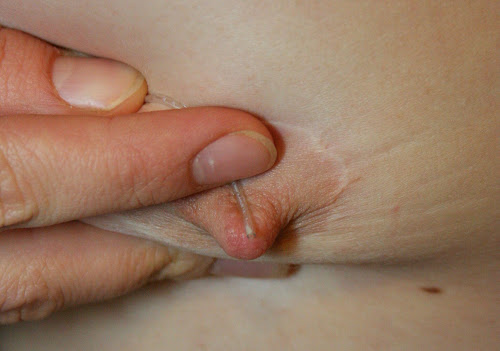
I mould my chest tissue using my middle finger and thumb, and position the tube with my forefinger. End of tube is in line with the end of my nipple.
Moulding the chest tissue and positioning the tube
How do you actually use this thing?? Some people latch the baby on first, and then sneak the tube in through the corner of the baby's mouth by moving a bit of breast tissue gently out of the way. This never worked for me. I have so little chest tissue that if I moved any part of it, my baby would lose his grip immediately. A downside of this method that a friend of mine learned the hard way is that it may become impossible to sneak the tube into your baby's mouth once he or she has teeth getting in the way.

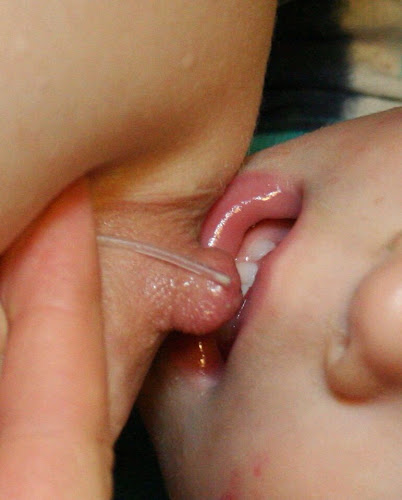
There's a lot to have to juggle between latching your newborn and placing a tube. This is how I do it: I get my baby in position and latch him first without the tube (otherwise he gets too antsy waiting for me to have everything ready). Then I take the end of the tube and get it near the end of my nipple. I briefly un-latch my baby. I use my thumb and middle finger to mould my chest tissue into a shape that my baby can latch to, and use my index finger to position the tube so that the end of it is in line with the tip of my nipple. The tube comes from above my nipple so that it points to the roof of my baby's mouth when he latches. I slip my index finger out of the way just as he is latching on and then I hold the tube in place for an extra second or two until the supplement is flowing up the tube. Some people tape the tube to their chest, but this didn't work for me. The tube would always flip in the wrong direction when I tried to mould my chest tissue for my baby to latch.

Immediately before latching, Jacob's mouth is open and the tube is already well-placed.
About to latch
Using a supplementer is initially very challenging. I couldn't position it on my own for the first two weeks! My partner had to help me with every single feeding until I developed this method of doing it on my own. It helped when my baby's latch became stronger. Nowadays, at eighteen months, I don't even think about it. My baby latches himself on, and I know exactly where the tube needs to go so that the supplement will come up easily.

Have you used a supplementer? Do you have any additional tips to share that we should know about?

8 Oct 2012

I LOVE Toddler Nursing

Nursing my kiddo has never been more fun than it is now.

Boy covers my nipple with his hands. Looks at me. Grins. I show my surprise and confusion: "Where, oh, where did my nipple go? I just can't seem to find it anywhere!" Boy takes his hands away, with a triumphant ta-da type gesture. I demonstrate my delight: "Oh, there's my nipple!" Repeat in classic peekaboo-with-toddler fashion.

Boy looks at my nipple. Yep, he's got that I'm-about-to-latch look on his face. He obviously wants to nurse. He leans in, kisses my nipple, and then pops back up and laughs uproariously. He tricked me! Repeat and repeat.

Some of the best moments of all happen after my boy has had a usual toddler tumble. He reaches up for my arms. Once I'm holding him, his right thumb goes in his mouth and his left hand searches through my shirt buttons. "Do you want to nurse?" I ask him. He nods his head quickly between full body sobs. There is no more guessing - he knows what he wants and how to tell me. He can affirm that, yes, absolutely yes, the only thing that will do right now is nursing.

We started out assuming we would formula-feed with bottles, and now I'm nursing an 18-month-old. I can't wait to see where the rest of this amazing parenting journey will take us.

5 Mar 2012

Tips for Transgender Breastfeeders and Their Lactation Educators

 This information is free for personal use. Any trans folk are welcome to print it out and give a copy to their health care provider! However, if you wish to publish any part of it or quote this material in a presentation you must obtain formal permission. Thanks!

I'm not a health care professional and this blog entry does not constitute or replace medical advice. Please consult your doctor if you need medical advice. 

**** This blog post has been updated and now comes in three parts: 1) general information 2) assisting trans men 3) assisting trans women

Transgender/transsexual/genderfluid Tip Sheet - General Information
Prepared by Trevor MacDonald

This tip sheet provides some key details you should be aware of when offering reproductive/lactation support to transgender, transsexual, or genderfluid individuals. Keep in mind that in most ways, medically and otherwise, trans people are just like everyone else. There is a list of key terms and their definitions at the end of this sheet. 

Gender vs. Sex

Our reproductive organs and sexual anatomy define our physical sex - male, female, or intersex. Gender, however, is a person's inner awareness of their femininity/masculinity. Gender expression has to do with how an individual presents their gender to others within a given cultural context. For example, within western culture the colour pink has gone from being a traditional boys' colour to one for girls in only a few generations.

In most cases, a persons biological sex conforms to their gender and gender expression. The term for such people is cisgender. Transgender, transsexual, and genderfluid people have a gender identity or gender expression that does not match what their particular society expects of them according to their anatomy. Some trans people choose to use medical therapies such as hormone treatments and/or surgeries to alter their bodies. Others do not want or are unable to obtain such interventions, but may express their gender in other ways such as choices of clothing or makeup.

Gender Identity vs Sexual Orientation

A person's gender identity has to do with how they self-identify. Their sexual orientation refers to what kind of person they are sexually attracted to. A person can be trans and gay, or trans and straight, or trans and bisexual, etc.

Asking Questions

It may be essential to ask questions regarding an individual's gender identity or history of medical transition in order to provide adequate care. However, only ask those questions that are relevant. Do not ask questions solely out of curiosity.

Language

Always use the pronouns that refer to an individual's expressed gender, not their assigned birth sex. For example, a male-to-female transsexual woman is 'she'. If you are unsure of which pronouns a particular individual may prefer, simply ask in a respectful manner. If you make a mistake, apologize promptly and move on. Some people prefer gender-neutral pronouns, such as 'them' and 'they' or 'ze' and 'zir'.

The following terms are derogatory. Do not use: tranny, he-she, she-male, gender-bender, or transvestite.

Do not refer to someone 'masquerading', 'pretending', 'disguising', etc. in their gender.

Use transgender as an adjective, not a noun or verb.
            He is a transgender person, not "He is a transgender." (similar to how it is best           to say             "He is a black person", rather than "He is a black")
            A person is transgender, not transgendered. It is never necessary to add the suffix 'ed' to transgender.

Common terms

*Note that these definitions explain how the following terms are generally understood. However, individuals within the trans community may define them differently or may self-identify outside of these labels.

cisgender: someone whose gender identity matches their assigned birth sex (they are not transgender)

FtM: female-to-male trans person

MtF: male-to-female trans person

gender binary: The notion that there are two genders, male and female. Many trans people understand gender as a spectrum. 

gender expression: a person's outward presentation of their gender through physical traits, clothing, makeup, etc.

genderfluid/genderqueer: someone who identifies between or beyond the extremes of female and male on the gender spectrum, or who identifies as both female and male at once or as some combination of genders.

gender identity: a person's inner sense of their gender.

intersex: a condition in which an individual is born with reproductive and/or sexual anatomy that does not fit the usual male or female definition.

trans: an umbrella term meant to include transgender, transsexual and genderfluid people

transgender: a person whose gender identity or expression does not match the typical societal expectations of their birth-assigned gender. Transgender people may or may not wish to modify their bodies to varying degrees by taking hormones or having surgery.

transition: a change in one's public gender identity (one's inner gender identity may have been the same since birth).

transsexual: a person whose gender identity does not match their sex as it was assigned at birth. Transsexual people usually wish to modify their bodies in order to alleviate this incongruence.


Tip sheet for assisting trans men

Trans men are individuals who were born with anatomy typical of females but identify on the masculine side of the gender spectrum. Some choose to give birth and/or nurse their babies, and may require lactation support.

Language

Although both men and women have breast tissue, the word 'breast' is most often associated with women. Trans men may be more comfortable referring to their 'chest' and 'chestfeeding' or 'nursing' their infants, rather than 'breastfeeding'. Trans men may refer to themselves as 'dad', 'papa', or another term, rather than 'mom'. Don't make assumptions. Remember that if you are unsure, it is best to ask about which names and pronouns an individual prefers to be used. If you make a mistake, apologize promptly and move on.

Testosterone Use

Many, but not all, trans men choose to take testosterone. Testosterone normally causes the cessation of menstruation and ovulation, and brings about male secondary sex characteristics such as deepening of the voice, growth of facial hair, and male pattern baldness.

When a trans man stops taking testosterone, his cycles are likely to return after several weeks or months, depending on how long he took the medication and his own physical particularities. However, most of his male secondary sex characteristics will remain. For example, once testosterone has stimulated the growth of hair follicles in a person's face, those follicles will stay there and hair will keep growing unless extensive electrolysis treatments are undertaken (a common element of male-to-female individuals' transitions).

Although very rare, some trans men have been known to become pregnant accidentally while taking testosterone. Testosterone is highly toxic to the fetus and should never be used during pregnancy. However, because the body metabolizes and clears testosterone rapidly, it is considered safe to conceive within a few months of discontinuing most forms of testosterone therapy.

Testosterone use during the period of lactation would likely interfere with the hormones required to produce milk and achieve let-down.

Top Surgery

Some trans men choose to have male chest-contouring surgery, also known as 'top surgery'. This is different from a mastectomy (a cancer treatment), or a breast reduction, which is performed to make a smaller but still female chest. The goal of top surgery is to create a male-appearing chest. In order to do this some, but not all, of the client's mammary tissue is removed. Complete removal of the mammary tissue would result in a sunken chest shape.

The preferred surgical technique for top surgery is variable, depending on factors such as volume of tissue and skin elasticity of the client. The 'double incision' technique usually involves nipple grafts, and is not ideal for maintaining nipple sensation nor preserving milk ducts. The 'peri-areolar' approach, with incisions that go around the outer borders of the areolae, leaves the nipple stalks intact and likely has better results in terms of future breastfeeding and milk production.

Binding

A trans man who has not had top surgery may choose to bind his chest in order to flatten it, thereby managing his gender dysphoria. Many years of binding may adversely affect the glandular tissue. Binding during the immediate postpartum period will increase the risk of blocked ducts and mastitis and may damage the milk supply. However, some individuals have had success with occasional, careful binding once the milk supply is well established and regulated. Anyone who practices binding during the lactation period should be advised of the risks of doing so, and should monitor the health of their chest closely.

Chestfeeding Goals

Some trans men who give birth do not want to chestfeed at all, in some cases for reasons to do with mental health. Others do, and opt to postpone desired top surgery so that they will be able to produce a full milk supply. Others who have had top surgery may still wish to develop a nursing relationship and may do so using an at-chest (at-breast) supplementer.

Gender Dysphoria and Chestfeeding

Gender dysphoria occurs when an individual feels discomfort due to parts of their body that do not match their gender identity. Growth (or re-growth after top surgery) of chest tissue during pregnancy may bring up extreme feelings of gender dysphoria in some individuals, possibly causing anxiety or even depression. Chestfeeding can do the same. For this reason, deciding to chestfeed is a very personal choice.

Supporting the Decision NOT to Nurse

Support an individual who has chosen not to chestfeed by sharing how he can quickly reduce his milk supply after the birth. Explain the supply and demand system that governs lactation. Encourage the client to remove only as much milk as necessary to feel relatively comfortable, since removing more milk will cause the body to increase production. Cold compresses and cold cabbage leaves may help reduce pain and swelling. The parent should NOT bind at this time due to the increased risk of pain, blocked ducts, and mastitis. Several herbs such as sage, peppermint, and parsley are said to decrease milk supply.

Discuss the many other ways of bonding with baby, such as bed-sharing, babywearing, and loving, attentive feeding. You may wish to let the client know about the possibility of obtaining human milk through milk sharing sites such as Human Milk 4 Human Babies or Eats on Feets.

Supporting the Decision TO Nurse

Be respectful when providing hand-on care. As in most health care situations, ask permission before touching an individual's body, explaining what you are planning to do and why. If an individual is not comfortable being touched, find other ways to help, such as demonstrating on yourself.

Watch for signs of postpartum depression. Trans individuals may be particularly at risk due to struggling with gender dysphoria in addition to the usual challenges of giving birth and caring for a newborn.

When assisting those who wish to chestfeed after a previous top surgery, it is essential to remember that nursing a baby is not only about the milk. An individual who has had surgery may produce a surprising amount of milk, or only drops, or nothing at all. Any amount of milk is valuable. By using a supplementer, the parent and baby can gain the benefit of bonding through a nursing relationship even in the absence of milk production. In addition, the action of nursing helps promote the normal development of the jaws and teeth in the infant.

Latching may be challenging for the parent who has had previous top surgery due to a relative lack of pliable tissue and skin. The parent may need to learn how to vigorously mould the chest tissue (make a 'sandwich'). When providing assistance, be creative and expect to try many different grasps from varying angles in order to find what works.

A reclining position may unfortunately cause the chest tissue to become even more taut and difficult to latch to. In this case, football hold or cross cradle may be easier.

Support Meetings

Encourage the trans breastfeeding parent to attend group meetings and ensure that a safe and positive environment is provided. We know that peer support is an important predictor of a parent's success achieving their personal breastfeeding goals. Trans parents may already feel isolated, especially if they do not know other LGBT families. Group meetings can be tremendously beneficial.

Those facilitating the meeting should know the location of a men's washroom or gender neutral washroom near the meeting room. They should use gender-neutral language such as "breastfeeding parent" instead of "mother" when addressing the group.

Other Support and Resources

The community of trans individuals interested in birth and various infant feeding methods is growing fast. At this time, the only online support group is the Facebook-based Birthing and Breastfeeding Transmen and Allies, with over 500members worldwide. The group includes many interested and supportive lactation consultants and LLL Leaders.

Toronto's LGBT Parenting Network runs a weekend course once every few years for transmasculine individuals considering pregnancy.

Diana West's book, Defining Your Own Success: Breastfeeding After Reduction Surgery, contains information relevant to trans men who have had top surgery. Also see her web site, bfar.org.


Tip sheet for assisting trans women

Trans women are individuals who were born with anatomy typical of males but identify on the feminine side of the gender spectrum. Some trans women may wish to breastfeed their children via induced lactation and/or using a supplementer.

Inducing Lactation

Trans women may induce lactation by following the Newman-Goldfarb protocol. A physician would need to prescribe the appropriate medications. Birth control pills should be started about six months before the baby is expected or as soon as possible. Domperidone is also suggested in the protocol. 6-8 weeks before the birth, the birth control pills should be stopped, and the woman should begin pumping frequently to stimulate glandular tissue and to remove milk. The domperidone is normally continued for the duration of the lactation period.

A trans woman should discuss with a physician, such as a reproductive endocrinologist, what kind of hormone treatment is best to take during lactation. Unfortunately, there has been little to no research done in this area. Some trans women have successfully taken a decreased dose of their usual estrogen while lactating. Any medications, such as anti-androgens or estrogens, should be carefully considered for safety during lactation on an individual basis.

Expectations

Some trans women have induced lactation with impressive results, providing nearly a full supply to their babies. The amount of milk that is produced will depend somewhat on how many years the women used hormones prior to inducing lactation, and how fully her glandular tissue developed during that time. If the woman had implant surgery, she may encounter some difficulty with severed ducts, damaged nerves, compressed glandular tissue, and/or scarring.

As is the case with chestfeeding trans men, the amount of milk that is produced is not as important as the nursing relationship itself. An at-breast supplementer may be used to support a nursing relationship.

Support Meetings

Encourage the trans breastfeeding parent to attend group meetings and ensure a safe and positive environment is provided. We know that peer support is an important predictor of a parent's success achieving their personal breastfeeding goals. Trans parents may already feel isolated, especially if they do not know other LGBT families. Group meetings can be tremendously beneficial.

Resources and Further Information

"Trans Women and Breastfeeding: A Personal Interview" by Trevor MacDonald, available at http://www.milkjunkies.net/2013/05/trans-women-and-breastfeeding-personal.html.

"Trans Women and Breastfeeding: The Health Care Provider" by Trevor MacDonald, available at http://www.milkjunkies.net/2013/07/trans-women-and-breastfeeding-health.html

Facebook-based Birthing and Breastfeeding Transmen and Allies group welcomes trans women interested in nursing their infants.

Diana West's book, Defining Your Own Success: Breastfeeding After Reduction Surgery, contains information relevant to trans women who have had breast surgery. Also see her web site, bfar.org.